Central Investigative Agencies and Electoral Level Playing Field
Source:The Hindu ↗
Why It Matters
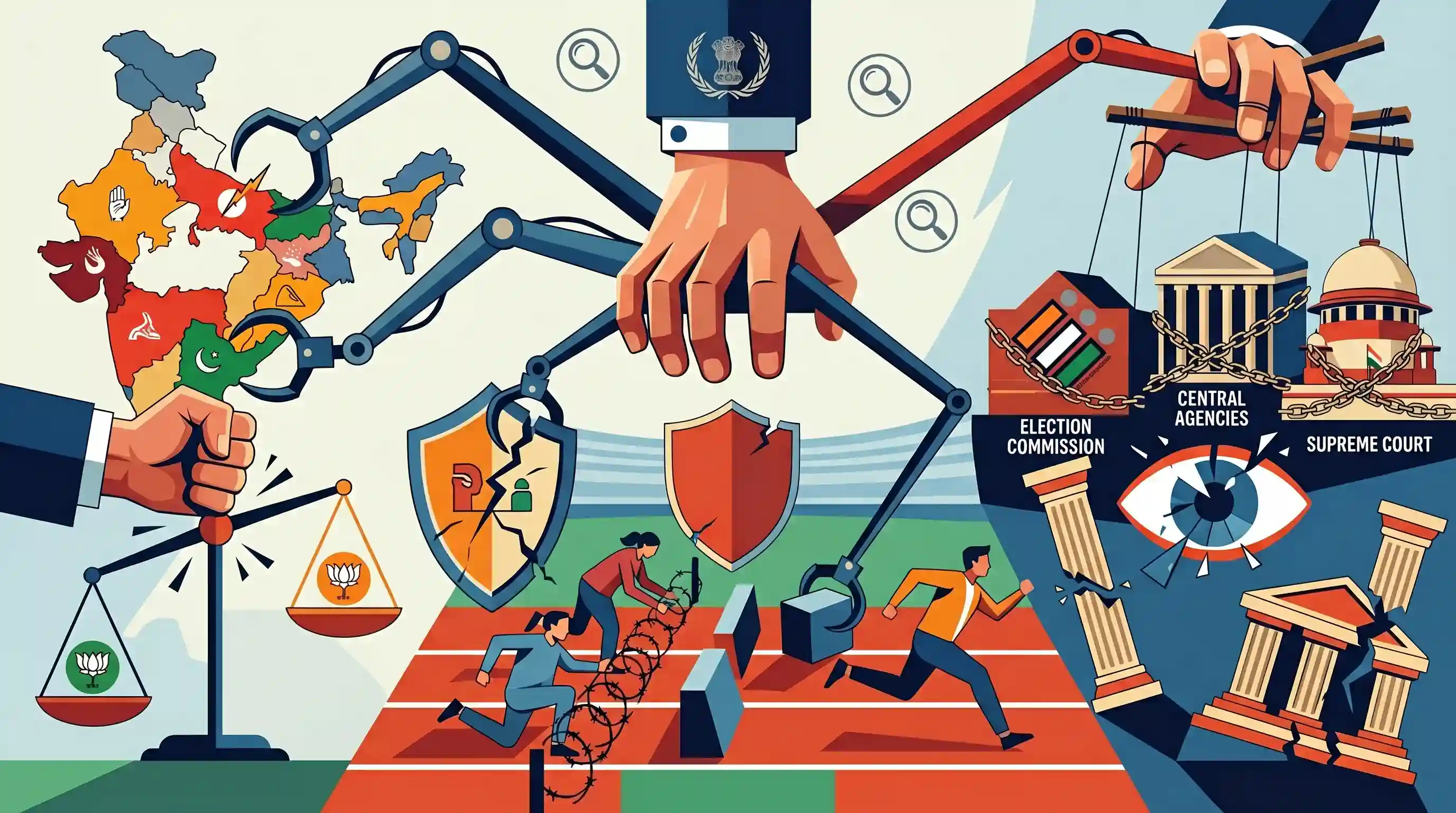
The weaponization of central agencies and the disruption of a level playing field in elections are critical themes in GS Paper 2, concerning the separation of powers, federalism, and the role of institutions like the ECI and CBI/ED in maintaining democratic integrity.
Summary
An editorial discusses the recent Enforcement Directorate (ED) raids on the Indian Political Action Committee (I-PAC) in West Bengal, which the ruling Trinamool Congress alleges is a politically motivated attempt to steal election strategy data ahead of the 2026 Assembly polls. The incident highlights a broader trend of central investigative agencies being perceived as instruments of the ruling party at the Centre to target opposition states. This perceived weaponization threatens the federal structure, undermines the level playing field necessary for free and fair elections, and risks eroding public confidence in the independence of democratic institutions and watchdogs.
Key Points
- The ED's raid on political consultancy I-PAC in Kolkata ahead of the 2026 Assembly elections has led to allegations of central agencies being weaponized for political gain.
- The Trinamool Congress (TMC) claims the raids are aimed at accessing internal election strategy and voter data to benefit the ruling party at the Centre.
- Frequent deployment of central investigative bodies like the ED, CBI, and IT Department against opposition-ruled state governments is increasingly straining Centre-State relations and federal trust.
- Partisan use of state power, such as the freezing of opposition bank accounts during elections, severely compromises the 'level playing field' essential for democratic elections.
- The editorial emphasizes that the perceived partiality of agencies erodes public confidence in the integrity of key institutions, weakening democratic checks and balances.
Important Terms
Enforcement Directorate (ED)

A multi-disciplinary agency under the Ministry of Finance mandated to investigate economic crimes and enforce laws like the PMLA and FEMA.
UPSC context
GS-III: Internal Security/Money Laundering; GS-II: Statutory Bodies. Tests understanding of investigative powers vs. civil liberties.
Prevention of Money Laundering Act (PMLA)
The primary legislative framework in India to combat money laundering, granting the ED extensive powers for asset attachment, searches, and arrests.
UPSC context
GS-III: Internal Security and Economy. Focuses on legal safeguards and the burden of proof in financial crimes.
Federalism
A constitutional system dividing powers between the Union and States. India is often described as 'quasi-federal' due to a strong central bias.
UPSC context
GS-II: Indian Polity (Functions and responsibilities of the Union and States). Key for issues like central agency overreach.
Election Commission of India (ECI)
An autonomous constitutional authority established under Article 324, responsible for administering election processes in India at national and state levels.
UPSC context
GS-II: Constitutional Bodies. Vital for topics on electoral integrity and the Model Code of Conduct.
Indian Political Action Committee (I-PAC)
A prominent political consultancy firm specializing in data-driven campaign management and voter outreach, representing the professionalization of Indian elections.
UPSC context
GS-II: Electoral Reforms. Relevant for discussing the influence of non-state actors and data privacy in democracy.
Statutory Body
Non-constitutional organizations created by an Act of Parliament (e.g., SEBI, NHRC) to oversee specific sectors or enforce particular regulations.
UPSC context
GS-II: Governance. Tests knowledge of the legal basis and independence of regulatory/investigative agencies.
Prelims Trap
"The Enforcement Directorate (ED) requires 'general consent' from the State government before initiating money laundering investigations within that state."
Unlike the CBI under the DSPE Act, the ED derives its powers from the PMLA and FEMA, granting it pan-India jurisdiction without needing state consent.
Static Concepts Connected
What distinguishes the jurisdiction of the ED from the CBI?
- ED Mandate: Enforces PMLA, 2002 and FEMA, 1999 under the Department of Revenue (Ministry of Finance). Has pan-India jurisdiction without requiring state consent.
- CBI Mandate: Governed by the Delhi Special Police Establishment (DSPE) Act, 1946. Requires 'general consent' from states under Section 6 to operate within their jurisdiction.
How is the "Level Playing Field" in elections constitutionally protected?
- Basic Structure: Upheld as an integral part of the "free and fair elections" aspect of the Basic Structure doctrine in the Indira Nehru Gandhi v. Raj Narain (1975) case.
- Article 324: Grants plenary, overarching powers to the ECI to superintend, direct, and control elections, including enforcing the Model Code of Conduct.
Cross-Topic Patterns
PMLA stringency and Federal friction
The strict bail conditions under PMLA (twin conditions) are frequently litigated alongside federalism concerns, directly linking fundamental rights (Article 21) with Centre-State political disputes.
Electoral Bonds & Level Playing Field
Concerns over agency raids on political entities mirror the recent Supreme Court strike-down of Electoral Bonds: both are fundamentally tied to preserving transparency and a level playing field in elections.

Expect a multi-statement Prelims question contrasting ED’s pan-India PMLA jurisdiction with CBI’s state-consent requirement under DSPE Act.
Linked PYQs · 3
Linked PYQs · 3
- 2021MainsGS2
The jurisdiction of the Central Bureau of Investigation (CBI) regarding lodging an FIR and conducting probe within a particular State is being questioned by various States. However, the power of the States to withhold consent to the CBI is not absolute. Explain with special reference to the federal character of India.
- 2024MainsGS2
What changes has the Union Government recently introduced in the domain of Centre-State relations ? Suggest measures to be adopted to build the trust between the Centre and the States and for strengthening federalism.
- 2022MainsGS2
Discuss the role of the Election Commission of India in the light of the evolution of the Model Code of Conduct.
