Grid Stability and Baseload Challenges in Renewable Energy Transition
Source:Indian Express ↗
Why It Matters
With India targeting 500 GW of non-fossil fuel capacity by 2030 and a Net Zero goal by 2070, understanding the technical and geopolitical limitations of an exclusively solar/wind-focused strategy is vital for framing robust national energy policies and ensuring grid stability.
Summary
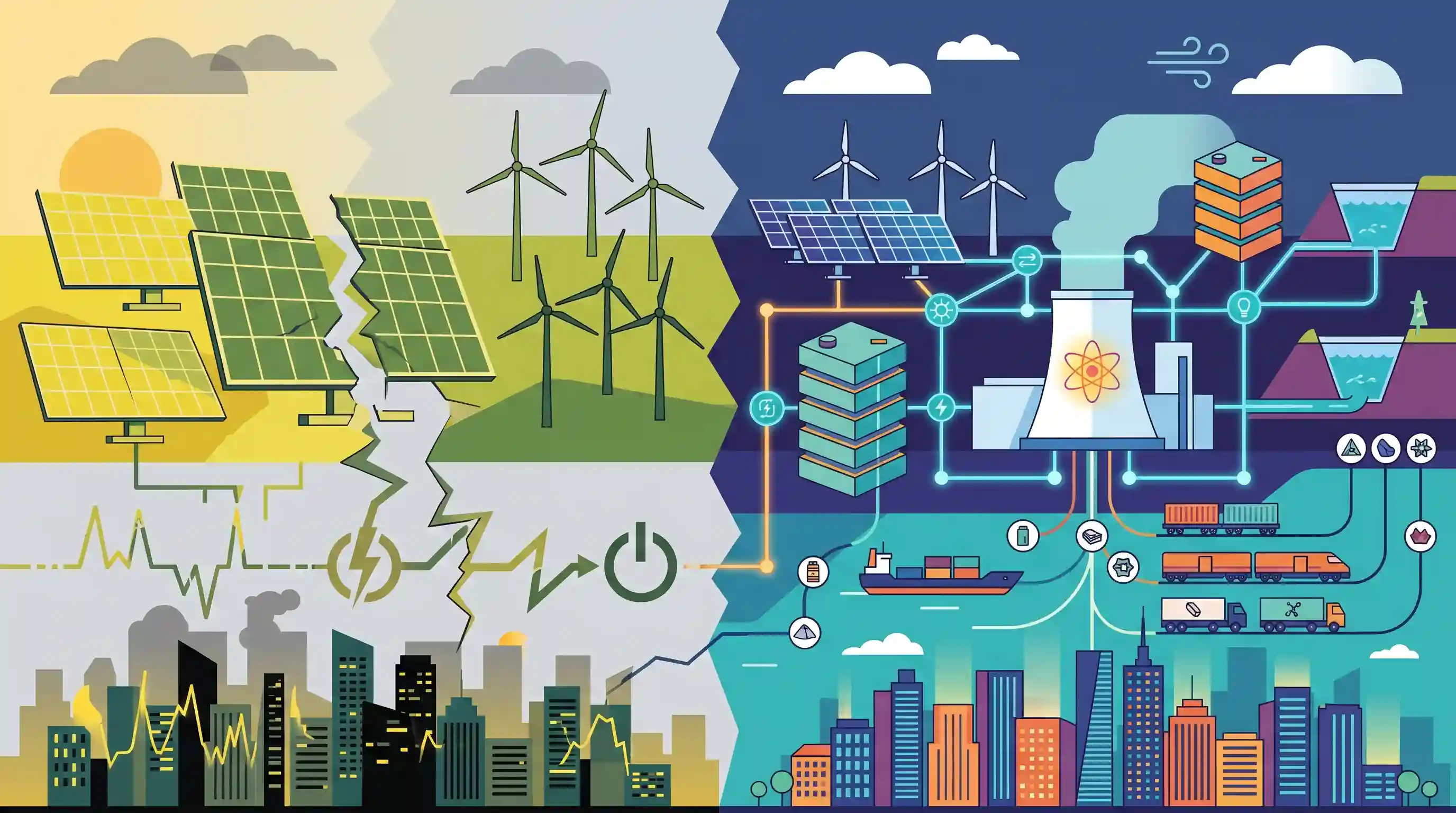
The article critiques the over-reliance on solar and wind power in global energy transition strategies, highlighting that simply scaling up these intermittent sources is insufficient for long-term energy security. It argues that a sustainable and resilient energy transition requires addressing the intermittency problem through firm baseload power (like nuclear or natural gas), massive investments in energy storage systems, grid modernization, and mitigating new geopolitical vulnerabilities tied to critical mineral supply chains.
Key Points
- Intermittency of Renewable Energy: Solar and wind power are inherently variable (Variable Renewable Energy) and cannot consistently meet peak demand without dispatchable backup power.
- Need for Baseload and Firm Power: A secure energy transition requires complementary baseload sources, such as nuclear power, hydro-electricity, or natural gas, to ensure grid stability when the sun isn't shining or wind isn't blowing.
- Importance of Energy Storage: Integrating massive renewable capacity demands significant parallel investments in Battery Energy Storage Systems (BESS) and pumped hydro storage to manage supply-demand mismatches.
- Supply Chain and Mineral Dependencies: Shifting heavily to solar and wind risks substituting historical reliance on fossil fuels with a new dependence on critical minerals (lithium, cobalt, rare earths) that are geographically concentrated.
Important Terms
Paris Agreement

A legally binding 2015 global treaty aiming to limit global warming to well below 2°C, preferably 1.5°C, through Nationally Determined Contributions (NDCs).
UPSC context
GS Paper III (Environment/Climate Change); critical for understanding global governance and India's international environmental obligations.
Panchamrit Targets
India's five climate commitments made at COP26 (2021), including 500 GW non-fossil capacity and 50% renewable energy use by 2030.
UPSC context
GS Paper III (Environment); tests India's specific Nationally Determined Contributions (NDCs) and renewable energy trajectory.
Net Zero by 2070
India's long-term goal to achieve carbon neutrality—balancing greenhouse gas emissions and removals—by the year 2070.
UPSC context
GS Paper III (Environment); focuses on India's long-term low-carbon development strategy and energy security.
International Energy Agency (IEA)
An autonomous intergovernmental organization (est. 1974) providing data and policy advice on global energy security and clean energy transitions.
UPSC context
GS Paper II & III; relevant for international institutions and energy policy discussions.
UNFCCC
The 1992 treaty providing a global framework for climate action and the parent treaty of the Paris Agreement.
UPSC context
GS Paper III (Environment); foundational concept for international environmental conventions and climate diplomacy.
Prelims Trap
Solar and wind energy are rapidly replacing coal as the primary sources of baseload power in India's electricity grid.
Solar and wind are Variable Renewable Energy (VRE) sources, not baseload. Baseload requires continuous, reliable 24/7 supply (like coal or nuclear) which VRE cannot provide without immense storage.
Static Concepts Connected
What distinguishes Baseload from Peak Load and Dispatchable power?
- Baseload Power: Meets the minimum continuous electricity demand 24/7. Typically supplied by coal, nuclear, or run-of-river hydro plants that run constantly.
- Peak Load: The maximum electrical demand occurring at specific times (e.g., evenings). It is met by quick-start sources like gas or pumped hydro.
- Dispatchable Power: Electricity sources that can be adjusted or turned on/off on demand by grid operators to match fluctuations, unlike weather-dependent solar and wind.
How does Pumped Hydroelectric Storage (PHS) function as a grid battery?
- Charging Mechanism: Uses surplus off-peak electricity (when solar/wind is high and demand is low) to pump water from a lower elevation reservoir to a higher one.
- Discharge Phase: Releases the stored water downhill through hydroelectric turbines to generate electricity instantly during peak demand hours or when renewable generation dips.
- Grid Balancing: It remains the most mature, large-scale technology for long-duration energy storage globally, essential for stabilizing grids heavily reliant on intermittent renewables.
Cross-Topic Patterns
Energy transition to Mineral geopolitics
Shifting from fossil fuels replaces historical oil reliance with new vulnerabilities in critical minerals, shifting geopolitical leverage to nations dominating lithium, cobalt, and rare earth processing.
Panchamrit targets vs. Grid stability
India's 500 GW non-fossil capacity target by 2030 faces execution bottlenecks without parallel, massive investments in Green Energy Corridors and Battery Energy Storage Systems (BESS) for grid stability.

Expect a 2026 prelims question linking variable renewable energy constraints with pumped hydro mechanics and critical mineral geopolitics.
Linked PYQs · 4
Linked PYQs · 4
- 2022MainsGS3
Do you think India will meet 50 percent of its energy needs from renewable energy by 2030 ? Justify your answer. How will the shift of subsidies from fossil fuels to renewables help achieve the above objective ? Explain.
- 2025MainsGS3
How can India achieve energy independence through clean technology by 2047? How can biotechnology can play a crucial role in this endeavour?
- 2024PrelimsGS1
Consider the following: 1. Battery storage 2. Biomass generators 3. Fuel cells 4. Rooftop solar photovoltaic units How many of the above are considered "Distributed Energy Resources"?
- 2018MainsGS3
“Access to affordable, reliable, sustainable and modern energy is the sine qua non to achieve Sustainable Development Goals (SDGs).” Comment on the progress made in India in this regard.
