Andhra Pradesh High Court Rules on Endowments Tribunal Chairperson
Source:times-of-india ↗
Why It Matters
This issue highlights the tension between executive power and judicial independence in the context of administrative tribunals. For APPSC aspirants, it underscores the importance of understanding the composition of state-level tribunals, the scope of judicial review under Article 226, and the constitutional safeguards required to maintain the independence of quasi-judicial bodies.
Summary
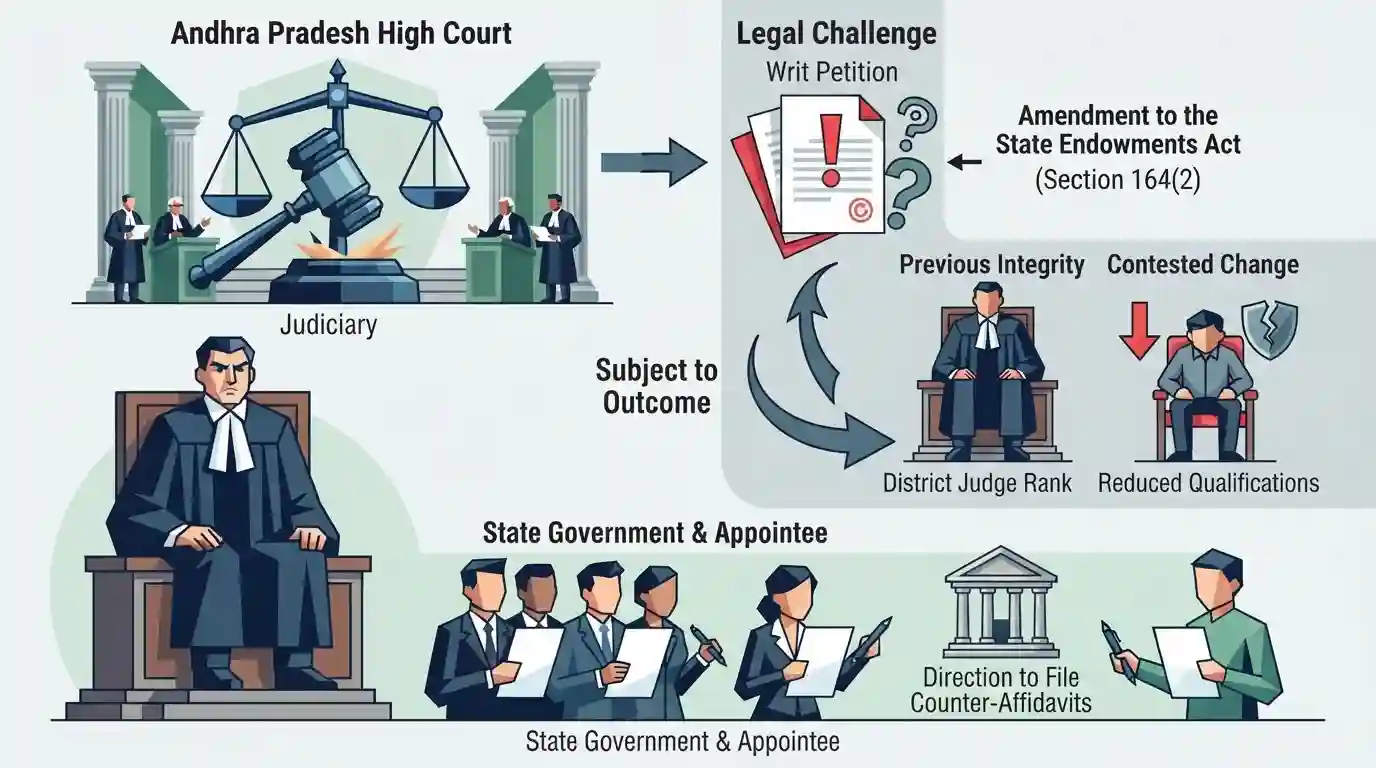
The Andhra Pradesh High Court has determined that the appointment of retired district judge A Bharathi as the chairperson of the AP Endowments Tribunal will be subject to the outcome of a writ petition challenging an amendment to the state's Endowments Act. The amendment, specifically the insertion of Section 164(2), is being contested on the grounds that it enables the state government to reduce the rank and required qualifications of the tribunal's chairperson and members. Critics argue this undermines the tribunal's judicial integrity, as the position previously required a judicial officer of the rank of a district judge. The court has directed the state government and the appointee to file counter-affidavits.
Key Points
- The Andhra Pradesh High Court ruled that the appointment of retired district judge A Bharathi as chairperson of the Endowments Tribunal is contingent upon the final verdict of an ongoing writ petition.
- The petition challenges a recent amendment to Section 164(2) of the AP Endowments Act, which allegedly dilutes the rank and qualification requirements for the tribunal's chairperson and members.
- Previously, the tribunal's chairperson role was mandated to be filled by a judicial officer of the rank of a district judge, ensuring a certain level of judicial competence and independence.
- The High Court bench, comprising Justice R Raghunandan Rao and Justice Harinath Nunepally, issued notices to the state government and the newly appointed chairperson to file counter-affidavits.
Important Terms
AP Endowments Tribunal

A statutory quasi-judicial body established to adjudicate disputes concerning the administration, classification, and encroachment of religious and charitable endowment properties in Andhra Pradesh.
UPSC context
GS Paper 2 (Statutory Bodies). Highlights the functioning of state-level tribunals and contemporary issues surrounding their judicial independence.
Section 164(2) of the AP Endowments Act
A contested legislative amendment empowering the state government to lower the required rank and legal qualifications for the chairperson of the AP Endowments Tribunal.
UPSC context
GS Paper 2 (Separation of Powers). Relevant for analyzing executive overreach and the dilution of tribunal independence.
Andhra Pradesh Endowments Act
A state legislation regulating the administration, financial management, and dispute resolution for Hindu religious institutions, charitable trusts, and endowment properties in Andhra Pradesh.
UPSC context
GS Paper 2 (State Legislature). Connects to state administration of religious endowments and broader secularism debates.
Andhra Pradesh High Court
The apex constitutional court of Andhra Pradesh. In this context, it exercised its writ jurisdiction to review whether state amendments unlawfully undermine the judicial integrity of tribunals.
UPSC context
GS Paper 2 (Judiciary). Exemplifies judicial review to protect quasi-judicial bodies from unwarranted executive interference.
Prelims Trap
"State legislatures cannot establish administrative tribunals; only Parliament can do so."
Article 323B explicitly empowers both Parliament and State legislatures to establish tribunals for specific matters, unlike Article 323A which is exclusive to Parliament.
Static Concepts Connected
What distinguishes Article 323A from Article 323B regarding tribunals?
- Scope: 323A is for public service matters only; 323B covers other specific matters like taxation, land reforms, rent, and state matters.
- Legislative Authority: 323A tribunals can only be created by Parliament; 323B tribunals can be established by both Parliament and State Legislatures.
What did L. Chandra Kumar (1997) rule regarding tribunals?
- Basic Structure: Judicial review of tribunal decisions by High Courts under Articles 226/227 is a part of the basic structure of the Constitution.
- Routing Appeals: Tribunal decisions cannot be appealed directly to the Supreme Court; they must first go to a Division Bench of the jurisdictional High Court.
Cross-Topic Patterns
Tribunal Reforms & Judicial Independence
This AP dispute mirrors national concerns over the Tribunal Reforms Act, 2021, and the Madras Bar Association judgments preventing executive dilution of tribunal member qualifications and tenure.
Religious Endowments & Concurrent List
Connects administrative tribunal law with the ongoing Constitutional debate under Article 26 over state control, regulation, and management of Hindu religious endowments (Entry 28, Concurrent List).

Expect a 2026 Prelims statement comparing Art 323A and 323B, specifically testing a State Legislature's power to establish tribunals.
Linked PYQs · 2
Linked PYQs · 2
- 2023APPSC_PRELIMSGS1
What is/are the provision(s) to safeguard the autonomy of the Supreme Court of India? I. While appointing the Supreme Court Judges, the President of India has to consult the Chief Justice of India. II. The Supreme Court Judges can be removed by the Chief Justice of India only. III. The salaries of the Judges are charged on the Consolidated Fund of India on which the legislature does not have to vote. Which of the statements given above is/are correct?
- 2019APPSC_PRELIMSGS1
Choose the correct answer relating to the Supreme Court of India :
