Addressing Endometriosis Requires Comprehensive Public Health Policies
Source:The Hindu ↗
Why It Matters
Endometriosis highlights a critical gap in India's public health approach, which often prioritizes maternal health while neglecting chronic reproductive and gynecological conditions. Understanding this is essential for GS-2 questions on health policy, social justice, and the management of social sectors.
Summary
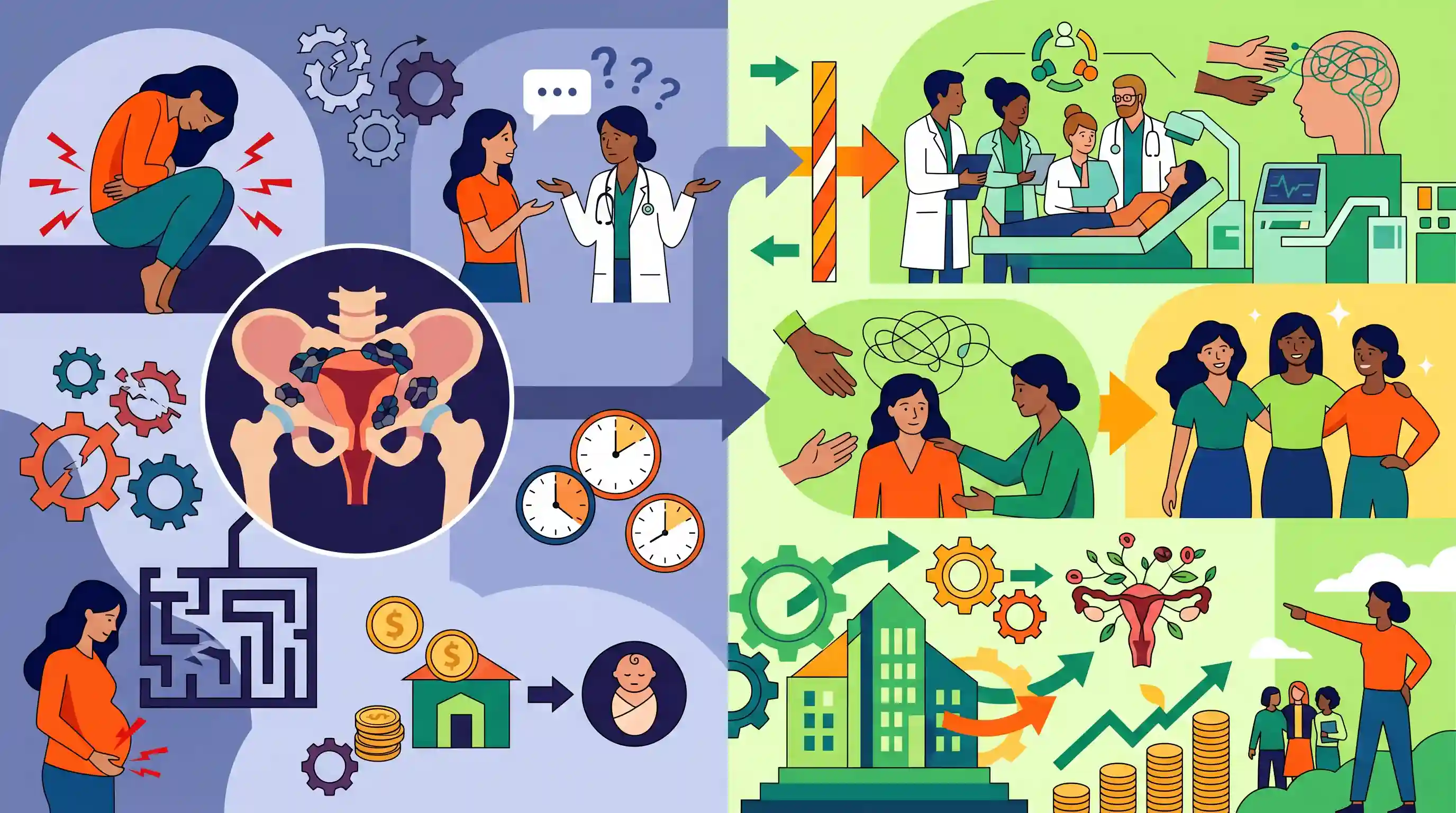
The article highlights the urgent need for a comprehensive and multi-disciplinary approach to treating endometriosis, a chronic reproductive health condition that affects millions of women. Characterized by tissue similar to the uterine lining growing outside the uterus, it causes severe pain and can lead to infertility. The disease is frequently underdiagnosed due to a lack of awareness and the societal normalization of menstrual pain, reflecting broader systemic gaps in women's healthcare. The author advocates for holistic treatment strategies that include early diagnosis, specialized medical care, and psychological support. Furthermore, it underscores the necessity for public health policies to evolve beyond their traditional focus on maternal health, ensuring adequate resources and attention for chronic women's health issues.
Key Points
- Endometriosis is a chronic and painful condition where tissue similar to the uterine lining grows outside the uterus, often leading to severe pelvic pain and infertility.
- The condition suffers from widespread underdiagnosis and misdiagnosis, largely due to a lack of awareness and the societal normalization of severe menstrual pain.
- Effective management requires a comprehensive, multi-disciplinary healthcare approach, including gynecologists, pain specialists, and mental health professionals, rather than isolated symptom treatment.
- The systemic neglect of endometriosis highlights the urgent need to expand women's health policies beyond traditional maternal care to cover chronic reproductive illnesses comprehensively.
Important Terms
Endometriosis

A chronic inflammatory condition where tissue similar to the uterine lining grows outside the uterus, causing debilitating pain, inflammation, and potential infertility.
UPSC context
GS Paper 2 (Health) and GS Paper 3 (Science & Tech); tests understanding of non-communicable diseases and women's healthcare challenges.
Reproductive Reductionism
A policy bias that views women’s health solely through their reproductive roles as mothers, often neglecting chronic conditions unrelated to pregnancy or childbirth.
UPSC context
GS Paper 2 (Social Justice); critical for analyzing gaps in women-centric welfare schemes and health policy evolution.
World Health Organization (WHO)
The UN agency for international public health that provides global guidance, sets standards, and advocates for sexual and reproductive health rights.
UPSC context
GS Paper 2 (International Institutions); relevant for understanding global health governance and normative standards for disease management.
Maternal Mortality Ratio (MMR)
The number of maternal deaths per 100,000 live births; it is India's primary benchmark for measuring success in women's healthcare delivery.
UPSC context
GS Paper 2 (Health); used to compare India's health progress against Sustainable Development Goal (SDG) 3.1 targets.
Social Justice in Healthcare
The fair distribution of health resources and the removal of systemic barriers, such as gender-based stigma, that prevent equitable access to medical care.
UPSC context
GS Paper 2 (Social Justice/Welfare); relates to the State's duty to provide 'Health for All' under Directive Principles.
Multi-disciplinary Care Approach
A healthcare model involving a team of diverse specialists (e.g., gynecologists, psychologists, physiotherapists) to address all aspects of a patient’s chronic condition.
UPSC context
GS Paper 2 (Health Policy); tests ability to propose holistic solutions for complex public health issues beyond clinical surgery.
Normalization of Menstrual Pain
The societal tendency to dismiss severe menstrual symptoms as a standard part of womanhood, often leading to significant delays in clinical diagnosis.
UPSC context
GS Paper 1 (Social Issues); relevant for discussing gender-based health disparities and the impact of patriarchal norms on medical outcomes.
Comprehensive Primary Healthcare (CPHC)
A system providing a broad range of services, including screening for non-communicable diseases, as seen in India's Ayushman Bharat Health and Wellness Centres.
UPSC context
GS Paper 2 (Government Policies); key to evaluating the effectiveness of the National Health Mission in shifting from curative to preventive care.
Prelims Trap
Endometriosis is a maternal health condition where the uterine lining grows abnormally inside the uterus.
It involves tissue growing OUTSIDE the uterus (e.g., on ovaries or fallopian tubes) and is a chronic condition affecting women independently of pregnancy or maternal status.
Static Concepts Connected
How do India's health policies reflect a 'maternal bias' in women's healthcare?
- Maternal focus: Schemes like Janani Suraksha Yojana and RCH prioritize reducing the Maternal Mortality Ratio (MMR) and incentivizing institutional deliveries.
- Family planning: Policies heavily target contraceptive prevalence and population stabilization through initiatives like Mission Parivar Vikas.
- Policy blindspots: Chronic non-maternal conditions like PCOS, endometriosis, and menopause lack dedicated screening and management guidelines in primary care.
What is Endometriosis and what are its key biological impacts?
- The Pathology: Tissue resembling the uterine lining (endometrium) grows abnormally outside the uterus, typically affecting ovaries, fallopian tubes, and pelvic tissue.
- Major Symptoms: It triggers chronic inflammation, severe pelvic pain (dysmenorrhea), and is a primary driver of female infertility.
- Bacterial link: Recent research associates the condition with Fusobacterium infection, opening potential pathways for non-hormonal antibiotic treatments.
Cross-Topic Patterns
Women's Health Gap & Economic Growth
Addressing chronic female illnesses like endometriosis reduces lost life years, directly boosting Female Labor Force Participation (FLFP) and broader economic output.
Gender Bias in Clinical Data
The widespread misdiagnosis of endometriosis highlights the "gender data gap" in medical research, where female-specific pain is structurally normalized or ignored.

Expect a Prelims science pairing of endometriosis with 'Fusobacterium', or a Mains question on the maternal bias in India's health policy.
Linked PYQs · 2
Linked PYQs · 2
- 2020MainsGS2
In order to enhance the prospects of social development, sound and adequate health care policies are needed particularly in the fields of geriatric and maternal health care. Discuss.
- 2024MainsGS2
In a crucial domain like the public healthcare system the Indian State should play a vital role to contain the adverse impact of marketisation of the system. Suggest some measures through which the State can enhance the reach of public healthcare at the grassroots level.
