Endocrine Disruptors in Plastic Waste and Public Health
Source:The Hindu ↗
Why It Matters
The article directly connects environmental pollution (plastic waste) with human health (endocrine disruption), which is a recurring theme in UPSC Prelims (e.g., questions on BPA, microbeads) and Mains GS3 (waste management and toxic pollution). Understanding chemical pollutants and their biological mechanisms is crucial for Science and Environment sections.
Summary
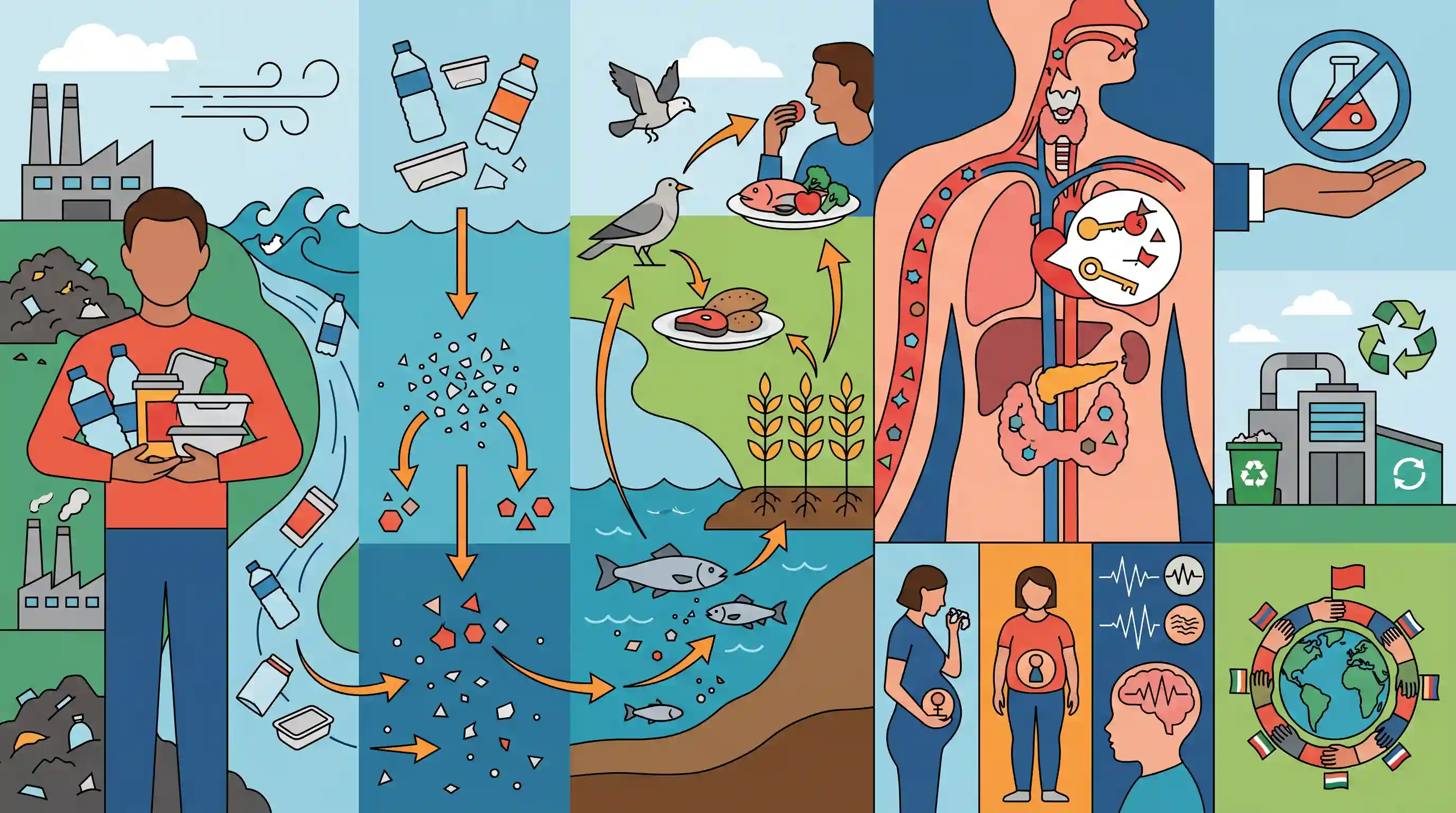
The escalating crisis of plastic pollution presents a severe, yet often overlooked, public health threat through the release of endocrine-disrupting chemicals (EDCs). As plastic waste breaks down into microplastics, chemical additives like Bisphenol A (BPA) and phthalates leach into the environment, contaminating the food web and human bodies. These EDCs interfere with the endocrine system, causing a range of health issues from fertility disorders and metabolic diseases to neurodevelopmental problems. Mitigating this risk requires a comprehensive approach, including stringent regulation of plastic additives, enhanced solid waste management, and global cooperation to reduce plastic dependency.
Key Points
- Plastics are manufactured with various chemical additives, including endocrine-disrupting chemicals (EDCs) like Bisphenol A (BPA) and phthalates, to improve flexibility and durability.
- As plastic waste degrades into microplastics and nanoplastics, it releases these toxic EDCs into the environment, infiltrating water systems, soil, and the food chain.
- EDCs mimic or block natural hormones in the human body, leading to severe health impacts such as reproductive and fertility issues, neurodevelopmental disorders, and metabolic diseases.
- Addressing this dual crisis of environmental pollution and public health requires strict regulatory limits on chemical additives, transitioning away from single-use plastics, and robust solid waste management protocols.
Important Terms
Plastic Waste Management Rules

India's regulatory framework under the Environment (Protection) Act, 1986, mandating plastic waste segregation, recycling targets, and phased bans on single-use plastics to ensure environmentally sound disposal.
UPSC context
GS Paper III: Environmental Pollution. Essential for questions on waste management, circular economy, and government interventions in pollution control.
Global Plastics Treaty
A proposed international legally binding instrument aimed at ending plastic pollution by addressing the full lifecycle of plastics, from production and design to disposal and recycling.
UPSC context
GS Paper II/III: International Relations and Environment. Tests knowledge of global governance, UNEA resolutions, and multilateral environmental agreements.
Endocrine-Disrupting Chemicals (EDCs)
Exogenous substances or mixtures that alter the function(s) of the endocrine system, causing adverse health effects such as reproductive disorders, metabolic diseases, and neurodevelopmental issues.
UPSC context
GS Paper III: Science & Technology (Public Health). Relevant for understanding chemical pollution's impact on human physiology and biological systems.
Extended Producer Responsibility (EPR)
A policy approach and environmental protection strategy where producers are made physically or financially responsible for the post-consumer stage of a product's life cycle.
UPSC context
GS Paper III: Solid Waste Management. A key mechanism for managing plastic, e-waste, and battery waste through circular economy principles.
United Nations Environment Programme (UNEP)
The leading global environmental authority that sets the global environmental agenda and serves as an authoritative advocate for the global environment within the UN system.
UPSC context
GS Paper II: International Organizations. Key for understanding global efforts against the triple planetary crisis (climate, biodiversity, pollution).
World Health Organization (WHO)
A specialized UN agency responsible for international public health, collaborating with UNEP to assess chemical risks and the state of science regarding endocrine disruptors.
UPSC context
GS Paper II: International Relations/Public Health. Crucial for questions regarding global health standards and disease control.
Prelims Trap
"Bisphenol A (BPA) is a universally used additive present in all single-use plastics, including standard PET water bottles."
BPA is specific to polycarbonate plastics (hard, durable plastics) and epoxy resins. Common single-use water bottles are made of PET, which typically does not use BPA.
Static Concepts Connected
How do microplastics contribute to the biomagnification of toxins?
- Biomagnification: The increasing concentration of toxic chemicals in the tissues of organisms at successively higher levels in a food chain.
- Chemical Sponges: Microplastics act as vectors, absorbing hydrophobic persistent organic pollutants (POPs) and heavy metals from the surrounding aquatic environment.
- Trophic Transfer: Plankton and small fish consume toxin-laden plastics; these absorbed EDCs accumulate and magnify as they move up the marine food web to humans.
What are the biological mechanisms of Endocrine Disrupting Chemicals (EDCs)?
- Mimicking Hormones: EDCs can trick the body by structurally mimicking natural hormones like estrogen or testosterone, leading to abnormal cellular responses.
- Blocking Receptors: They can bind to hormone receptors without activating them, physically blocking natural hormones from executing their necessary physiological functions.
- Altering Production: EDCs can directly interfere with the synthesis, transport, metabolism, or excretion of natural hormones, fundamentally altering the body's metabolic balance.
Cross-Topic Patterns
Hidden plastics in everyday consumption
UPSC loves targeting unapparent pollutants. The revelation that modern chewing gum uses a synthetic polyisobutylene base links everyday habits directly to non-biodegradable microplastic pollution and EDC exposure.
Global Plastics Treaty & Trade Law
The UN Environment Assembly's push for a legally binding treaty bridges ecology and international trade, focusing on regulating and capping harmful chemical additives like phthalates at the manufacturing stage.

Expect a 2026 Prelims question pairing specific EDCs (BPA, phthalates) with their exact industrial plastic types and biological mechanisms.
Linked PYQs · 4
Linked PYQs · 4
- 2021PrelimsGS1
Bisphenol A (BPA), a cause of concern, is a structural/key component in the manufacture of which of the following kinds of plastics?
- 2019PrelimsGS1
Why is there a great concern about the 'microbeads' that are released into environment?
- 2024PrelimsGS1
Consider the following statements : Statement-I: Many chewing gums found in the market are considered a source of environmental pollution. Statement-II : Many chewing gums contain plastic as gum base. Which one of the following is correct in respect of the above statements?
- 2018MainsGS3
What are the impediments in disposing the huge quantities of discarded solid wastes which are continuously being generated? How do we remove safely the toxic wastes that have been accumulating in our habitable environment?
