Expiration of New START Treaty Threatens Global Strategic Stability
Source:The Hindu ↗
Why It Matters
The demise of the last remaining nuclear arms control pact between the US and Russia threatens to revive a Cold War-style arms race. It destabilizes global security, exacerbates broader geopolitical rifts (such as the USA vs. Russo-Chinese alignment), and underscores the fragility of international non-proliferation architectures that UPSC aspirants must track for GS Paper 2.
Summary
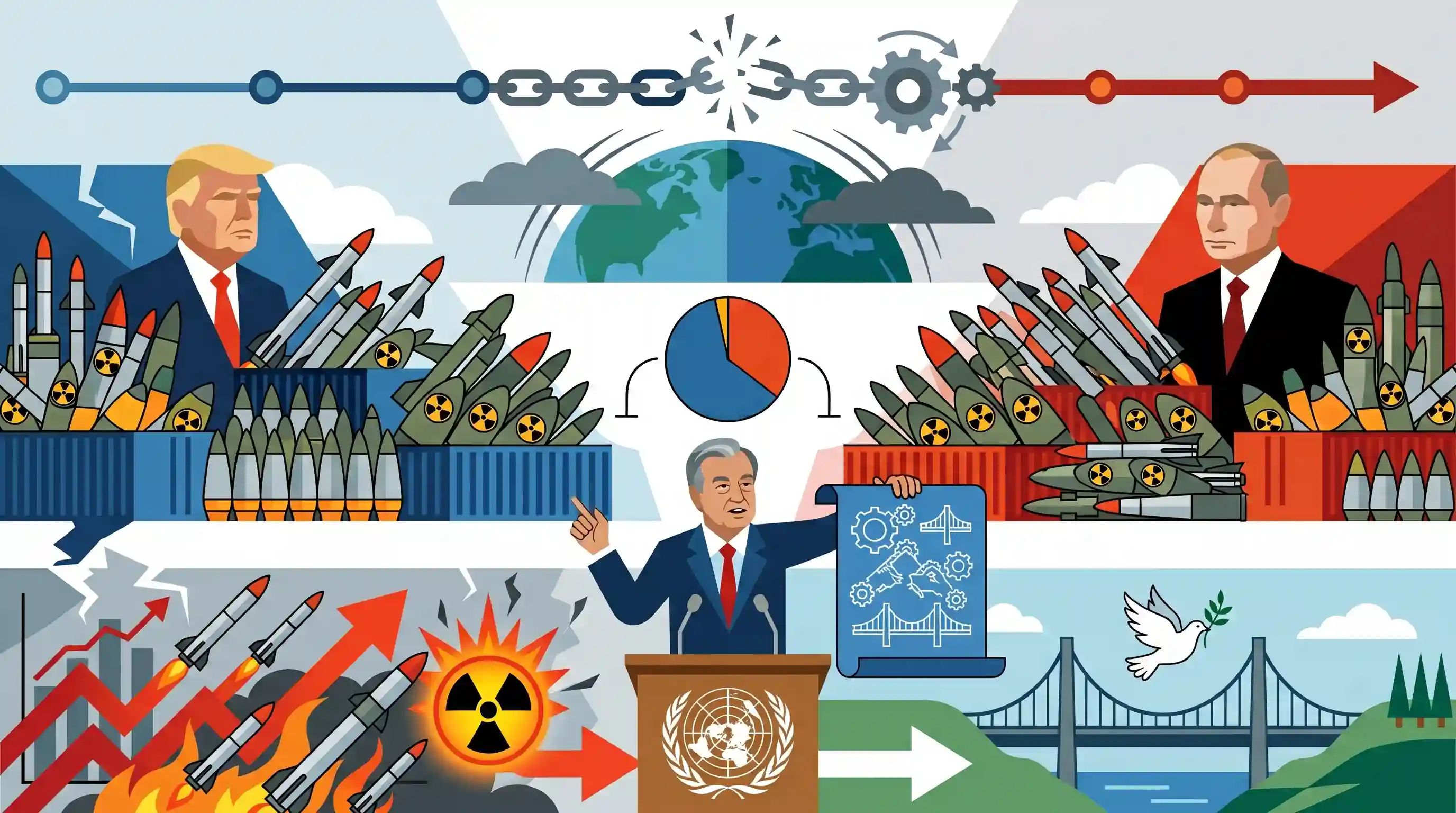
The New START treaty between the United States and Russia expired on February 5, 2026, leaving the world without binding limits on the strategic nuclear arsenals of the two superpowers for the first time in over half a century. The treaty, originally signed in 2010, had restricted deployed strategic warheads to 1,550 on each side and permitted mutual on-site inspections. UN Secretary-General Antonio Guterres described the expiration as a "grave moment for international peace and security" and urged Washington and Moscow—who together possess over 80% of the world's nuclear warheads—to urgently negotiate a successor framework to avert the risk of nuclear conflict and a renewed global arms race.
Key Points
- The New START treaty between the US and Russia officially expired on February 5, 2026, leaving both nations without binding limits on their strategic nuclear arsenals.
- UN Secretary-General Antonio Guterres warned that the expiration marks a "grave moment for international peace and security."
- Signed in 2010, the treaty capped deployed strategic warheads at 1,550 for each nation and established a framework for mutual on-site inspections.
- This is the first time in more than half a century that the two superpowers, who control over 80% of the world's nuclear warheads, lack a formal strategic arms limitation agreement.
- Guterres urged Moscow and Washington to urgently negotiate a successor framework to prevent a renewed arms race and nuclear conflict.
Important Terms
New START

A 2010 US-Russia treaty limiting deployed strategic nuclear warheads to 1,550 and launchers. It includes verification measures like on-site inspections to prevent a nuclear arms race.
UPSC context
GS Paper II (International Relations); tests understanding of strategic stability and bilateral security frameworks between superpowers.
Strategic Nuclear Arsenals
Long-range nuclear weapons (ICBMs, SLBMs, bombers) designed for large-scale deterrence and striking remote targets (over 5,500 km), distinguished from battlefield-focused tactical nuclear weapons.
UPSC context
GS Paper III (Security); tests knowledge of nuclear doctrine, triad capabilities, and deterrence logic.
Arms Control
International agreements to limit, manage, or verify the development, testing, and deployment of weapons to stabilize state relations and reduce the risk of war.
UPSC context
GS Paper II (International Relations); relevant for global security architecture and conflict prevention mechanisms.
Nuclear Disarmament
The process of reducing or eliminating military weapons, specifically nuclear ones, to achieve a world free of weapons of mass destruction.
UPSC context
GS Paper II (International Relations); tests awareness of India's demand for a universal, non-discriminatory nuclear-free world.
Nuclear Non-Proliferation Treaty (NPT)
A 1968 treaty based on three pillars: non-proliferation, disarmament, and peaceful nuclear use. India remains a non-signatory, labeling it discriminatory 'atomic apartheid'.
UPSC context
GS Paper II (International Relations); critical for understanding India’s nuclear stance and foreign policy evolution.
United Nations
The principal international organization established in 1945 to maintain global peace, security, and cooperation through diplomacy, mediation, and peacekeeping.
UPSC context
GS Paper II (International Institutions); tests knowledge of the UN's role in mediating superpower conflicts.
Prelims Trap
"The New START Treaty placed binding limits on both the strategic and tactical nuclear arsenals of the US and Russia."
The treaty only capped deployed strategic warheads (at 1,550). It did not limit tactical (short-range/battlefield) nuclear weapons or non-deployed stockpiles.
Static Concepts Connected
What are the key historical treaties in US-Russia nuclear arms control?
- SALT I & II (1970s): Strategic Arms Limitation Talks capped the number of ballistic missile launchers but did not mandate the reduction of existing nuclear arsenals.
- INF Treaty (1987): Banned all land-based ballistic and cruise missiles with ranges between 500 and 5,500 km. The US withdrew from it in 2019, citing Russian violations.
- START Framework (1991-2026): Shifted focus from limitation to active reduction of deployed strategic arsenals, culminating in the New START treaty which defined the 2010-2026 era.
How do Strategic and Tactical nuclear weapons differ in doctrine and capability?
- Strategic weapons: Long-range (e.g., ICBMs) and high-yield weapons designed to destroy cities or national infrastructure to achieve deterrence via mutually assured destruction.
- Tactical weapons: Short-range and lower-yield weapons intended for use in immediate battlefield operations against specific military formations or tactical targets.
Cross-Topic Patterns
NPT Article VI obligations
Expiration of New START severely undermines Article VI of the NPT, which mandates recognized nuclear-weapon states to pursue negotiations toward total nuclear disarmament in good faith.
China's rise and tri-polar deterrence
The collapse of bilateral US-Russia caps accelerates a tri-polar nuclear arms race involving an expanding China, directly complicating India's strategic calculations and its "No First Use" deterrence doctrine.

Expect a 2026 prelims question testing the operational status and specific constraints of major nuclear treaties (New START, INF, NPT, TPNW).
Linked PYQs · 3
Linked PYQs · 3
- 2025MainsGS2
"The reform process in the United Nations remains unresolved, because of the delicate imbalance of East and West and entanglement of the USA vs. Russo-Chinese alliance.” Examine and critically evaluate the East-West policy confrontations in this regard.
- 2025MainsGS2
"With the waning of globalization, post-Cold War world is becoming a site of sovereign nationalism.” Elucidate.
- 2018MainsGS2
In what ways would the ongoing US-Iran Nuclear Pact Controversy affect the national interest of India? How should India respond to this situation?
