Bilateral Nuclear Arms Treaty Lapse and Global Security Risks
Source:The Hindu ↗
Why It Matters
The expiration of the New START treaty profoundly impacts the global security architecture. It removes critical verification and limitation mechanisms on US and Russian nuclear arsenals, raising the specter of a renewed arms race. For UPSC aspirants, this highlights the fragility of international arms control regimes and the shifting dynamics of great power competition, relevant to GS Paper 2 (International Relations).
Summary
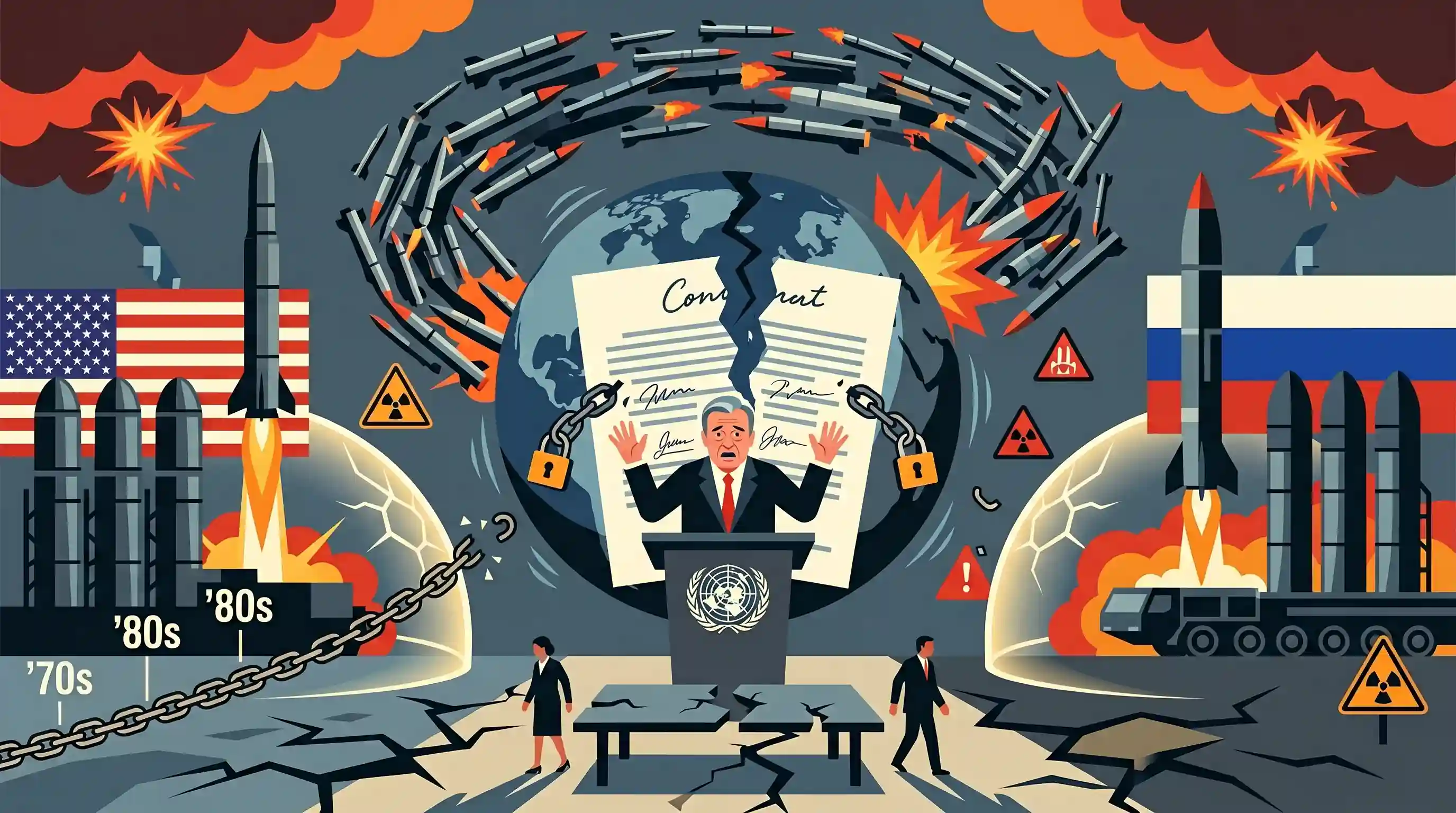
UN Secretary-General Antonio Guterres has expressed deep alarm over the expiration of the New START treaty between the United States and Russia. This lapse formally ends binding limits on the strategic nuclear arsenals of both superpowers for the first time in over half a century. Calling it a 'grave moment' for global security, Guterres emphasized the urgent need for both nations to return to the negotiating table. The absence of a verifiable arms control framework raises the risk of an unconstrained nuclear arms race, further destabilizing an already fragile global geopolitical landscape.
Key Points
- The New START treaty between the US and Russia has officially expired, removing formal constraints on their strategic nuclear arsenals.
- This marks the first time in over 50 years that the world's two largest nuclear powers operate without binding, verifiable arms control limits.
- UN Secretary-General Antonio Guterres labeled the expiration a 'grave moment' for global peace and international security.
- The UN Chief urged immediate negotiations for a successor framework to prevent an unchecked nuclear arms race and mitigate geopolitical instability.
Important Terms
New START treaty

A 2010 bilateral agreement between the US and Russia limiting deployed strategic nuclear warheads (1,550) and launchers. It was the last remaining verifiable arms control pact between the two superpowers until its 2026 expiration.
UPSC context
GS Paper 2: International Relations; critical for understanding bilateral diplomacy and global nuclear stability.
Treaty on the Non-Proliferation of Nuclear Weapons (NPT)
A 1968 landmark multilateral treaty aimed at preventing nuclear weapons spread, promoting peaceful nuclear energy, and achieving disarmament. It distinguishes between nuclear-weapon states (P5) and non-nuclear-weapon states.
UPSC context
GS Paper 2: Important International institutions; tests India’s 'discriminatory' stance and global disarmament frameworks.
United Nations
An international organization of 193 states established in 1945 to maintain global peace, security, and cooperation. It serves as a central forum for negotiating multilateral disarmament and human rights.
UPSC context
GS Paper 2: International Relations; tests knowledge of multilateralism and global governance structures.
United Nations Security Council
A principal UN organ with 15 members (5 permanent) responsible for maintaining international peace. It holds the unique power to issue binding resolutions and enforce nuclear compliance through sanctions.
UPSC context
GS Paper 2: International Relations; focuses on P5 dynamics and UN reform debates.
Prelims Trap
The New START treaty limits both strategic and tactical nuclear weapons globally under a UN framework.
New START is strictly a bilateral US-Russia pact. Crucially, it only caps deployed 'strategic' nuclear warheads, not tactical/short-range weapons, and operates entirely outside UN frameworks.
Static Concepts Connected
What distinguishes the NPT from the recent TPNW?
- NPT framework: Recognizes 5 states as nuclear powers based on a 1967 cutoff, focusing on preventing wider proliferation while allowing peaceful nuclear energy use.
- TPNW total ban: Enforced in 2021, it comprehensively prohibits the development and possession of nuclear weapons, though no nuclear-armed nation has joined it.
Why does India refuse to sign the NPT and CTBT?
- Discriminatory nature: India views the NPT as fundamentally flawed for creating a two-tier world, arbitrarily dividing nations into recognized nuclear 'haves' and 'have-nots'.
- Disarmament deficit: India opposes the CTBT because it merely bans explosive testing without mandating a time-bound, universal disarmament process by existing nuclear powers.
Cross-Topic Patterns
UNSC Paralysis & Veto Politics
The breakdown of US-Russia bilateral trust directly correlates with increased veto usage at the UNSC, stalling multilateral resolutions on separate geopolitical crises and further delaying critical UN institutional reform.
Emerging Tech & Nuclear Deterrence
The lapse of nuclear warhead limits will accelerate an arms race in hypersonic glide vehicles and AI-integrated command systems, directly linking GS-2 global diplomacy with GS-3 defence technology.

Expect a multi-statement Prelims question contrasting bilateral pacts (New START/INF) with multilateral regimes (NPT/TPNW) in 2026.
Linked PYQs · 4
Linked PYQs · 4
- 2025MainsGS2
"The reform process in the United Nations remains unresolved, because of the delicate imbalance of East and West and entanglement of the USA vs. Russo-Chinese alliance.” Examine and critically evaluate the East-West policy confrontations in this regard.
- 2024MainsGS2
‘Terrorism has become a significant threat to global peace and security.’ Evaluate the effectiveness of the United Nations Security Council's Counter Terrorism Committee (CTC) and its associated bodies in addressing and mitigating this threat at the international level.
- 2015PrelimsGS1
Consider the following countries: 1. China 2. France 3. India 4. Israel 5. Pakistan Which among the above are Nuclear Weapons States as recognized by the Treaty on the Non-Proliferation of Nuclear Weapons, commonly known as Nuclear Non-Proliferation Treaty (NPT)?
- 2018PrelimsGS1
What is/are the consequence/consequences of a country becoming the member of the 'Nuclear Suppliers Group'? 1. It will have access to the latest and most efficient nuclear technologies. 2. It automatically becomes a member of "The Treaty on the Non-Proliferation of Nuclear Weapons (NPT)". Which of the statements given above is/are correct?
