Andhra Pradesh Withdrawal of Disha Bill and Criminal Code Alignment
Source:the-south-first ↗
Why It Matters
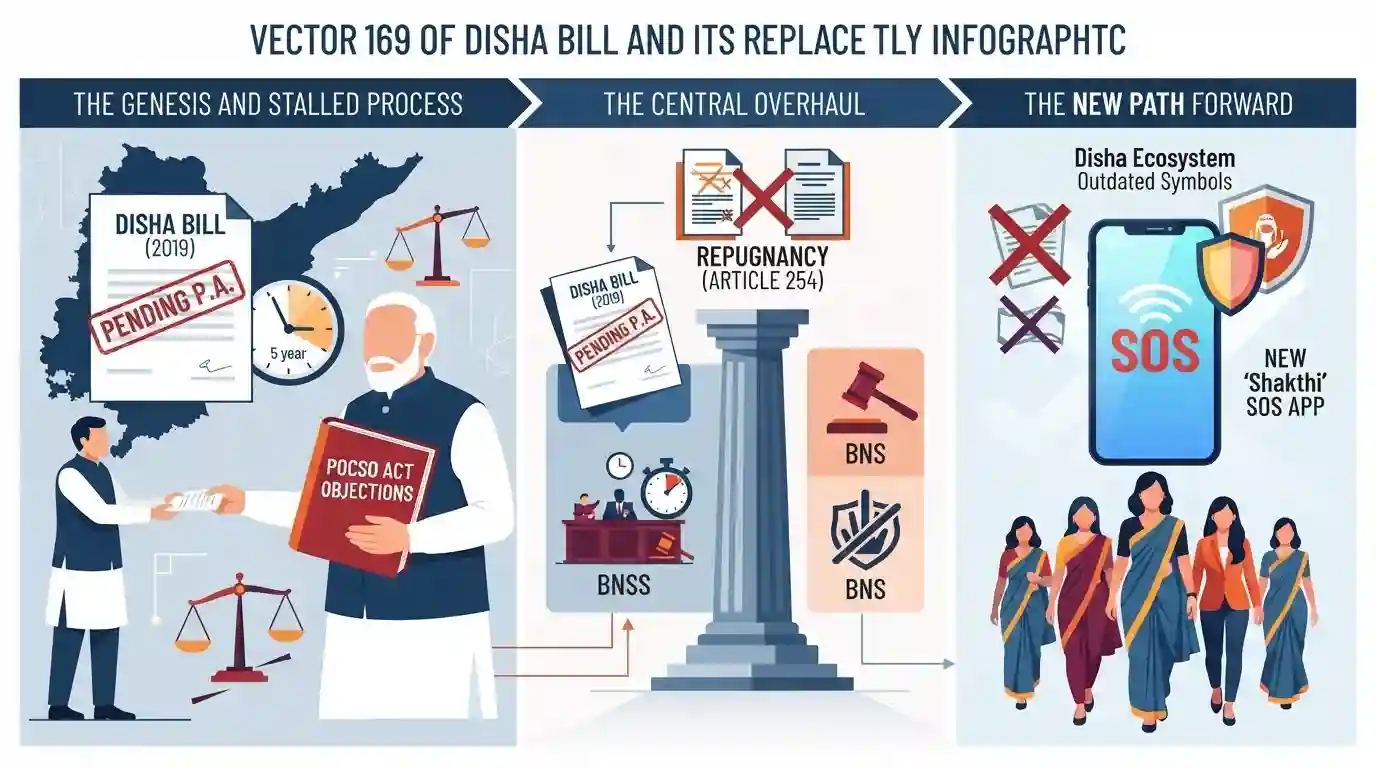
It offers a live case study of Article 254 of the Constitution, illustrating how a state bill on a Concurrent List subject requires Presidential assent if it is repugnant to Central laws, and how national legal reforms (BNS/BNSS) can override pending state legislation.
Summary
The Andhra Pradesh cabinet has officially withdrawn the Disha Bill (Andhra Pradesh Criminal Law (Amendment) Bill, 2019), which had been pending Presidential assent for nearly five years. The Bill, which aimed to drastically alter the IPC and CrPC to expedite trials and impose the death penalty for severe crimes against women, faced consistent objections from the Union Ministry of Home Affairs due to overlaps with the POCSO Act. The rollout of new central criminal codes—the Bharatiya Nyaya Sanhita (BNS) and Bharatiya Nagarik Suraksha Sanhita (BNSS)—rendered the state's proposed amendments entirely obsolete. Consequently, the state is phasing out the Disha ecosystem and introducing 'Shakthi' initiatives, including a new SOS app for women's safety.
Key Points
- The Andhra Pradesh state cabinet, led by CM N Chandrababu Naidu, formally approved the withdrawal of the pending Andhra Pradesh Criminal Law (Amendment) Bill, 2019, commonly known as the Disha Bill.
- Passed in 2019 by the previous YSRCP government, the Bill sought to amend the IPC and CrPC to provide capital punishment for rape and mandate a 21-day timeline for investigation and trial, but it never received Presidential assent.
- The Ministry of Home Affairs (MHA) had repeatedly raised objections to the Bill, noting repugnancy with central laws like the POCSO Act and criticizing the use of subjective terms such as "shame" and "annoyance."
- The state government determined the Bill was legally obsolete because the central statutes it sought to amend (IPC and CrPC) have been fully replaced by the Bharatiya Nyaya Sanhita (BNS) and Bharatiya Nagarik Suraksha Sanhita (BNSS).
- Following the withdrawal, the state government has dismantled the Disha branding, replacing the Disha SOS app with the 'Shakthi app' and renaming patrol vehicles as Shakthi teams.
Important Terms
Andhra Pradesh Criminal Law (Amendment) Bill, 2019 (Disha Bill)

A 2019 state bill proposing the death penalty for severe sexual crimes and 21-day expedited trials. Andhra Pradesh withdrew it in 2026 due to overlaps with the POCSO Act and the new central criminal codes.
UPSC context
Relevant to GS-2 (Polity). Tests knowledge of Center-State relations, Article 254 (repugnancy), and Presidential assent to state bills.
Bharatiya Nyaya Sanhita (BNS), 2023
The official criminal code of India effective July 2024, replacing the colonial-era IPC. It modernizes offence definitions, adds organized crime provisions, increases penalties for crimes against women, and introduces community service.
UPSC context
Essential for GS-2 (Governance). Tests understanding of criminal justice reforms and the modernization of India's penal framework.
Bharatiya Nagarik Suraksha Sanhita (BNSS), 2023
India's primary procedural law for criminal justice, effective July 2024, replacing the CrPC. It mandates forensic evidence for serious offences, enforces strict timelines, and enables electronic modes for trials, enhancing judicial efficiency.
UPSC context
Important for GS-2 (Polity & Governance). Focuses on procedural law reforms, speedy trials, and the integration of technology in policing.
Protection of Children from Sexual Offences (POCSO) Act, 2012
A comprehensive central law protecting minors (under 18) from sexual abuse, harassment, and pornography. It establishes Special Courts for speedy, child-friendly trials and provides stringent, graded punishments based on the offence's gravity.
UPSC context
Crucial for GS-2 (Social Justice/Vulnerable Sections). Evaluates statutory frameworks for child protection and gender justice.
Prelims Trap
"If a state legislature passes a reserved bill a second time, the President is bound to give assent."
Unlike the Governor (who must assent if a bill is passed again), the President is NEVER constitutionally bound to give assent to a reconsidered State Bill under Article 201.
Static Concepts Connected
What happens when a State law conflicts with a Central law on the Concurrent List?
- General Rule: Under Article 254(1), the Central law generally prevails, and the State law becomes void to the extent of the repugnancy.
- Presidential Assent Exception: Under Article 254(2), if the State law was reserved for and received the President's assent, it will prevail within that specific state.
- Parliamentary Override: Parliament can still override an assented state law at any time by enacting a new law on the same matter, adding to, amending, or repealing it.
What are the President's options for a reserved State Bill under Article 201?
- Grant Assent: The President may declare that he assents to the Bill, allowing it to become law in that state.
- Withhold Assent: The President may declare that he withholds assent, which effectively ends the Bill (an absolute veto).
- Return for Reconsideration: If it is not a Money Bill, the President can direct the Governor to return it to the state legislature for reconsideration within six months.
Cross-Topic Patterns
Repugnancy + New Central Criminal Codes
The transition from IPC/CrPC to BNS/BNSS renders pending state-level criminal amendments obsolete, forcing states to draft fresh legislation aligned with the new central framework to avoid repugnancy.
Women's Safety + Political Scheme Branding
Schemes like 'Disha' shifting to 'Shakthi' highlight how state-level women’s safety initiatives are heavily tied to ruling party branding, leading to their rapid dismantling upon political regime change.

Expect a tricky Prelims question contrasting the President's veto power over Parliament bills (Art 111) versus State bills (Art 201).
Linked PYQs · 2
Linked PYQs · 2
- 2024APPSC_PRELIMSGS1
Which of the following State Bill/Bills will have to be mandatorily reserved for the President's consideration? I. A Bill that proposes to give effect to certain Directive Principles of State Policy. II. A Bill requiring prior Presidential sanction but which was however not obtained under Article 304. III. A Bill that attracts the provisions of Article 288. IV. A Bill seeking to operate a provision that belongs to one of the Concurrent List entries, but which is however repugnant to any Union law. Select the correct answer using the codes given below :
- 2023APPSC_PRELIMSGS1
The following App developed by Government of Andhra Pradesh is an SOS service for women in distress or danger.
