Former Police Officers Criticize Encounter Actions in Uttar Pradesh
Source:The Hindu ↗
Why It Matters
This article highlights a key constitutional debate concerning the balance between maintaining law and order, and adhering to the due process of law. It underscores the foundational principles of constitutional morality as envisioned by Dr. B.R. Ambedkar, which are frequently tested by public demands for instant justice and state-sponsored encounter actions. It is highly relevant for GS Paper 2 (Polity and Governance) and GS Paper 4 (Ethics and Public Administration).
Summary
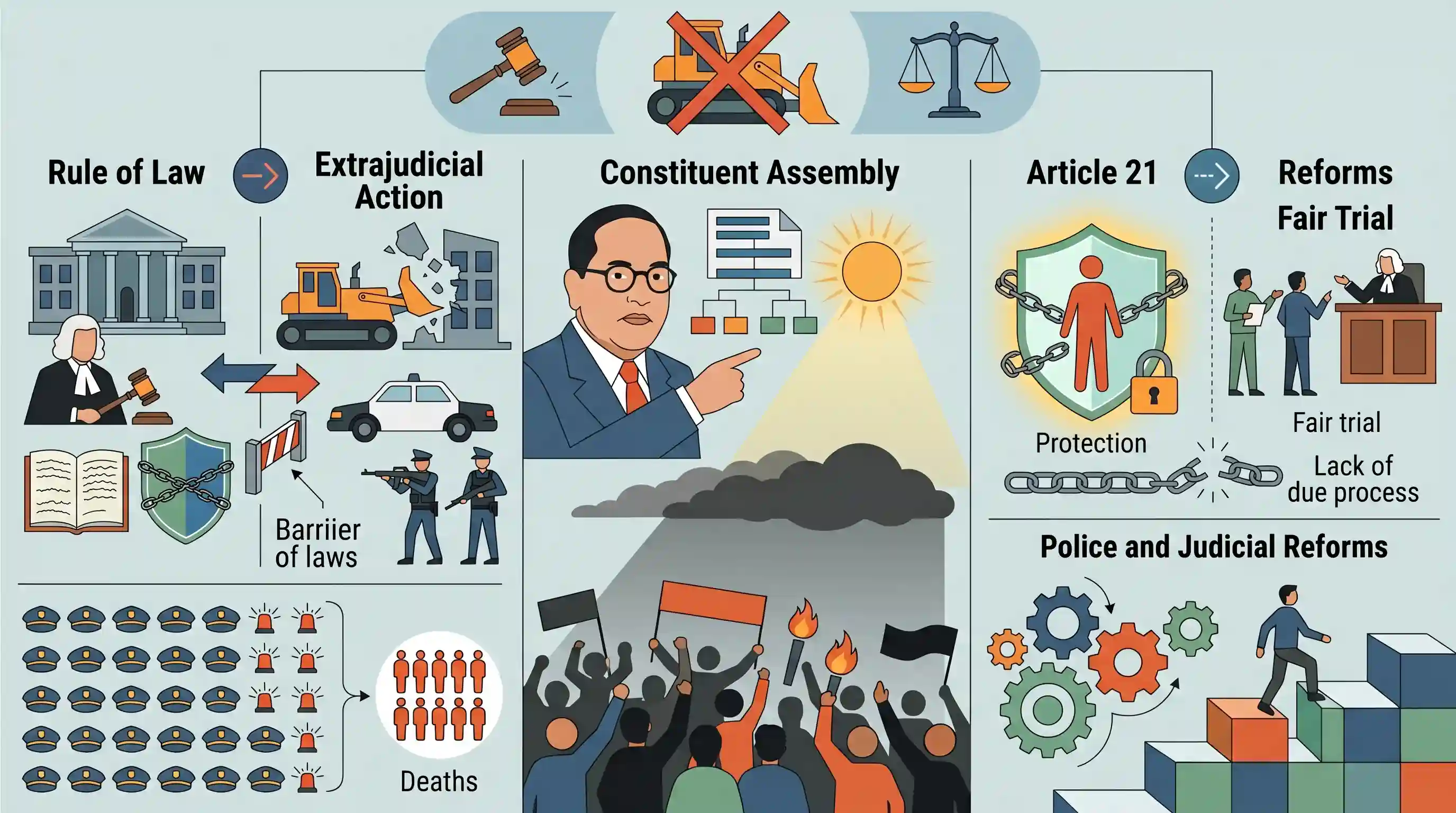
Former top police officers of Uttar Pradesh, including retired DGPs Sulkhan Singh and Vibhuti Narain Rai, have expressed strong criticism against the state's policy of police encounters and 'bulldozer actions' [1.1]. They argue that such practices bypass due process, violate constitutional rights (specifically Article 21), and normalize medieval-style extrajudicial violence [1.1]. Sulkhan Singh invoked Dr. B.R. Ambedkar’s Constituent Assembly warnings against 'popular morality' eclipsing 'constitutional morality' and the rule of law [1.1]. The debate follows official UP government statistics reporting 289 criminal deaths across 17,043 encounter operations over the last nine years [1.1].
Key Points
- Former senior UP police officials (including retired DGPs Sulkhan Singh and Vibhuti Narain Rai) have criticised police encounters and bulldozer actions, stating they undermine the criminal justice system, bypass due process, and foster vigilantism [1.1].
- Sulkhan Singh highlighted that Dr. B.R. Ambedkar had warned the Constituent Assembly about the danger of prioritizing popular morality of 'instant justice' over constitutional morality and the rule of law [1.1].
- Vibhuti Narain Rai compared the present policy to the 1980s 'Maro, Maro' campaign under the V.P. Singh regime, but argued that the state has now institutionalised extrajudicial encounters as a mainstream crime-control policy, transforming police officers into judges and executioners [1.1].
- According to UP government data released on May 18, 2026, over the past nine years, the state police conducted 17,043 encounter operations in which 289 criminals were killed ('neutralised'), 34,253 were arrested, and 11,834 accused were injured [1.1].
- The data also reported that 18 policemen were martyred and 1,852 were injured in these operations [1.1].
- The debate on extrajudicial justice intensified after Asad, the prime accused in the stabbing of Ghaziabad teenager Surya Pratap Chauhan, was shot dead in a late-night police encounter on May 30 following demands for instant action [1.1].
Important Terms
Constitutional Morality

The commitment to the core values, ethics, and democratic spirit of the Constitution (like justice, equality, and liberty) over popular sentiments or majoritarian prejudices when exercising power or interpreting laws.
UPSC context
GS Paper II (Polity & Governance). Tests understanding of constitutionalism, judicial ethics, and public versus constitutional values.
Rule of Law
The democratic principle that the law is supreme, applies equally to everyone, and protects individuals from arbitrary exercise of power by ensuring actions conform to established legal procedures.
UPSC context
GS Paper II (Polity). Tests concepts of equality before law, administrative discretion, and the basic structure of the Constitution.
Due Process of Law
A legal doctrine ensuring that any law or procedure depriving a person of life, liberty, or property must be fair, just, reasonable, and aligned with natural justice.
UPSC context
GS Paper II (Polity). Tests evolution of judicial review and its contrast with the narrow "procedure established by law."
Article 21 of the Indian Constitution
A fundamental right guaranteeing that no person, citizen or non-citizen, shall be deprived of their life or personal liberty except according to the procedure established by law, ensuring dignified survival.
UPSC context
GS Paper II (Polity). Tests the expansive scope of fundamental rights, judicial creativity, custodial justice, and right to privacy.
Article 32 of the Indian Constitution
A fundamental right guaranteeing the right to constitutional remedies, empowering citizens to approach the Supreme Court directly to enforce fundamental rights through writs like habeas corpus and mandamus.
UPSC context
GS Paper II (Polity). Tests the "heart and soul" of the Constitution, judicial review, and the Supreme Court's writ jurisdiction.
Prelims Trap
The term 'Constitutional Morality' was originally coined and conceptualized for the first time by Dr. B.R. Ambedkar.
While Dr. B.R. Ambedkar introduced and popularized the term in India during the 1948 debates, the intellectual term itself was coined by British historian George Grote in his 'A History of Greece'.
Static Concepts Connected
What is the distinction between 'Procedure Established by Law' and 'Due Process of Law'?
- Procedure Established: Originated from British practice, meaning a law is valid if the legislature followed correct statutory procedures, regardless of the law's fairness.
- Due Process: Ensures that the law itself must be fair, just, and non-arbitrary, protecting individual liberty against both executive and legislative excesses.
- Indian Shift: In Maneka Gandhi (1978), the Supreme Court integrated 'Due Process' and natural justice into Article 21, expanding judicial review.
What are the PUCL vs State of Maharashtra (2014) guidelines on encounters?
- Sixteen Guidelines: Mandates standard operating procedures including immediate FIR registration, independent CID/police station investigation, and compulsory magisterial inquiry.
- Human Rights Oversight: Requires immediate reporting of all encounter deaths to the National Human Rights Commission (NHRC) or State Human Rights Commission.
- Victim's Rights: Ensures the next of kin of the deceased are informed and have the right to participate in all inquiry proceedings.
Cross-Topic Patterns
Internal Security vs Human Rights balance
Extrajudicial actions taken to curb organized crime bypass judicial oversight, putting state-backed security measures in direct conflict with fundamental rights under Article 21.
Police Reforms and Cooperative Federalism
While 'Law and Order' is a State Subject, binding national-level guidelines like PUCL (2014) and Prakash Singh (2006) represent judicial centralization of police standards.

A multi-statement question on Article 21's evolution from 'Procedure Established' to 'Due Process' alongside the PUCL guidelines is likely.
Linked PYQs · 2
Linked PYQs · 2
- 2025UPPSC_PRELIMSGS1
Match List-I (Committee): (A) Union Constitution Committee (B) Rules of Procedure Committee (C) Drafting Committee (D) Advisory Committee on Fundamental Rights, Minorities and Tribal and Excluded Areas List-II (Chairman): 1. Dr. B.R. Ambedkar 2. Sardar Vallabhbhai Patel 3. Jawaharlal Nehru 4. Dr. Rajendra Prasad
- 2016UPPSC_PRELIMSGS1
Consider the following statements: Assertion (A): Dr. Ambedkar had described Article 32 of the Constitution as the very soul of it. Reason (R): Article 32 provides effective remedy against the violation of Fundamental Rights. Select the correct answer using the codes given below.
