Electoral Reforms for Migrant Voting Rights in India
Source:The Hindu ↗
Why It Matters
It touches upon the core of democratic participation, highlighting how socio-economic realities (migration) conflict with rigid electoral laws. Understanding this issue is essential for GS2 questions on the RPA, the constitutional right to vote, and the Election Commission's role in electoral reforms.
Summary
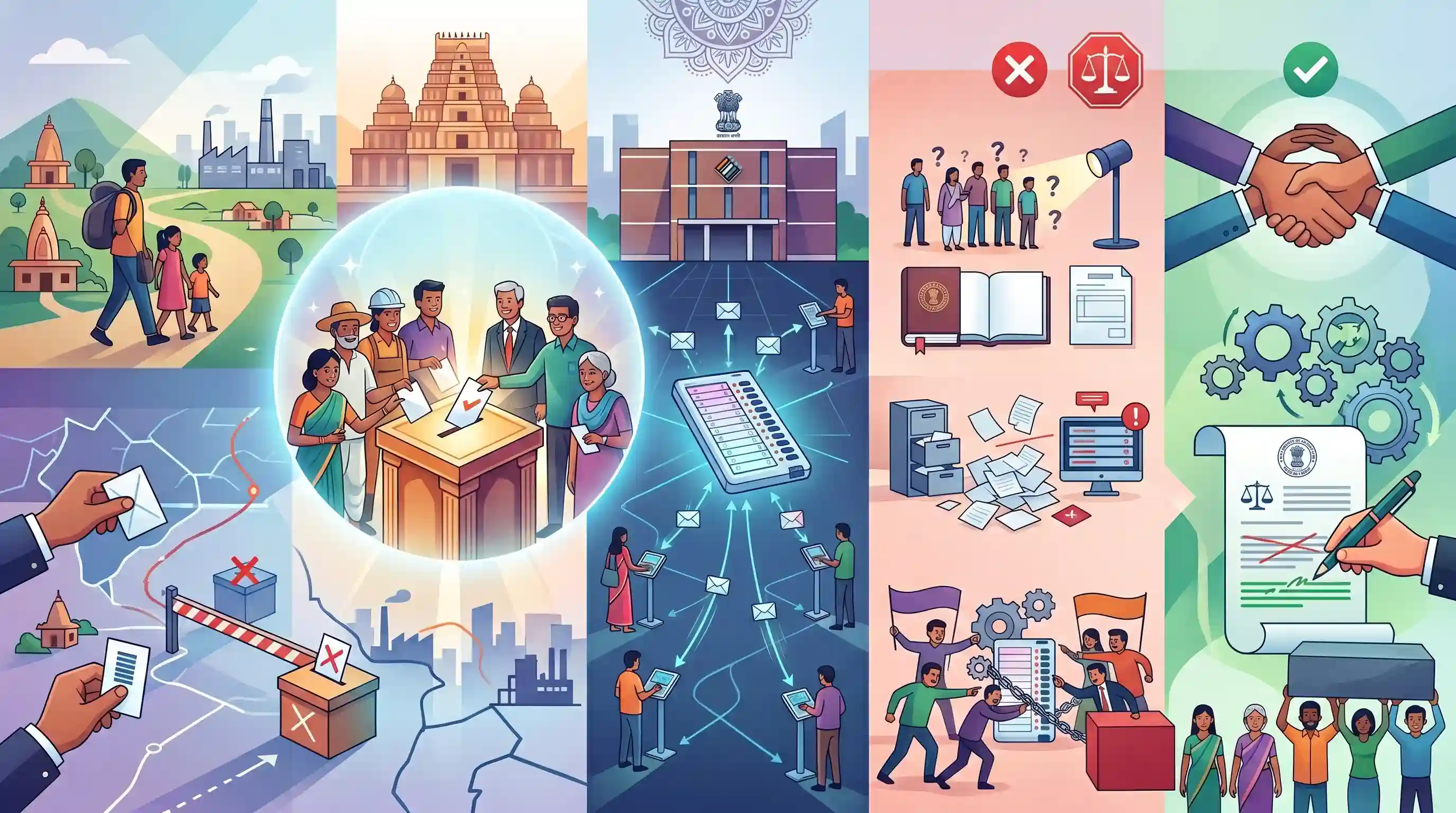
The article examines the structural disenfranchisement of internal migrants in India, who frequently lose their voting rights due to geographical displacement and the cost of returning home to vote. To ensure universal adult suffrage under Article 326, the Election Commission of India introduced the concept of Multi-Constituency Remote Electronic Voting Machines (RVMs). However, operationalizing this technology is stalled by the lack of a clear legal definition for "domestic migrants," the absence of a centralized migrant registry, and resistance from political parties over electoral integrity. Realizing this reform necessitates political consensus alongside critical amendments to the Representation of the People Act.
Key Points
- A significant portion of India's electorate, primarily domestic migrants, faces de facto disenfranchisement as they cannot travel back to their home constituencies to cast their votes.
- The Election Commission of India (ECI) proposed the Multi-Constituency Remote Electronic Voting Machine (RVM) to facilitate remote voting for migrants without needing them to travel.
- Implementing remote voting faces major administrative hurdles, notably the absence of a comprehensive and centralized database defining and tracking domestic migrants.
- Legal implementation of the RVM would require substantial amendments to the Representation of the People Act (1950 and 1951) and the Conduct of Election Rules, 1961, particularly concerning the definition of 'ordinary residence' and remote polling booths.
- The initiative lacks political consensus, with opposition parties raising concerns regarding EVM tampering, electoral integrity, and the logistical complexities of verifying migrant identities.
Important Terms
Representation of the People Act, 1950

A primary law providing for the allocation of seats, delimitation of constituencies, and the preparation/revision of electoral rolls for Parliament and State Legislatures.
UPSC context
GS Paper 2; tests understanding of the legal-structural framework governing Indian elections before the actual voting process begins.
Representation of the People Act, 1951
Legislation governing the actual conduct of elections, including administrative machinery, candidate qualifications/disqualifications, political party registration, and resolution of electoral disputes.
UPSC context
GS Paper 2; crucial for questions on electoral integrity, decriminalization of politics, and the disqualification of lawmakers.
Article 326 of the Constitution of India
A constitutional provision mandating that elections to the Lok Sabha and State Legislative Assemblies be conducted on the basis of universal adult suffrage.
UPSC context
GS Paper 2; fundamental for discussing political equality, voting rights, and the 61st Amendment (lowering voting age).
Election Commission of India (ECI)
An autonomous constitutional authority established under Article 324, responsible for administering and supervising election processes in India at national and state levels.
UPSC context
GS Paper 2; tests knowledge of its administrative, advisory, and quasi-judicial powers to ensure free and fair elections.
Remote Electronic Voting Machines (RVMs)
Prototype standalone devices developed by ECI to enable domestic migrants to vote from remote polling stations without traveling to their home constituencies.
UPSC context
GS Paper 2/Current Affairs; tests awareness of electoral reforms, digital inclusivity, and technological solutions to low voter turnout.
Universal Adult Suffrage
The democratic principle granting the right to vote to all adult citizens irrespective of wealth, religion, race, gender, or social status.
UPSC context
GS Paper 2; core concept in Indian democracy, frequently linked to political justice and Article 326.
Prelims Trap
Temporary absence for work revokes a voter's 'ordinary resident' status under the Representation of the People Act, 1950.
Section 20 of RPA 1950 explicitly states that temporary absence does NOT negate 'ordinary residence'. This paradox is why migrants remain registered back home.
Static Concepts Connected
What defines an 'ordinary resident' under the Representation of the People Act, 1950?
- Property ownership: Merely owning or possessing a dwelling in a constituency does not automatically make a person an 'ordinarily resident' there.
- Temporary absence: Temporary absence for work, vacation, or treatment does not strip a person of their ordinary resident status in their home constituency.
- Service voters: Armed forces personnel or government employees posted abroad are legally 'deemed' to be ordinarily resident in their home constituencies.
What are the Constitutional contours of Universal Adult Suffrage?
- Article 326: Mandates that elections to the Lok Sabha and State Legislative Assemblies be conducted on the basis of adult suffrage (18+ years).
- Constitutional Disqualifications: Suffrage can be restricted only on specific constitutional grounds: non-residence, unsoundness of mind, crime, or corrupt/illegal practice.
Cross-Topic Patterns
RVMs vs Postal/Proxy Voting
Unlike service voters who use postal ballots or NRIs (where proxy voting was debated), RVMs introduce 'remote polling booths' outside the home constituency, needing unique Conduct of Election Rules amendments.
Migrant Registries and e-Shram
The ECI's primary hurdle—lack of a centralized domestic migrant database—ties directly into parallel administrative efforts for informal workers like the e-Shram portal and the One Nation One Ration Card (ONORC).

Expect a 2026 Prelims question testing the legal definition of 'ordinary resident' in RPA 1950 against Article 326 disqualifications.
Linked PYQs · 5
Linked PYQs · 5
- 2017PrelimsGS1
Right to vote and to be elected in India is a
- 2024MainsGS2
Examine the need for electoral reforms as suggested by various committees with particular reference to "one nation one election" principle.
- 2020MainsGS2
There is a need for simplification of procedure for disqualification of persons found guilty of corrupt practices under the Representation of Peoples Act". Comment.
- 2024MainsGS1
Why do large cities tend to attract more migrants than smaller towns? Discuss in the light of conditions in developing countries.
- 2022MainsGS2
Discuss the procedures to decide the disputes arising out of the election of a Member of the Parliament or State Legislature under The Representation of the People Act, 1951. What are the grounds on which the election of any returned candidate may be declared void ? What remedy is available to the aggrieved party against the decision ? Refer to the case laws.
