Feminisation of Agriculture and Food Security Challenges
Source:The Hindu ↗
Why It Matters
This issue sits at the intersection of GS-1 (Role of women/Society/Geography) and GS-3 (Agriculture/Food Security). It highlights the structural constraints faced by women farmers, directly addressing UPSC syllabus points like feminisation of agriculture, land reforms, and the role of SHGs and microfinance in breaking the cycle of poverty and malnutrition.
Summary
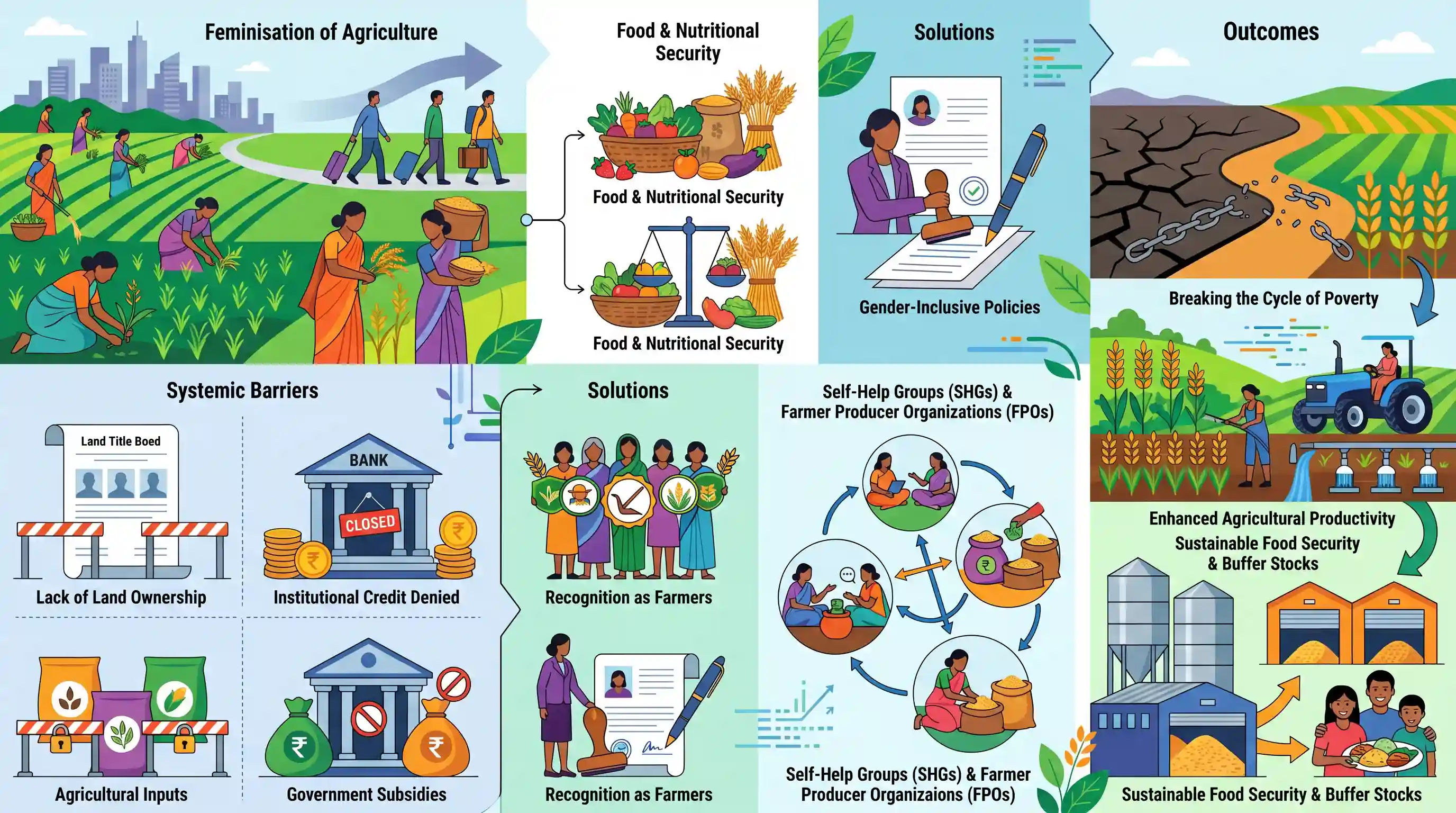
The article emphasizes the indispensable role of women in agriculture and its direct correlation with achieving food and nutritional security. As Indian agriculture becomes increasingly feminised due to male out-migration, women shoulder a disproportionate share of agricultural labor. However, systemic barriers—most notably the lack of land ownership—prevent them from accessing institutional credit, agricultural inputs, and government subsidies. The piece advocates for formally recognizing women as farmers, enhancing their participation in Self-Help Groups (SHGs) and Farmer Producer Organizations (FPOs), and enacting gender-inclusive policies. Empowering women farmers is presented not just as a matter of gender equity, but as a crucial strategy for breaking the cycle of poverty, enhancing agricultural productivity, and ensuring sustainable food security.
Key Points
- The agricultural sector is witnessing an increasing 'feminisation' due to rural-to-urban male migration, placing a higher burden of farm labor on women.
- Despite making up a significant portion of the agricultural workforce, the vast majority of women lack land titles, which restricts their formal recognition as 'farmers' and denies them access to institutional credit, insurance, and subsidies.
- Empowering women in agriculture is intrinsically linked to improved household food and nutritional security, as women are more likely to reinvest their income into family health and nutrition.
- Collectives such as Self-Help Groups (SHGs) and Farmer Producer Organizations (FPOs) play a crucial role in providing women with market access, financial inclusion, and better bargaining power.
- Policy interventions must focus on gender-sensitive agricultural strategies, equitable land tenure rights, and targeted technological and financial support to break the vicious cycle of gender inequality and rural poverty.
Important Terms
Feminisation of Agriculture

The increasing involvement and dependence on women in agricultural roles—as laborers and managers—driven largely by male out-migration from rural areas for non-farm jobs.
UPSC context
GS Papers I (Society) and III (Agriculture). Tests understanding of rural demographic shifts and their socio-economic impact on women.
Mahila Kisan Sashaktikaran Pariyojana (MKSP)
A sub-component of DAY-NRLM launched in 2011 to empower women farmers, enhance their productivity, and formally recognize the identity of 'Mahila' as 'Kisan.'
UPSC context
GS Paper II (Welfare Schemes). Tests knowledge of gender-centric interventions in the primary sector and rural livelihood security.
Self-Help Groups (SHGs)
Informal voluntary associations of 10-20 individuals (primarily women) who pool savings to provide collateral-free loans to members, fostering financial inclusion and collective empowerment.
UPSC context
GS Paper II (Role of NGOs/SHGs) and GS Paper III (Inclusive Growth). Tests knowledge of microfinance and community-led development.
Farmer Producer Organizations (FPOs)
Legal entities (Producer Companies or Cooperatives) formed by farmers to leverage collective bargaining power, access modern inputs, and establish direct market linkages.
UPSC context
GS Paper III (Agricultural Marketing). Tests understanding of institutional reforms to improve the income of small and marginal farmers.
National Rural Livelihood Mission (NRLM)
A flagship poverty alleviation program (launched 2011) that organizes the rural poor into institutional platforms like SHGs to ensure sustainable livelihoods and financial services.
UPSC context
GS Paper II (Social Justice) and GS Paper III (Inclusive Growth). Tests knowledge of large-scale rural development and poverty reduction strategies.
Food and Agriculture Organization (FAO)
A specialized UN agency established in 1945 that leads international efforts to defeat hunger and ensure global food and nutritional security.
UPSC context
GS Paper II (International Relations). Tests knowledge of global governance and its role in coordinating international food security policies.
Prelims Trap
Under MKSP, women must hold legal land titles in their name to be formally recognized as 'farmers' and access benefits.
MKSP specifically recognizes rural women as 'farmers' (Kisan) regardless of land ownership, actively bypassing traditional title-based criteria to provide agricultural skills and support.
Static Concepts Connected
What drives the 'feminisation of agriculture' in India?
- Male out-migration: Rural-to-urban migration of men for non-farm employment leaves women as the primary managers and laborers of household farms.
- Agrarian distress: Declining farm incomes push male members into alternative rural casual labor or construction, shifting primary farm responsibilities to women.
- Mechanization gender gap: Women are disproportionately relegated to labor-intensive, non-mechanized agricultural tasks like weeding, sowing, and harvesting.
How do Farmer Producer Organizations (FPOs) empower marginalized farmers?
- Collective bargaining: Aggregating small volumes of produce enables better price negotiation and helps eliminate exploitative intermediaries.
- Input cost reduction: Bulk procurement of seeds and fertilizers lowers the per-unit cost of cultivation for individual member farmers.
- Institutional credit access: Formal registration allows FPOs to access institutional credit and government infrastructure grants that are often denied to individual landless farmers.
Cross-Topic Patterns
Land titles and climate adaptation
Without land titles, women farmers cannot access government subsidies for micro-irrigation or climate-resilient seeds, linking gendered land reforms directly to national climate action and disaster resilience.
SHGs scaling into FPOs
The policy shift from credit-focused SHGs to market-linked FPOs marks a crucial transition from basic financial inclusion to commercial agricultural empowerment for rural women.

Expect a GS3 Mains question linking 'feminisation of agriculture' with land tenure hurdles and the role of FPOs in household food security.
Linked PYQs · 4
Linked PYQs · 4
- 2014MainsGS1
Discuss the various economic and socio-cultural forces that are driving increasing feminization of agriculture in India.
- 2021MainsGS2
Can the vicious cycle of gender inequality, poverty and malnutrition be broken through microfinancing of women SHGs? Explain with examples.
- 2020MainsGS2
Micro-Finance as an anti-poverty vaccine, is aimed at asset creation and income security of the rural poor in India". Evaluate the role of the Self Help Groups in achieving the twin objectives along with empowering women in rural India.
- 2013MainsGS3
Food Security Bill is expected to eliminate hunger and malnutrition in India. Critically discuss various apprehensions in its effective implementation along with the concerns it has generated in WTO.
