Gujarat announces major welfare push for rural infrastructure
Source:aninews ↗
Why It Matters
Highlights critical state-level governance interventions spanning rural housing, public infrastructure accountability (PPP/performance contracts), child nutrition, and youth education. Important for understanding state models of welfare delivery and contract management reforms.
Summary
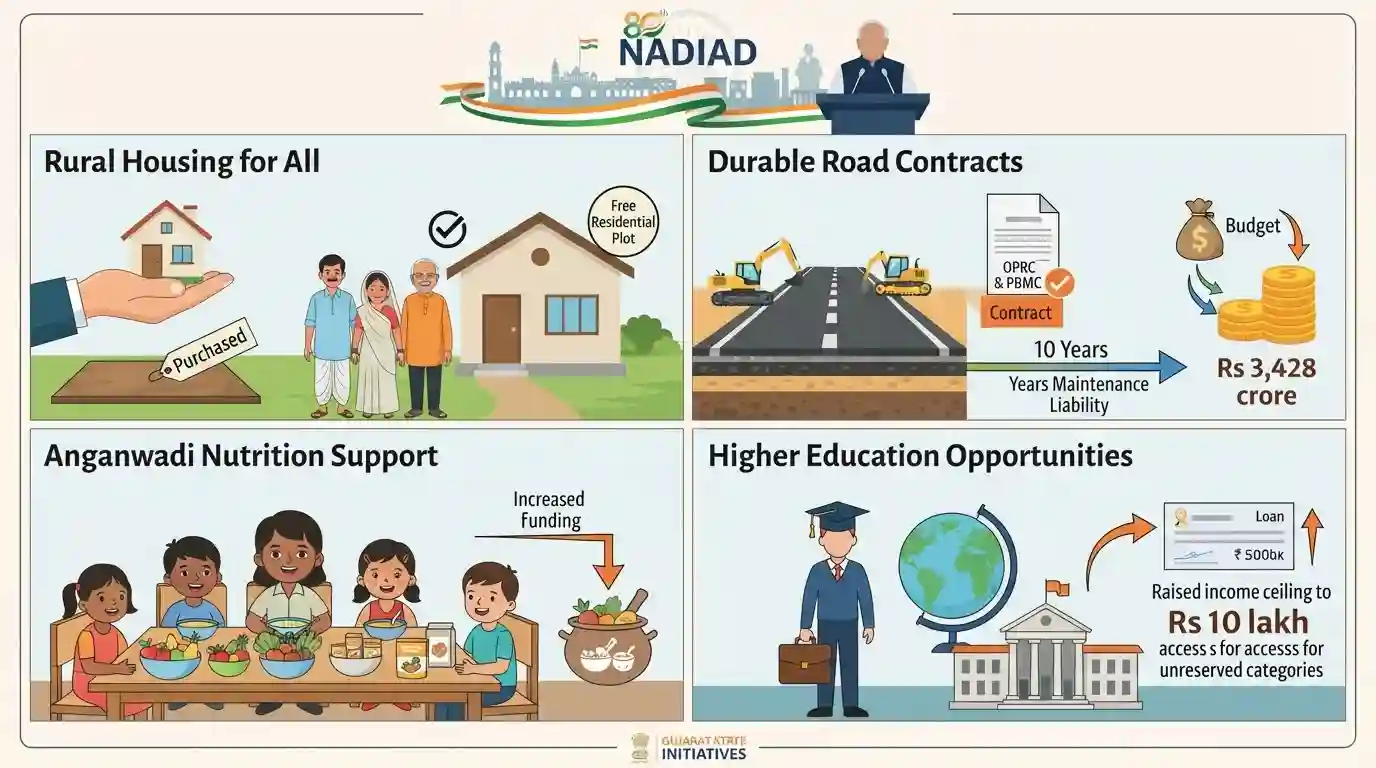
On the 80th Independence Day, Gujarat Chief Minister Bhupendra Patel announced major welfare and infrastructure initiatives in Nadiad. Key policies include the state purchasing private land to provide free residential plots to rural families where public land is unavailable, bolstering the 'Housing for All' vision. In a move to improve road durability, the state introduced Output and Performance Road Contracts (OPRC) and Performance-Based Maintenance Contracts (PBMC), allocating Rs 3,428 crore and extending contractors' maintenance liabilities up to 10 years. Additionally, nutrition funding for Anganwadi children was significantly increased, and the income ceiling for overseas education loans for unreserved categories was raised to Rs 10 lakh.
Key Points
- To support the 'Housing for All' initiative, the Gujarat government will purchase private land to allocate free residential plots to rural families in areas lacking government or panchayat land.
- The state allocated Rs 3,428 crore to repair 2,010 km of 214 roads using advanced contract models (OPRC and PBMC), which extend contractor maintenance responsibility from 4 years to 8-10 years.
- The daily procurement rate for hot breakfast for Anganwadi children was increased by 67%, from Rs 5.10 to Rs 8.50 per child, requiring an additional Rs 169 crore allocation.
- The family income ceiling for unreserved-category students seeking foreign higher education loans was raised from Rs 6 lakh to Rs 10 lakh to benefit more youth.
Important Terms
Output and Performance Road Contracts (OPRC)

A rural infrastructure contracting model used in Gujarat where payment is linked to the long-term performance and quality of the road rather than just construction. Contractors have maintenance liability for up to 10 years.
UPSC context
Important for GPSC infrastructure and governance topics, illustrating Gujarat's shift towards accountability and longevity in rural road construction.
Performance-Based Maintenance Contracts (PBMC)
A road maintenance contracting system in Gujarat applied to projects worth Rs 2-25 crore. It ties contractor payments to long-term road quality, enforcing up to 7-10 years of maintenance liability.
UPSC context
Relevant for GPSC General Studies (Infrastructure), showing how Gujarat ensures contractor accountability for rural connectivity and road durability.
Gujarat Unreserved Educational and Economical Development Corporation (GUEEDC)
A Gujarat state corporation under the Social Justice and Empowerment Department that provides educational and economic support, including foreign study loans, to students from unreserved (general) categories.
UPSC context
Tests knowledge of state-specific welfare initiatives for unreserved classes, highly relevant for GPSC Social Justice and Governance topics.
Housing for All
A central government flagship initiative adopted by states like Gujarat to provide affordable housing to the rural and urban poor. Gujarat supports this by purchasing private land for free residential plots where public land is unavailable.
UPSC context
Crucial for GPSC Welfare Schemes and Rural Development sections, highlighting the state-centre convergence on poverty alleviation.
Prelims Trap
Plots for 'Housing for All' in Gujarat are strictly allocated from existing government wasteland or panchayat properties.
The new policy specifically allows the state to purchase private land to allocate free residential plots when public/panchayat land is unavailable.
Static Concepts Connected
What are Performance-Based Maintenance Contracts (PBMC) in road infrastructure?
- Outcome focused: Payments depend on maintaining specified road quality metrics (e.g., no potholes, smooth riding surface) rather than the raw quantity of materials used.
- Extended liability: Contractors hold long-term maintenance responsibility (often 8-10 years), incentivizing them to ensure high-quality initial construction to avoid recurring repair costs.
What is the core mandate of Anganwadi Centres under the ICDS scheme?
- Target demographics: Delivers supplementary nutrition, health check-ups, and immunization to children (0-6 years), pregnant women, and lactating mothers.
- Early education: Provides non-formal pre-school education specifically for children aged 3 to 6 years before they enter the formal schooling system.
Cross-Topic Patterns
Nutrition indices & State augmentation
Gujarat's 67% hike in Anganwadi breakfast funds highlights how states are augmenting central ICDS allocations to combat poor child nutrition outcomes consistently flagged in NFHS surveys.
Shift to Outcome-Based Infra Contracts
Transitioning from traditional item-rate contracts to OPRC/PBMC aligns with the broader national push (like NHAI's BOT and TOT models) to reduce life-cycle costs and shift maintenance risks to private developers.

Expect multi-statement questions mixing Gujarat's PBMC road contracts with its unique provision of buying private land for rural housing.
Linked PYQs · 3
Linked PYQs · 3
- 2025GPSC_PRELIMSGS1
Which of the following statements is/are correct regarding the G-SAFAL scheme?
- 2025GPSC_PRELIMSGS1
Consider the following statements regarding Public Private Partnership (PPP) in infrastructure in India: 1. Policies and projects under PPP are regulated by the Department of Economic Affairs, Ministry of Finance 2. PPP has well-defined allocation of risk between the private and public entities Which of the statement(s) given above is/are correct?
- 2026GPSC_PRELIMSGS1
Food subsidy is the difference between
