Urban Local Bodies and Devolution for Effective Governance
Source:Indian Express ↗
ఇది ఎందుకు ముఖ్యం
Urban local bodies are the foundational tiers of grassroots democracy and urban management. With rapid urbanization in India, questions regarding municipal efficiency, the 3Fs (Funds, Functions, Functionaries), and municipal reforms frequently feature in the UPSC Mains GS2 exam.
సారాంశం
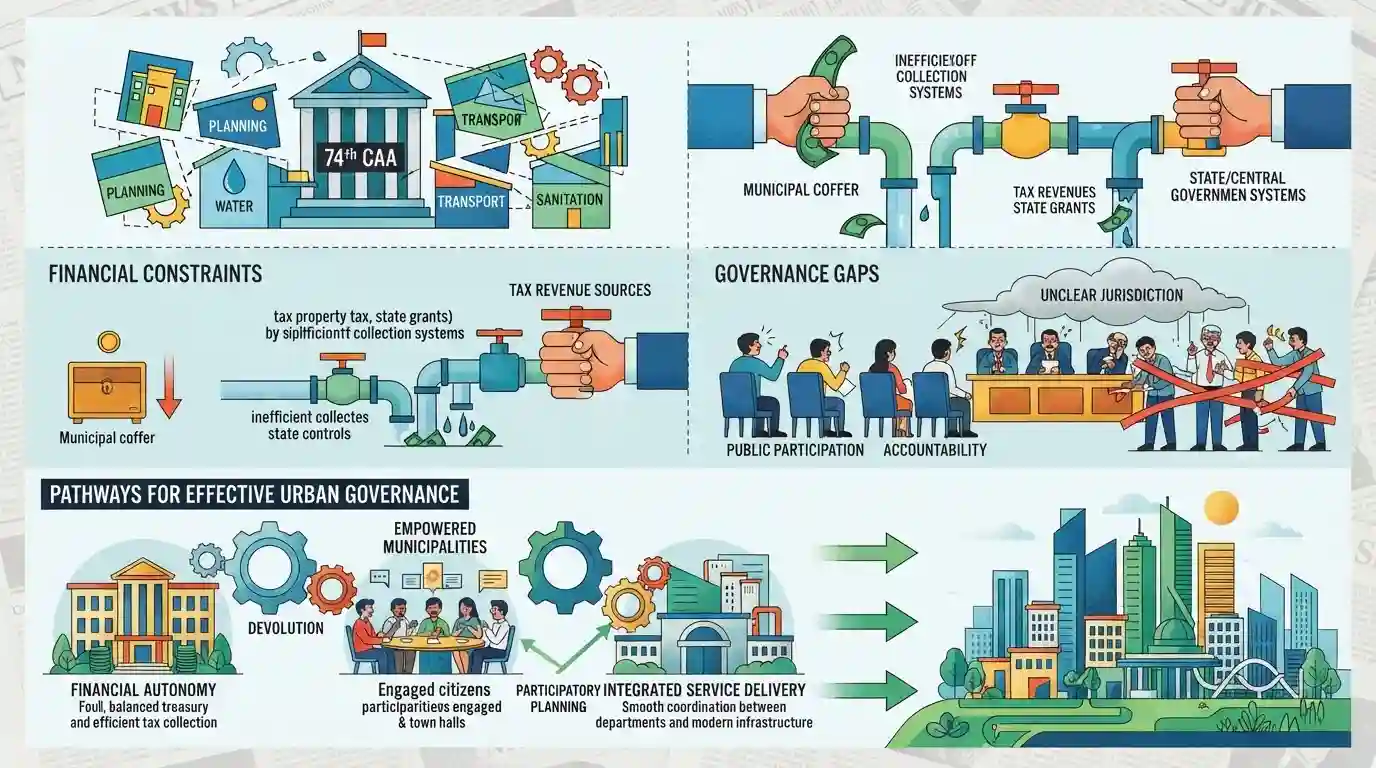
The article discusses the critical challenges plaguing urban local bodies in India, analyzing structural shortcomings, financial constraints, and governance gaps following the 74th Constitutional Amendment Act, and highlights pathways for effective urban governance.
ముఖ్య అంశాలు
- Urban local bodies in India face severe structural, financial, and functional challenges, impeding effective urban governance.
- The 74th Constitutional Amendment Act aimed to decentralize power, but implementation gaps remain regarding the devolution of funds, functions, and functionaries.
- Key bottlenecks include lack of fiscal autonomy, heavy reliance on state governments for grants, parallel bodies encroaching upon municipal jurisdiction, and capacity constraints among urban personnel.
- Effective urban governance requires strengthening municipal finances through property tax reforms, professionalizing urban management, and empowering local leadership.
ముఖ్యమైన పదాలు
74th Constitutional Amendment Act

A landmark 1992 legislation that granted constitutional status to Urban Local Bodies in India, adding Part IX-A and the 12th Schedule to decentralize governance and empower municipal bodies.
UPSC context
GS Paper II (Polity & Governance) - Important aspects of governance, transparency, and accountability, devolution of powers up to local levels.
అనుసంధానమైన స్థిర భావనలు
What are the key constitutional provisions and institutional mechanisms governing Urban Local Bodies in India?
- Constitutional Basis: Part IX-A of the Constitution (Articles 243-P to 243-ZG) was added by the 74th Constitutional Amendment Act, 1992.
- Twelfth Schedule: The Twelfth Schedule enumerates 18 functional items that may be entrusted to municipalities by state legislatures.
- Financial Devolution: State Finance Commissions are constituted every five years to review the financial position of municipalities and recommend tax assignments and grants-in-aid.
- Planning Machinery: District Planning Committees (DPCs) and Metropolitan Planning Committees (MPCs) are mandated to consolidate district and metropolitan level development plans.
అంతర-అంశ నమూనాలు
ULB Devolution and State Finance Commissions
State Finance Commissions are mandated by the 74th Amendment to review municipal finances, creating an institutional link between rural-urban decentralization and cooperative federalism.

Expect statement-based questions on the 74th Amendment focusing on the discretionary nature of 3Fs devolution and municipal own-source revenues.
అనుసంధాన PYQలు · 2
అనుసంధాన PYQలు · 2
- 2024MainsGS2
Analyse the role of local bodies in providing good governance at local level and bring out the pros and cons merging the rural local bodies with the urban local bodies.
- 2020MainsGS2
The strength and sustenance of local institutions in India has shifted from their formative phase of 'Functions, Functionaries and Funds' to the contemporary stage of 'Functionality'. Highlight the critical challenges faced by local institutions in terms of their functionality in recent times.
