MGNREGA Faces Operational Crisis Due to Funding and Tech Hurdles
Source:The Hindu ↗
ఇది ఎందుకు ముఖ్యం
MGNREGA is a flagship welfare program frequently tested in both UPSC Prelims and Mains. Understanding its operational challenges—especially the intersection of technology (like ABPS) and welfare delivery—is crucial for answering questions on governance, social justice, and inclusive growth.
సారాంశం
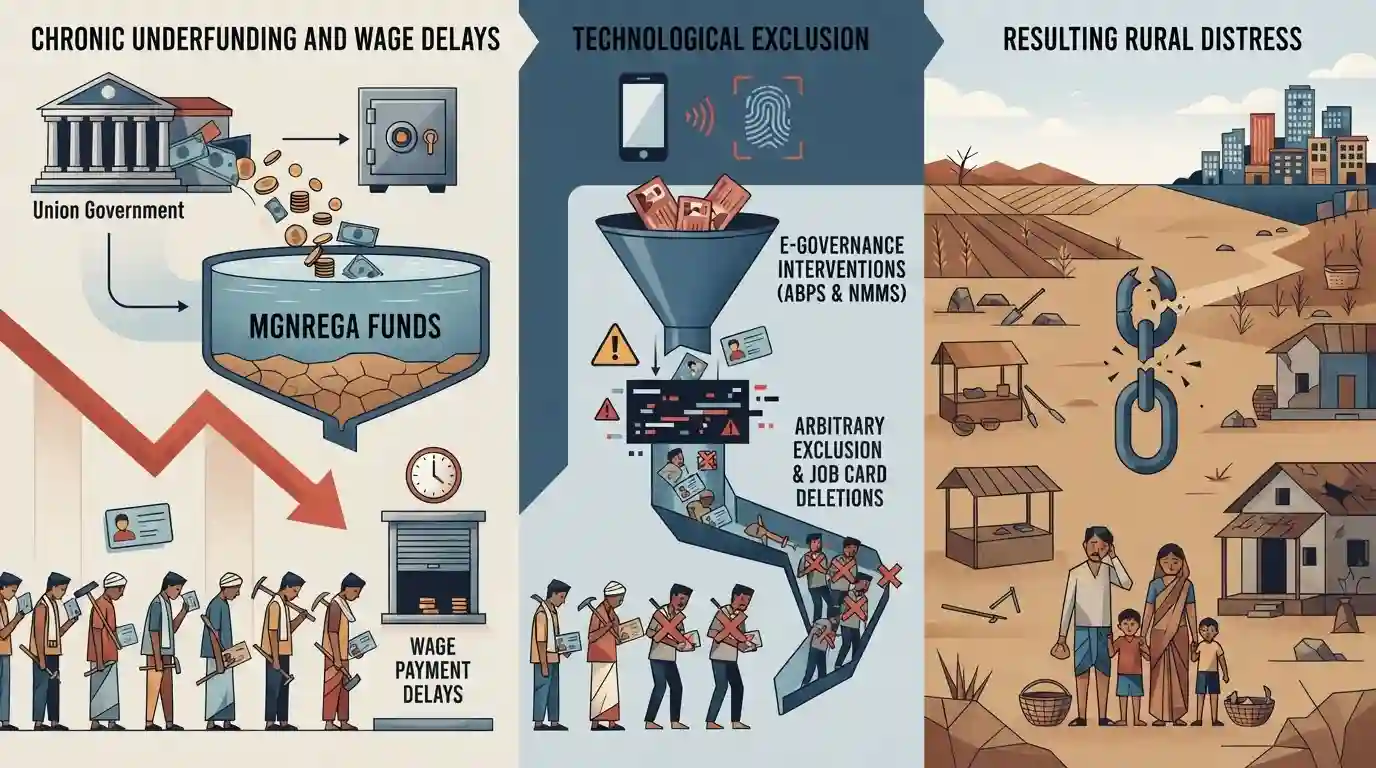
The article critiques the current state of the Mahatma Gandhi National Rural Employment Guarantee Act (MGNREGA), arguing that the rural employment guarantee scheme has slipped into "limbo." This decline is largely attributed to chronic underfunding by the Union government, which has resulted in severe delays in wage payments and a reduction in available work opportunities. Furthermore, the mandatory introduction of technological interventions—such as the Aadhaar-Based Payment System (ABPS) and the National Mobile Monitoring System (NMMS)—has inadvertently excluded millions of vulnerable workers through arbitrary job card deletions and technical glitches. By eroding this critical social safety net, the administration is failing its statutory obligation to provide rural employment, thereby exacerbating rural distress and inequality.
ముఖ్య అంశాలు
- MGNREGA is experiencing a severe crisis due to chronic underfunding by the Union government, leading to widespread delays in wage payments and denial of work.
- The mandatory implementation of technological tools like the Aadhaar-Based Payment System (ABPS) and the National Mobile Monitoring System (NMMS) has caused massive exclusion errors and arbitrary deletion of job cards.
- Administrative hurdles and budget constraints are actively undermining the scheme's statutory mandate to provide 100 days of guaranteed wage employment.
- The erosion of MGNREGA weakens a critical social safety net, exacerbating rural distress and poverty among vulnerable communities.
ముఖ్యమైన పదాలు
Mahatma Gandhi National Rural Employment Guarantee Act (MGNREGA)

A 2005 law guaranteeing 100 days of unskilled manual wage employment in a financial year to every rural household whose adult members volunteer. It is a demand-driven, rights-based scheme.
UPSC context
GS Paper II: Tests knowledge of welfare schemes, poverty alleviation, and issues of rural livelihood and employment guarantee.
National Mobile Monitoring System (NMMS)
A digital platform launched to capture real-time, geo-tagged, and time-stamped attendance of MGNREGA workers at worksites. It aims to reduce ghost beneficiaries and improve transparency.
UPSC context
GS Paper II: Highlights e-governance applications, accountability, and the challenges of digital exclusion in rural welfare delivery.
Aadhaar-Based Payment System (ABPS)
A bank-led payment model linking a worker's Aadhaar number with their job card and bank account. It functions as their financial address for direct wage transfers under schemes like MGNREGA.
UPSC context
GS Paper II & III: Relevant for direct benefit transfers, financial inclusion, e-governance, and tech-induced exclusion issues.
ప్రిలిమ్స్ ఉచ్చు
The Central Government bears 100% of the cost for unskilled wages under the current rural employment guarantee framework.
Under the new VB-G RAM G Act, the funding model for unskilled wages shifted to a 60:40 Centre-State ratio, departing from MGNREGA's historical 100% central funding for unskilled labor.
అనుసంధానమైన స్థిర భావనలు
What are the prerequisites for successful wage transfer via the Aadhaar-Based Payment System (ABPS)?
- Aadhaar Seeding: Linking the beneficiary's job card or scheme ID directly to their Aadhaar number.
- Bank Authentication: Linking the Aadhaar to a bank account and completing mandatory e-KYC norms.
- NPCI Mapping: The bank account must be actively mapped with the National Payments Corporation of India (NPCI) clearing house for routing.
How do Centrally Sponsored Schemes (CSS) differ in their Centre-State funding patterns?
- Core of Core: Schemes of utmost national importance (e.g., legacy MGNREGA) historically received near 100% central funding for core components.
- Core Schemes: Most flagship schemes (like the new VB-G RAM G) follow a 60:40 Centre-State sharing ratio for general category states.
- NE & Himalayan States: To accommodate lower fiscal capacity, these states generally enjoy a 90:10 funding ratio across most Central schemes.
అంతర-అంశ నమూనాలు
Digital exclusion in welfare delivery
The rigid mandate of ABPS and NMMS highlights the tension between reducing leakages (e-governance) and generating inclusion errors, a recurring theme also seen in PDS and Ayushman Bharat.
Balancing farm labor and public works
The new provision allowing states to suspend public works for 60 days addresses long-standing criticisms that rural employment schemes cause acute farm labor shortages during peak sowing and harvesting seasons.

Transition from MGNREGA to VB-G RAM G will be a Prelims target; expect multi-statement questions contrasting the funding and 125-day rule.
అనుసంధాన PYQలు · 4
అనుసంధాన PYQలు · 4
- 2011PrelimsGS1
Among the following who are eligible to benefit from the “Mahatma Gandhi National Rural Employment Guarantee Act”?
- 2019MainsGS2
Performance of welfare schemes that are implemented for vulnerable sections is not so effective due to absence of their awareness and active involvement at all stages of policy process. Discuss.
- 2021MainsGS2
Has digital illiteracy, particularly in rural areas, coupled with lack of Information and Communication Technology (ICT) accessibility hindered socio-economic development? Examine with justification.
- 2022MainsGS2
Besides the welfare schemes, India needs deft management of inflation and unemployment to serve the poor and the underprivileged sections of the society. Discuss.
