Global Capability Centres and Employment Growth in India
Source:Indian Express ↗
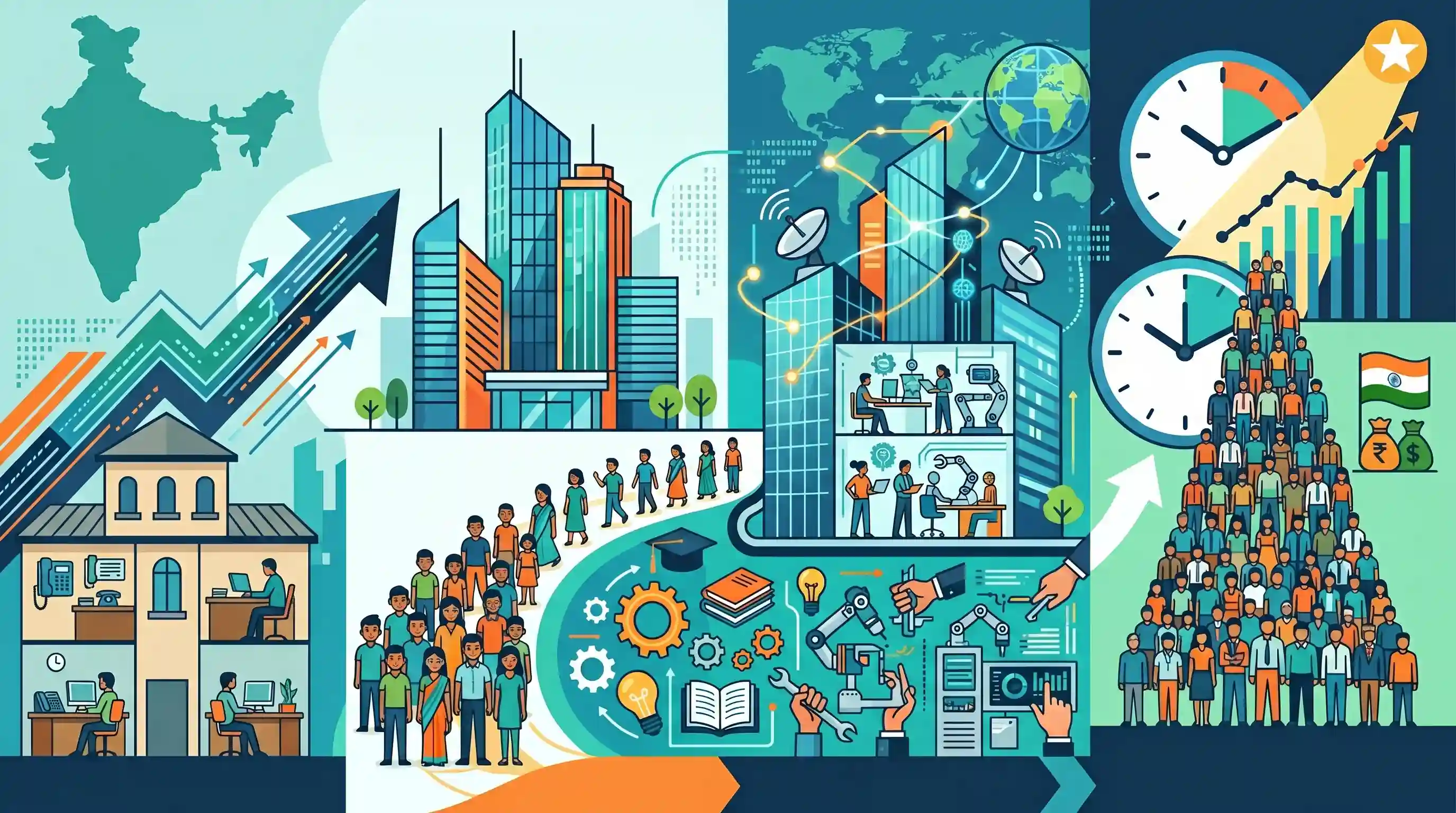
Why It Matters
The rise of Global Capability Centres (GCCs) represents a major structural shift in India's service sector, moving up the value chain from basic IT services to strategic R&D and innovation. This trend is directly relevant for analyzing contemporary patterns of employment generation, understanding the impacts of FDI and globalization, and formulating strategies to harness India's demographic dividend.
Summary
Finance Minister Nirmala Sitharaman highlighted that Global Capability Centres (GCCs) are projected to employ up to 2.8 million people in India by 2030. This growth underscores a structural shift in the Indian service sector, as the country transitions from lower-end outsourcing to serving as a strategic hub for global corporate innovation and research. The expansion of GCCs presents a significant opportunity for robust employment generation, provided there is continued emphasis on skill development to fully leverage India's demographic dividend.
Key Points
- Finance Minister Nirmala Sitharaman projected that employment in Global Capability Centres (GCCs) in India will reach 2.8 million by 2030.
- The rapid expansion of GCCs illustrates India's evolution from a traditional back-office outsourcing destination to a strategic global hub for innovation, R&D, and technology.
- This expected surge in high-value job creation is critical for absorbing the expanding workforce and maximizing the potential of India's demographic dividend.
- Realizing this employment potential will require a sustained policy focus on skill development and improving youth employability to meet the standards of multinational corporations.
Important Terms
Global Capability Centres (GCCs)

Captive offshore units of multinational corporations (MNCs) that perform strategic, knowledge-intensive functions like R&D, IT engineering, and global operations internally rather than through third-party vendors.
UPSC context
GS Paper III: Economy/Employment. Tests India's transition from low-end outsourcing to a high-value global innovation hub.
Demographic Dividend
The economic growth potential resulting from shifts in a population's age structure, specifically when the working-age population (15-64) is larger than the dependent population.
UPSC context
GS Paper I (Society) & GS Paper III (Economy). Tests understanding of population dynamics and growth planning.
Skill Development
The process of acquiring or enhancing vocational and technical competencies to improve workforce productivity and employability in line with market demands.
UPSC context
GS Paper II & III. Central to human capital investment and government schemes like Skill India Mission.
Cost Arbitrage
The economic practice of utilizing labor from a location with lower costs (wages) to perform tasks, providing a competitive price advantage for firms.
UPSC context
GS Paper III: Liberalization. Key for analyzing India's historical IT growth versus its current shift toward value-addition.
Service-Led Growth Model
India's unique economic development path where the economy transitioned directly from agriculture to services as the primary driver of GDP and growth.
UPSC context
GS Paper III: Planning/Growth. Evaluates understanding of sectoral shifts in Gross Value Added (GVA).
Strategic Hubs
Offshore centers that focus on high-value activities like product engineering, intellectual property creation, and complex digital transformation rather than routine back-office support.
UPSC context
GS Paper III: Industrial Growth/S&T. Relates to India's role in the global knowledge economy and innovation.
Prelims Trap
Global Capability Centres (GCCs) are essentially low-cost business process outsourcing (BPO) hubs.
GCCs represent a structural shift away from BPOs; they are in-house, strategic global innovation and R&D hubs for MNCs, not third-party back-office outsourcing units.
Static Concepts Connected
How do GCC exports impact India's Balance of Payments (BoP)?
- Invisibles surplus: GCC-driven software and ER&D services boost the net invisibles surplus, acting as a crucial buffer to offset India's structural merchandise trade deficit (CAD).
- Stable capital flows: Setting up GCCs attracts continuous Foreign Direct Investment (FDI) under the 100% automatic route, strengthening the capital account and forex reserves.
What defines India's 'employability gap' in the knowledge economy?
- Demand-supply mismatch: Despite a massive working-age population, only about half of graduates are industry-ready, creating a 60-70% deficit in frontier tech roles like Data Science and AI.
- Targeted upskilling: Bridging this gap requires transitioning from basic academic degrees to targeted, capital-intensive digital upskilling through state-industry partnerships (e.g., FutureSkills Prime).
Cross-Topic Patterns
GCC expansion driving Tier-2 urbanization
The migration of GCCs beyond metro hubs links IT industrial policy with GS1 urban geography, spurring commercial real estate demand and demographic shifts in Tier-2 cities.
GCC 4.0 and National AI Policy
As GCCs take on end-to-end product ownership and Generative AI, their growth directly intersects with India’s broader national AI Mission and digital data protection frameworks.

Expect a Mains GS3 question analyzing India's shift from BPOs to GCCs and its capacity to absorb the demographic dividend by 2030.
Linked PYQs · 3
Linked PYQs · 3
- 2014MainsGS3
While we flaunt India's demographic dividend, we ignore the dropping rates of employability. What are we missing while doing so? Where will the jobs that India desperately needs come from? Explain.
- 2022MainsGS3
Economic growth in the recent past has been led by increase in labour productivity." Explain this statement. Suggest the growth pattern that will lead to creation of more jobs without compromising labour productivity.
- 2020PrelimsGS1
With reference to Foreign Direct Investment in India, which one of the following is considered its major characteristic?
