Allied Nations Pledge Reassurance Force for Post War Ukraine
Source:Indian Express ↗
Why It Matters
This article is critical for understanding the evolving post-conflict security architecture in Europe and the strategic maneuvers of Western powers (US, NATO, EU) regarding the Russia-Ukraine war. It is highly relevant for GS Paper 2 (International Relations), specifically concerning the geopolitical implications of military alliances, economic sanctions, and global energy security.
Summary
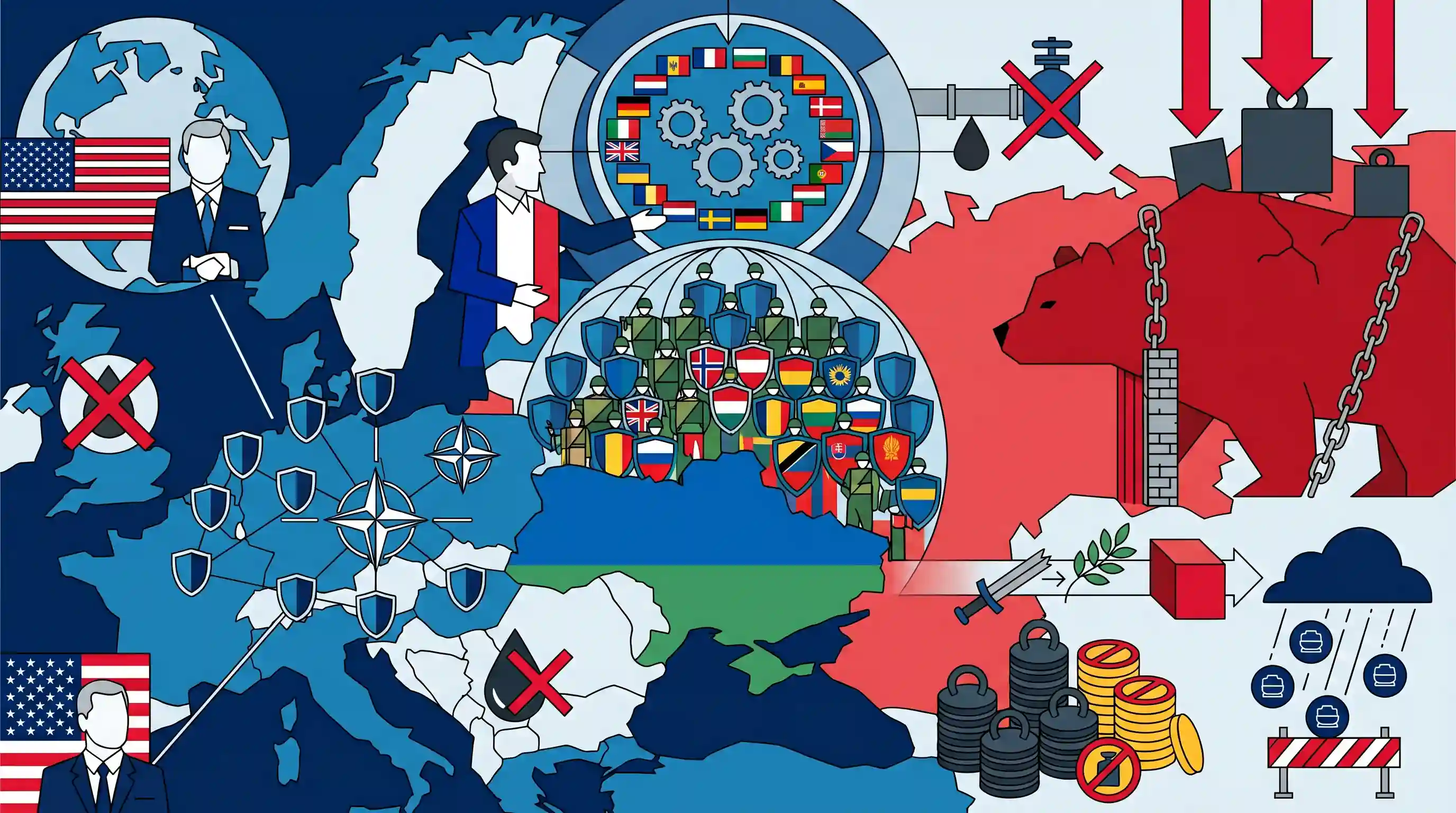
French President Emmanuel Macron announced that 26 allied nations have committed to deploying troops as a 'reassurance force' in Ukraine once fighting ceases, aiming to guarantee the country's long-term security against future Russian aggression. Coordinated by a 35-nation 'coalition of the willing', the plan has received preliminary backing from the United States, with talks underway for security guarantees mirroring NATO's collective defence mandate. Concurrently, US President Donald Trump and European leaders are pushing for heightened economic pressure on Russia, including halting European purchases of Russian oil and gas, and threatening increased sanctions if Moscow obstructs diplomatic peace efforts. The developments reflect a concerted effort by Western allies to establish a robust post-conflict security architecture in Eastern Europe.
Key Points
- French President Emmanuel Macron announced that 26 nations from a 35-country 'coalition of the willing' have pledged to deploy a 'reassurance force' to Ukraine after the conflict ends.
- The force aims to maintain a land, sea, or air presence in Ukraine to guarantee its long-term security and prevent new major aggression, without waging war against Russia.
- The US has shown willingness to participate, potentially providing security guarantees resembling NATO's collective defence mandate, though exact details are unfinalised.
- US President Donald Trump urged Europe to halt purchases of Russian oil and gas to apply economic pressure, and also urged pressure on China for indirectly funding Russia's war efforts.
- European leaders, including German Chancellor Friedrich Merz, have indicated that sanctions against Russia will increase if Moscow delays a diplomatic resolution and ceasefire.
- NATO Secretary-General Mark Rutte stressed the necessity of a broad coalition to deter any further military action by Moscow against other European nations.
Important Terms
Coalition of the willing

An ad hoc 35-nation group, co-chaired by France and the UK, providing long-term military support and post-conflict security guarantees to Ukraine outside formal NATO structures.
UPSC context
GS Paper 2 (International Relations); tests understanding of ad hoc alliances vs. formal treaties in global security architecture.
NATO collective defence mandate
The principle enshrined in NATO's Article 5, stating an attack against one member is an attack against all, requiring collective response including potential armed force.
UPSC context
GS Paper 2 (International Relations); fundamental concept for analyzing regional stability and international security obligations.
Reassurance force
A 26-nation multinational military presence pledged to deploy post-ceasefire in Ukraine to deter future aggression and provide strategic signaling without active frontline combat.
UPSC context
GS Paper 2 (Global Security); relevant for post-conflict stabilization models and peacekeeping mechanisms.
NATO
An intergovernmental military alliance of 32 member states (as of 2026) established by the 1949 Washington Treaty to ensure collective security in the North Atlantic area.
UPSC context
GS Paper 2 (International Relations); essential for discussing European security, Russia-West relations, and multilateral organizations.
Security guarantees
Formal bilateral or multilateral commitments (such as "Article 5-like" protections) provided to a non-member state to ensure its defense against future aggression.
UPSC context
GS Paper 2 (Bilateral Agreements); tests knowledge of diplomacy used to bypass formal alliance barriers.
European Union
A political and economic union of European countries that coordinates security policy and implements economic sanctions (e.g., oil and gas embargoes) in international crises.
UPSC context
GS Paper 2 (International Institutions); focuses on its role in global governance and economic diplomacy.
Prelims Trap
"The post-conflict reassurance force in Ukraine will operate under NATO's formal Article 5 collective defence mandate."
Aspirants often confuse Western military support for Ukraine with formal NATO operations. This force is an ad-hoc coalition, operating specifically because NATO cannot extend Article 5 to a non-member.
Static Concepts Connected
What distinguishes NATO's Article 5 from an ad-hoc 'Coalition of the Willing'?
- Article 5: Mandates strict collective defence among formal treaty members; an armed attack against one member is legally considered an attack against all.
- Ad-hoc Coalitions: Flexible, issue-specific groups of nations bypassing formal treaties to act militarily or strategically, often deployed when UN or NATO consensus fails.
- Non-member Limits: NATO's formal collective defence umbrella strictly does not cover non-members like Ukraine, necessitating these alternative, non-treaty security guarantees.
How do 'secondary sanctions' function in modern economic warfare?
- Mechanism: They penalize third-party countries or corporate entities for doing business with a sanctioned nation, aiming to comprehensively isolate the target.
- Extraterritorial Leverage: Heavily utilized by the US due to the dollar's dominance, effectively forcing foreign entities to choose between the US financial system and the sanctioned state.
- Impact on India: Creates friction for nations pursuing strategic autonomy. For India, secondary sanctions threaten energy security strategies (like buying Russian crude) and defense procurement (CAATSA).
Cross-Topic Patterns
Minilateralism over UN/NATO Consensus
The 35-nation coalition mirrors AUKUS and the Quad, highlighting a definitive global shift away from veto-paralyzed multilateral institutions towards agile, purpose-driven security alignments.
Energy Decoupling & India's Import Strategy
US demands for Europe to halt Russian oil purchases foreshadow tighter global supply constraints, directly impacting India's strategy of utilizing discounted Russian crude to manage its Current Account Deficit.

2026 Prelims may test the distinction between formal NATO Article 5 obligations and ad-hoc 'coalitions of the willing' security guarantees.
Linked PYQs · 4
Linked PYQs · 4
- 2023MainsGS2
‘The expansion and strengthening of NATO and a stronger US-Europe strategic partnership works well for India.’ What is your opinion about this statement ? Give reasons and examples to support your answer.
- 2025MainsGS2
"The reform process in the United Nations remains unresolved, because of the delicate imbalance of East and West and entanglement of the USA vs. Russo-Chinese alliance.” Examine and critically evaluate the East-West policy confrontations in this regard.
- 2025MainsGS2
"Energy security constitutes the dominant kingpin of India's foreign policy, and is linked with India's overarching influence in Middle Eastern countries.” How would you integrate energy security with India's foreign policy trajectories in the coming years?
- 2017MainsGS2
The question of India's Energy Security constitutes the most important part of India's economic progress. Analyze India's energy policy cooperation with West Asian countries.
