Uttar Pradesh Assembly Monsoon Session Agenda and Opposition Strategy
Source:theprint ↗
Why It Matters
This article highlights the functioning of the state legislature, the presentation of supplementary budgets, and key socio-political issues in UP such as primary education policy and governance of cultural sites. These topics form a crucial part of the UPPSC Prelims syllabus under Polity and UP Special Knowledge.
Summary
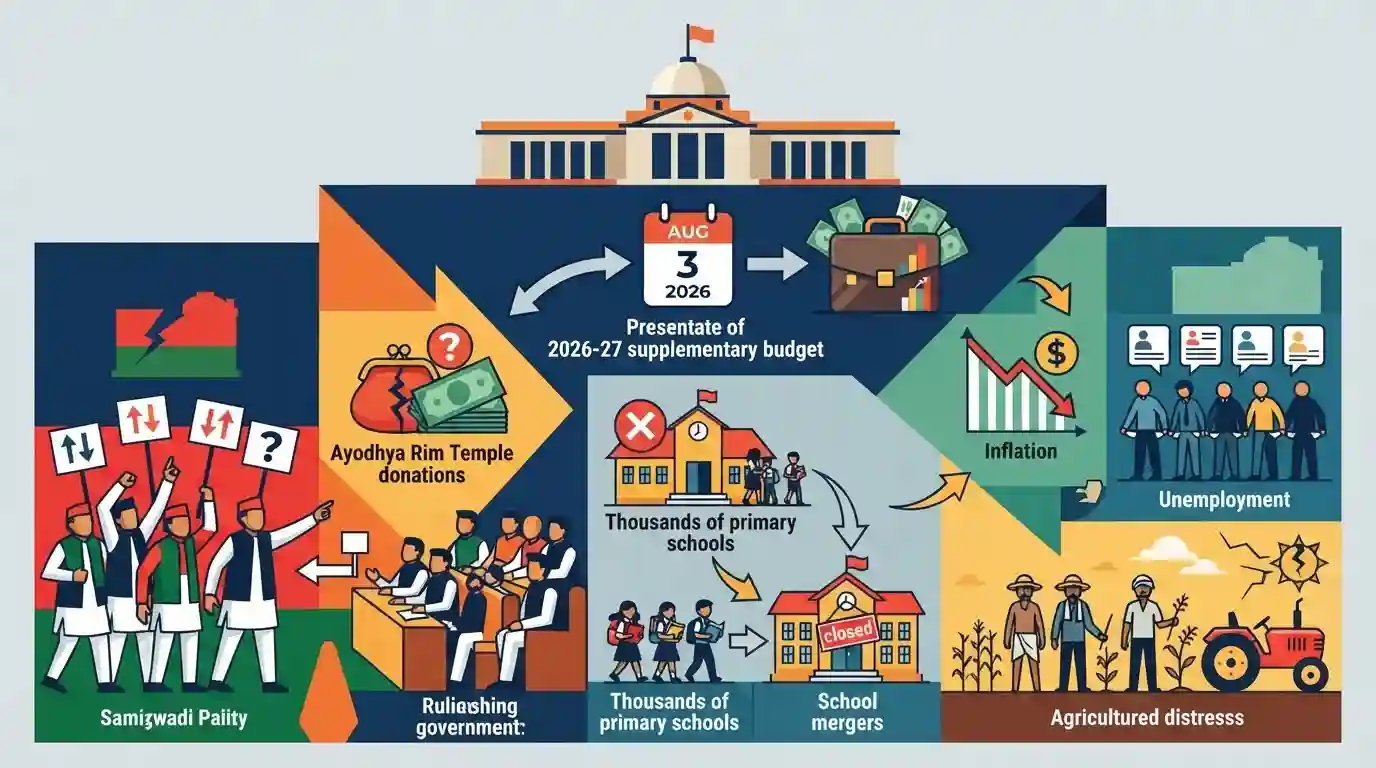
The Uttar Pradesh Legislative Assembly's monsoon session, starting August 3, 2026, will see the presentation of the 2026-27 supplementary budget and several new bills. The session is expected to be contentious, with the Samajwadi Party-led opposition planning to challenge the state government on multiple fronts. Key issues include alleged financial irregularities concerning Ayodhya Ram Temple donations, the controversial merger and closure of thousands of primary schools, and wider socio-economic problems like unemployment, inflation, and agricultural distress.
Key Points
- The Uttar Pradesh Legislative Assembly's monsoon session is scheduled to begin on August 3, 2026, primarily to introduce a supplementary budget and replace ordinances with bills.
- Leader of the Opposition Mata Prasad Pandey indicated that the Samajwadi Party will raise allegations regarding the embezzlement of donations made to the Ram Temple in Ayodhya.
- The opposition will also heavily criticize the state government for shutting down thousands of primary schools under the pretext of merging them, pointing to a weakened education infrastructure.
- Other focal points for debate will include the ongoing issues of inflation, unemployment, and farmers' grievances in the state.
Important Terms
Supplementary Budget

Additional funds granted under Article 205 of the Constitution when the original budget allocation is found insufficient or a new need arises during the financial year.
UPSC context
GS Paper 2 & 3. Tests knowledge of legislative financial control and constitutional provisions like Article 205.
State Legislative Assembly
The directly elected lower house of a state's legislature in India. It is responsible for making state laws, passing the state budget, and holding the state executive accountable.
UPSC context
GS Paper 2 (State Legislature). Tests the structure and functions of state-level democratic institutions and executive accountability.
Leader of the Opposition (LoP)
The leader of the largest opposition party in a legislative chamber. Serving as a crucial check on the ruling government, the LoP demands accountability and proposes alternative policies.
UPSC context
GS Paper 2 (Polity). Tests the functioning of parliamentary democracy and the opposition's role in maintaining checks and balances.
Primary School Consolidation
An administrative policy involving the merger of government schools with low student enrollment into nearby functional campuses, aiming to optimize resources and improve the student-teacher ratio under NEP 2020.
UPSC context
GS Paper 2 (Education). Examines the impact of education policies on accessibility, Right to Education (Article 21A), and marginalized groups.
Prelims Trap
The state legislature has statutory financial oversight over the Shri Ram Janmabhoomi Teerth Kshetra Trust.
Despite assembly debates, the Trust is an autonomous body formed via a Supreme Court mandate. It operates independently without direct government financial or administrative control.
Static Concepts Connected
What are the types of exceptional grants under Article 205?
- Supplementary Grant: Granted when the amount authorized by the Appropriation Act is found to be insufficient for a particular service in the current financial year.
- Additional Grant: Granted when a need arises for a new service not contemplated in the annual financial statement for that year.
- Excess Grant: Granted when money spent on a service exceeds the authorized amount. Demands for excess grants must be approved by the Public Accounts Committee first.
How does the Governor's ordinance-making power (Art 213) work?
- Promulgation: Issued only when the state legislature (or both houses if bicameral) is not in session, dealing with subjects under state/concurrent lists.
- Expiration: Automatically ceases to operate six weeks from the date of the state legislature's reassembly unless replaced by an Act.
- Presidential Sanction: The Governor cannot promulgate certain ordinances without instructions from the President (e.g., bills requiring prior Presidential sanction).
Cross-Topic Patterns
NEP 2020 vs Article 21A
School merger policies under the NEP 2020 raise questions about Right to Education accessibility versus state resource optimization, often debated in state assemblies and courts.
Oversight of Autonomous Trusts
Debates over the Ram Temple Trust highlight the friction between formal statutory autonomy (established via SC mandate) and informal political accountability demanded in state legislatures.

Prelims 2026 may test differences between Article 115 and 205 regarding supplementary and excess grants, linked to PAC approvals.
Linked PYQs · 3
Linked PYQs · 3
- 2021UPPSC_PRELIMSGS1
The functions of the State Public Service Commission of Uttar Pradesh can be extended by
- 2020UPPSC_PRELIMSGS1
Which of the following cities of Uttar Pradesh is/are covered under the 'Heritage City Development and Augmentation Yojana (HRIDAY)' ? 1. Varanasi 2. Mathura 3. Prayagraj 4. Ayodhya Select the correct answer from the codes given below.
- 2007UPPSC_PRELIMSGS1
High priority is being given by Uttar Pradesh Govt. to the children of which age group to provide primary education
