Global Geopolitical Conflicts and International Security Trends
Source:The Hindu ↗
Why It Matters
Provides a critical summary of the contemporary geopolitical landscape, equipping aspirants with factual grounding for GS-2 (International Relations) and GS-3 (Internal Security). Knowledge of specific conflict zones (like Donbas, Darfur, Goma) is essential for Prelims mapping questions, while broader trends of mediation and regional instability are crucial for Mains analysis.
Summary
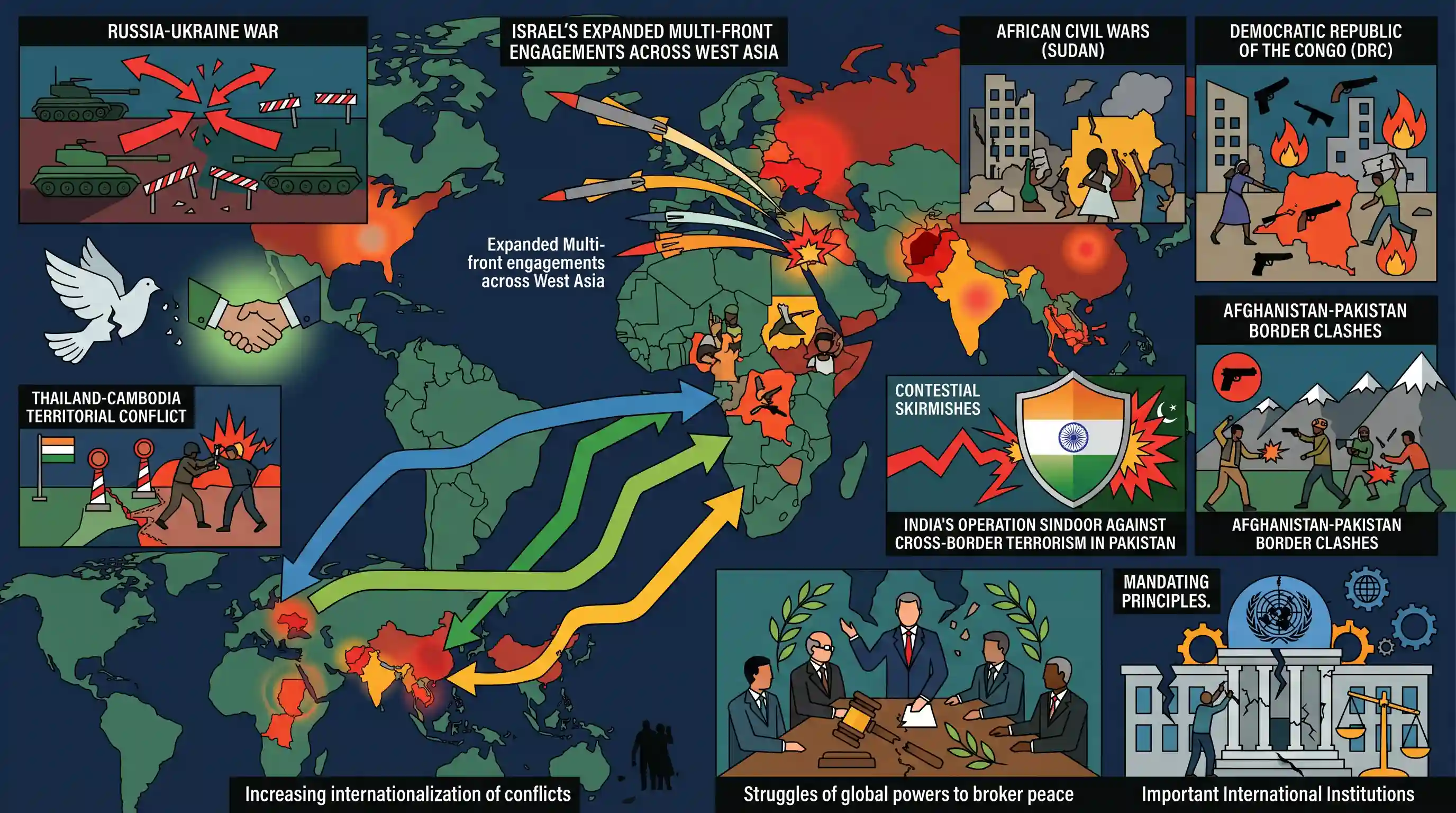
A comprehensive overview of major global conflicts in 2025, detailing the intensification and tentative peace efforts in the Russia-Ukraine war, Israel's expanded multi-front engagements across West Asia, and devastating civil wars in Sudan and the DRC. It also highlights regional disputes and border skirmishes, including the Thailand-Cambodia territorial conflict, India's Operation Sindoor against cross-border terrorism in Pakistan, and the Afghanistan-Pakistan border clashes. The year was defined by high civilian casualties, the increasing internationalization of conflicts, and the struggles of global powers to broker lasting peace agreements.
Key Points
- The year 2025 marked a significant escalation in global conflicts, with 16% of the global population exposed to unrest and over 2.4 lakh civilian deaths driven by dense urban warfare and new technology.
- The Russia-Ukraine war saw a tentative 20-point peace plan involving a demilitarized zone in Donbas and NATO Article 5-level security guarantees for Ukraine.
- Israel's conflicts expanded across West Asia, involving operations in Gaza, a 12-day conflict with Iran targeting key nuclear sites (Fordow, Natanz, Isfahan) with U.S. involvement, and a subsequent October ceasefire.
- The Sudanese civil war intensified with SAF (Saudi-backed) capturing Khartoum and RSF (UAE-backed) taking Darfur, leading to severe civilian casualties and an elusive peace proposal at the UNSC.
- In Southeast Asia, Thailand and Cambodia reached an ASEAN-brokered ceasefire over a colonial-era border dispute concerning ancient temples.
- Despite the Washington Accords, clashes continued between the DRC and Rwandan-backed M23 rebels following the latter's capture of key cities like Goma.
- India launched Operation Sindoor against terrorist infrastructure in Pakistan following the Pahalgam attack and kept the Indus Water Treaty in abeyance, while Pakistan engaged in a border conflict with Afghanistan targeting the TTP.
Important Terms
Operation Sindoor

A May 2025 Indian military operation involving precision missile and drone strikes against terrorist infrastructure in Pakistan. It signaled a shift from strategic restraint to a "deterrence by punishment" doctrine.
UPSC context
GS-3 Security/GS-2 IR. Tests understanding of India’s response to cross-border terrorism and the "non-contact war" doctrine.
Washington Accords for Peace and Prosperity
A 2025 US-mediated peace treaty between the Democratic Republic of the Congo (DRC) and Rwanda. It mandates Rwandan troop withdrawal and established a Regional Economic Integration Framework.
UPSC context
GS-2 IR. Relevant for questions on African security, Great Lakes region conflicts, and US-led mediation efforts.
NATO Article 5
The collective defense clause of the North Atlantic Treaty. In late 2025, it served as the model for bilateral security guarantees proposed for Ukraine to end the Russia-Ukraine war.
UPSC context
GS-2 IR. Essential for analyzing global security architectures and post-war security guarantees for non-NATO allies.
Indus Water Treaty
A 1960 World Bank-brokered water-sharing agreement between India and Pakistan. During the 2025 crisis, India temporarily suspended its implementation as a non-kinetic punitive measure against state-sponsored terrorism.
UPSC context
GS-2 IR. Fundamental for water diplomacy and bilateral relations; tests knowledge of leveraging international treaties for national security.
Rapid Support Forces (RSF)
A Sudanese paramilitary group led by General Dagalo (Hemedti). In 2025, its civil war against the Sudanese Armed Forces (SAF) caused one of the world's worst humanitarian crises.
UPSC context
GS-2 IR. Relevant for conflicts in the Global South, humanitarian interventions, and the role of non-state paramilitary actors.
United Nations Security Council (UNSC)
The primary UN organ for international peace. In 2025, it facilitated DRC-Rwanda mediation through Resolution 2773 and managed global responses to multi-front conflicts in West Asia and Sudan.
UPSC context
GS-2 International Institutions. Essential for discussing the effectiveness and reform of global governance bodies in resolving modern conflicts.
Prelims Trap
The Indus Water Treaty was brokered by the UN and can be unilaterally abrogated by India.
The IWT was brokered by the World Bank, not the UN. Furthermore, it lacks a unilateral exit clause, making its "abeyance" a legal gray area.
Static Concepts Connected
What is the river allocation and dispute mechanism under the Indus Water Treaty (1960)?
- River Allocation: Eastern rivers (Ravi, Beas, Sutlej) to India; Western rivers (Indus, Jhelum, Chenab) to Pakistan with limited run-of-the-river use for India.
- Dispute Mechanism: A graded 3-step process: Permanent Indus Commission, Neutral Expert (appointed by World Bank), and Court of Arbitration.
- World Bank's Role: Brokered by the World Bank in 1960, which acts as a signatory for specified administrative purposes, not as a guarantor of the treaty.
What are the key geographical contexts of recent global conflicts?
- Sudan's Geography: Civil war spans Khartoum (capital at the White and Blue Nile confluence) and Darfur (western region), driven by power struggles over territory and resources.
- DRC's Resources: Eastern Congo, including cities like Goma near the Rwandan border, is plagued by M23 rebels destabilizing the mineral-rich (cobalt/coltan) Congo Basin.
- Preah Vihear Temple: An ancient Hindu temple and UNESCO site on the Dangrek Mountains, at the center of a colonial-era border dispute between Cambodia and Thailand.
Cross-Topic Patterns
DRC conflict hits EV mineral supply chains
The M23 rebel conflict in DRC's mineral-rich Congo Basin directly threatens global supply chains for cobalt and coltan, essential for India's EV and critical technology manufacturing push.
Transboundary rivers & counter-terrorism leverage
Keeping the Indus Water Treaty in "abeyance" connects riparian geopolitics to counter-terrorism, mirroring a global trend of weaponizing transboundary resource sharing as diplomatic and strategic leverage.

Prelims 2026 will likely feature a match-the-pairs question linking conflict zones (Darfur, Goma, Preah Vihear, Natanz) to their countries.
Linked PYQs · 4
Linked PYQs · 4
- 2023PrelimsGS1
Consider the following pairs: Area of conflict mentioned in news Country where it is located 1. Donbas : Syria 2. Kachin : Ethiopia 3. Tigray : North Yemen How many of the above pairs are correctly matched?
- 2023PrelimsGS1
In the recent years Chad, Guinea, Mali and Sudan caught the international attention for which one of the following reasons common to all of them?
- 2024MainsGS3
India has a long and troubled border with China and Pakistan fraught with contentious issues. Examine the conflicting issues and security challenges along the border. Also give out the development being undertaken in these areas under the Border Area Development Programme (BADP) and Border Infrastructure and Management (BIM) Scheme.
- 2018MainsGS2
“India’s relations with Israel have, of late, acquired a depth and diversity, which cannot be rolled back.” Discuss.
