Starlink entry into India via Maharashtra connectivity deal
Source:Indian Express ↗
Why It Matters
Starlink's entry into India via Maharashtra is a major milestone for bringing high-speed broadband to remote and underserved areas using LEO satellite constellations. It highlights the practical application of space technology in addressing the rural-urban digital divide, improving administrative efficiency, and enhancing disaster response capabilities.
Summary
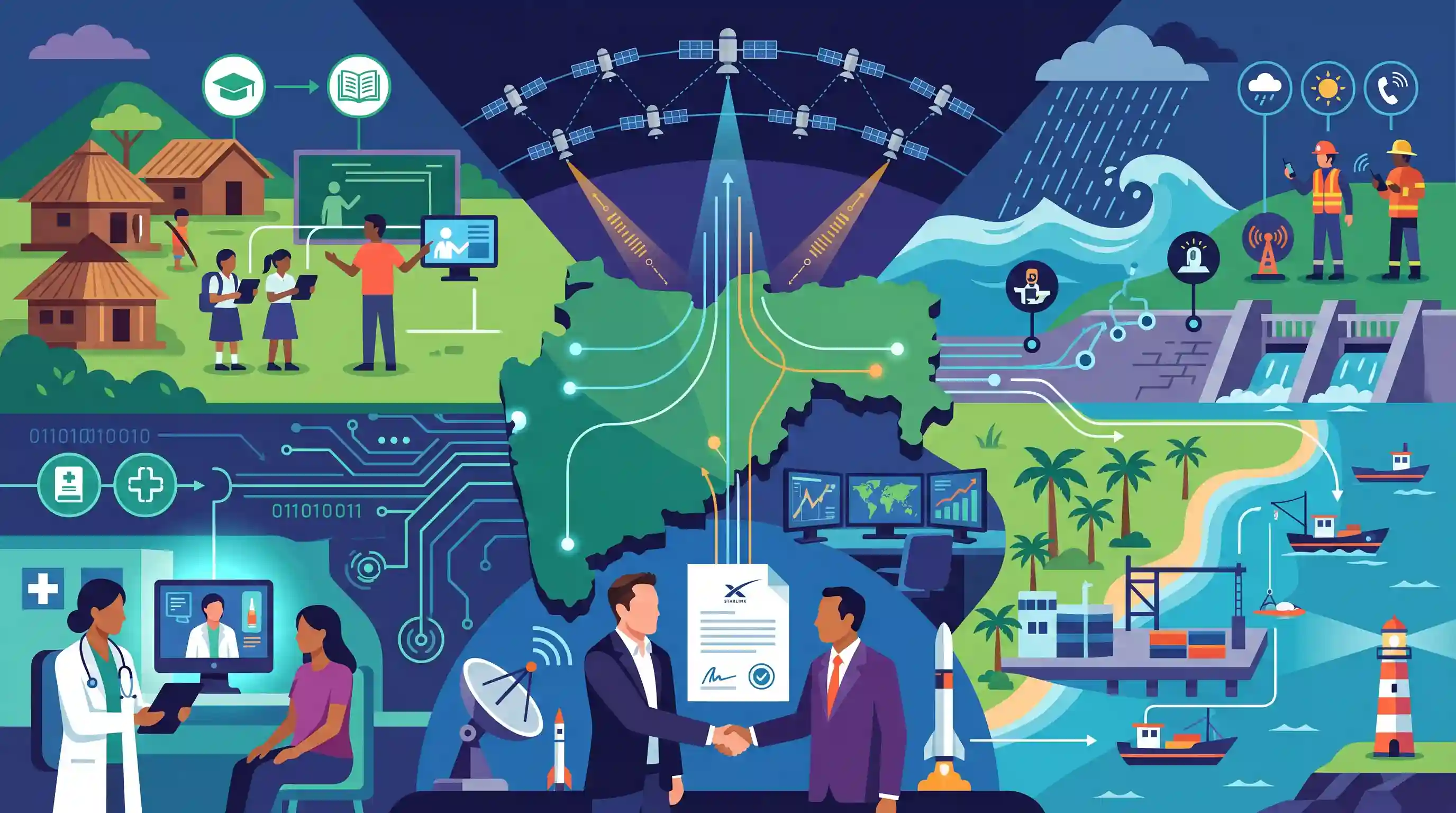
Elon Musk-owned Starlink has signed a Letter of Intent (LOI) with the Maharashtra government to provide satellite-based internet connectivity in the state. This marks the first such collaboration by an Indian state with the satellite internet provider. The initiative focuses on bridging the digital divide by delivering high-speed internet to remote, tribal, and underserved areas, including schools, health centers, and critical public infrastructure. A 90-day pilot rollout will be conducted, integrating satellite communication with Maharashtra's disaster resilience and coastal development programs. This development highlights the growing role of low-Earth orbit (LEO) satellite constellations in socio-economic development and e-governance.
Key Points
- The Maharashtra government signed a Letter of Intent (LOI) with Elon Musk's Starlink to provide satellite internet to remote regions.
- Maharashtra is the first Indian state to formally collaborate with Starlink for internet connectivity.
- The project aims to bridge the digital divide by connecting underserved villages, tribal areas, schools, and health centers.
- A 90-day pilot rollout is planned, which will integrate satellite internet with state disaster resilience and coastal development programs.
Important Terms
Starlink

A satellite internet constellation operated by SpaceX, using a network of low-Earth orbit (LEO) satellites to provide high-speed, low-latency broadband internet globally, particularly in remote areas.
UPSC context
GS Paper III (Space Technology); relevant for discussions on digital infrastructure and the role of private players in the space sector.
Low-Earth Orbit (LEO)
An orbit ranging from 160 to 2,000 km above Earth. Satellites here offer lower latency and faster data transmission than traditional geostationary satellites, crucial for real-time internet services.
UPSC context
GS Paper III (Science & Technology); tests understanding of orbital mechanics and its applications in modern communication.
Digital Divide
The socio-economic gap between individuals, households, or geographic areas that have access to modern information and communication technology (ICT) and those that do not.
UPSC context
GS Paper II (Governance/Social Justice) and GS Paper III (Economy); core topic for inclusive growth and digital literacy.
e-Governance
The application of information and communication technology (ICT) for delivering government services, exchange of information, and integration of various stand-alone systems between government-to-citizen (G2C) and government-to-business (G2B).
UPSC context
GS Paper II (Governance); essential for evaluating administrative efficiency and last-mile service delivery.
Indian Space Policy 2023
A comprehensive framework that allows non-governmental entities (NGEs) to engage in end-to-end space activities, including satellite operations and launches, while delineating the roles of ISRO, IN-SPACe, and NSIL.
UPSC context
GS Paper III (Infrastructure/Space); critical for understanding the liberalization and regulation of India's space economy.
IN-SPACe
An autonomous nodal agency under the Department of Space that acts as a single-window regulator to promote, authorize, and supervise space activities by non-governmental entities in India.
UPSC context
GS Paper III (Science & Tech/Institutional Frameworks); tests knowledge of regulatory bodies governing private sector participation in space.
GMPCS License
A mandatory authorization issued by the Department of Telecommunications (DoT) for companies to provide voice and data services via satellite within Indian territory.
UPSC context
GS Paper III (Telecommunications/Regulation); relevant for policies on national security and spectrum allocation.
Aspirational Districts
A NITI Aayog initiative launched in 2018 to quickly and effectively transform 112 of India’s most underdeveloped districts through convergence, collaboration, and competition.
UPSC context
GS Paper II (Government Policies/Governance); focuses on regional balanced development and targeted social sector interventions.
Prelims Trap
"Under the Telecommunications Act 2023, spectrum for satellite internet must be allocated exclusively through competitive auctions."
The Telecommunications Act 2023 specifically mandates "administrative allocation" for satellite communication spectrum (placed in the First Schedule), bypassing competitive auctions.
Static Concepts Connected
How does Low Earth Orbit (LEO) internet differ from Geostationary (GEO)?
- Altitude: LEO satellites orbit much closer to Earth (500-2,000 km) compared to GEO satellites stationed at ~35,786 km.
- Latency: Closer proximity gives LEO significantly lower signal delay (20-40ms), crucial for real-time applications like video calls.
- Coverage network: LEO requires a "constellation" of thousands of moving satellites for global coverage, whereas a few fixed GEO satellites can cover most of the Earth.
How does India legally fund rural telecom and internet connectivity?
- Funding source: A levy on telecom operators' adjusted gross revenue (AGR) historically funded the Universal Service Obligation Fund (USOF) to connect rural areas.
- Digital Bharat Nidhi: The Telecommunications Act 2023 renames USOF to "Digital Bharat Nidhi" and broadens its mandate to include telecom R&D alongside rural connectivity.
- Terrestrial focus: It funds flagship terrestrial projects like BharatNet, which aims to connect all Gram Panchayats via optical fiber.
Cross-Topic Patterns
Space Tech + Disaster Resilience
Terrestrial networks often collapse during cyclones and floods. Integrating LEO constellations ensures fail-safe, resilient communication for early warnings and post-disaster rescue, aligning directly with Sendai Framework disaster resilience goals.
Digital Divide + e-Governance Last Mile
Providing fiber-optics to harsh terrains faces Right-of-Way (RoW) and logistical hurdles. Space-based internet leapfrogs these barriers, enabling robust delivery of telemedicine, PM-eVIDYA, and targeted e-Governance to tribal belts.

Expect a Prelims statement comparing LEO vs GEO latency, paired with the "administrative allocation" clause of the Telecom Act 2023.
Linked PYQs · 4
Linked PYQs · 4
- 2016MainsGS3
Discuss India's achievements in the field of Space Science and Technology. How the application of this technology has helped India in its socio-economic development?
- 2021MainsGS2
Has digital illiteracy, particularly in rural areas, coupled with lack of Information and Communication Technology (ICT) accessibility hindered socio-economic development? Examine with justification.
- 2020MainsGS2
The emergence of Fourth Industrial Revolution (Digital Revolution) has initiated e-Governance as an integral part of government". Discuss.
- 2011PrelimsGS1
Satellites used for telecommunication relay are kept in a geostationary orbit. A satellite is said to be in such an orbit when: 1. The orbit is geosynchronous. 2. The orbit is circular. 3. The orbit lies in the plane of the Earth's equator. 4. The orbit is at an altitude of 22,236 km.
