SpaceX and xAI Merger Targets Space Based AI Data Centers
Source:The Hindu ↗
Why It Matters
Highlights the convergence of AI and Space technology to solve Earth's energy constraints. Raises critical governance issues regarding the commercialization and monopolization of Low Earth Orbit (LEO) by private entities, space debris management, and extreme technological hurdles like cosmic radiation and vacuum heat dissipation. Highly relevant for GS3 Science & Technology and energy security.
Summary
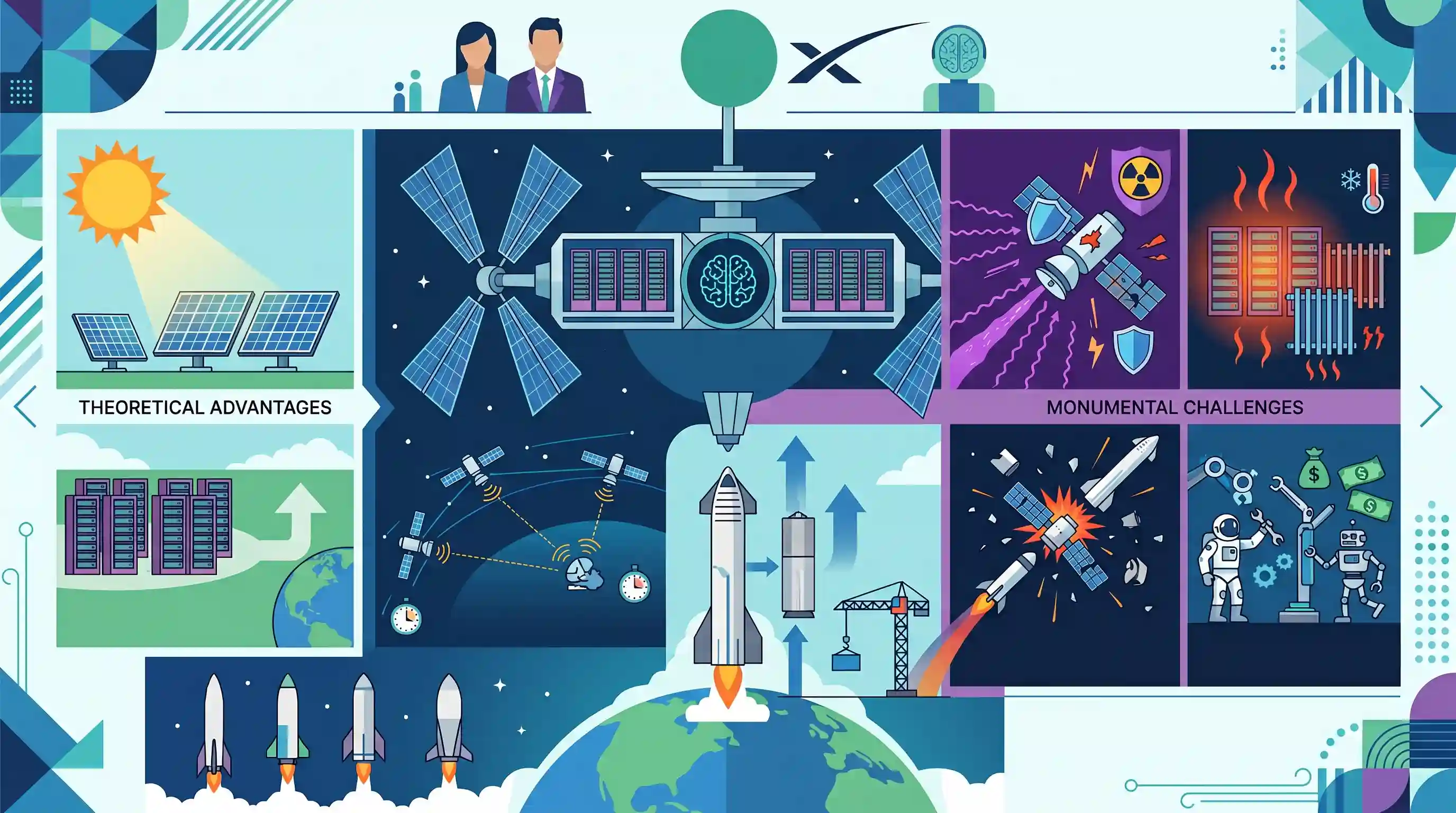
Elon Musk's companies, SpaceX and xAI, are pursuing a futuristic vision to deploy AI data centers in outer space to support massive AI models. While leveraging space offers theoretical advantages like 24/7 access to solar energy and vast physical room to bypass terrestrial power grid limitations, the challenges are monumental. These include navigating cosmic radiation, dissipating heat in a vacuum, ensuring high-speed low-latency satellite internet (via Starlink), launching colossal infrastructure (via Starship), mitigating space debris risks, and addressing astronomical orbital maintenance costs. This signals a broader trend, with tech giants like Google and Blue Origin also exploring orbital computing environments.
Key Points
- SpaceX and xAI are planning to deploy AI data centers in outer space to circumvent Earth's power grid limitations and support massive AI models like Grok.
- Theoretical benefits of space-based data centers include uninterrupted solar power and nearly limitless physical room to expand computational infrastructure.
- Major technological hurdles include the difficulty of dissipating heat in a vacuum, shielding delicate processors from cosmic radiation, and managing space debris risks.
- The system will require a robust, extremely low-latency communication network to transfer massive datasets, leveraging SpaceX's Starlink constellation.
- The logistics of launching heavy data center modules depend on the successful scaling of SpaceX's super-heavy lift vehicle, Starship.
- The initiative reflects a broader tech industry interest in orbital computing, as seen in Google's 'Project Suncatcher' and Blue Origin's space cloud initiatives.
Important Terms
Project Suncatcher

Google’s research "moonshot" to scale machine learning in space. It uses solar-powered satellite constellations carrying Tensor Processing Units (TPUs) to process AI workloads, bypassing Earth’s terrestrial power and cooling constraints.
UPSC context
GS Paper III (Science & Technology); highlights frontier technologies, sustainable AI infrastructure, and international competition in the orbital economy.
Orbital Computing
The hosting of data centers and processors in outer space. This architecture leverages near-constant solar energy and vacuum cooling to support power-intensive AI models without straining terrestrial electricity grids or land resources.
UPSC context
GS Paper III (Science & Technology); tests awareness of emerging digital infrastructure and sustainable solutions to AI’s massive energy consumption.
Kessler Syndrome
A phenomenon where space debris in low-Earth orbit reaches a density that triggers a self-sustaining cascade of collisions. This makes orbits unusable, posing a major risk to large satellite constellations.
UPSC context
GS Paper III (Space Technology); critical for topics on space sustainability, debris management, and international space treaties.
SpaceX
An American private aerospace company merging with xAI to build orbital data centers. It utilizes its heavy-lift Starship rocket to deploy massive satellite infrastructure at significantly lower costs.
UPSC context
GS Paper III (Science & Technology); represents the shift toward private-sector-led space exploration and innovative heavy-lift logistics.
xAI
An artificial intelligence startup founded by Elon Musk. Its merger with SpaceX aims to integrate generative AI models with satellite infrastructure, seeking a competitive edge through space-based computing resources.
UPSC context
GS Paper III (S&T - Artificial Intelligence); examines corporate consolidation and the strategic convergence of AI and space technologies.
Blue Origin
A private aerospace firm founded by Jeff Bezos. It is developing satellite constellations and orbital systems to support global communications and futuristic space-based computing environments, competing with SpaceX.
UPSC context
GS Paper III (Space Tech); tests knowledge of key global commercial space players and their impact on orbital infrastructure development.
Prelims Trap
Space-based data centers easily dissipate heat because the ambient temperature of outer space is extremely cold.
Space is a vacuum, lacking a medium for heat conduction or convection. Hardware must rely entirely on thermal radiation using massive deployable radiators to dissipate heat, making cooling extremely difficult.
Static Concepts Connected
What are the characteristics of a Sun-Synchronous Orbit (SSO)?
- Altitude & Path: It is a specific type of nearly polar Low Earth Orbit (LEO), typically situated at an altitude of 600 to 800 kilometers.
- Constant Illumination: The satellite passes over any given point on Earth at the same local solar time, ensuring consistent lighting and continuous sunlight exposure for solar panels.
What are Single Event Upsets (SEUs) in space electronics?
- Radiation trigger: They are anomalies caused by high-energy particles, such as cosmic rays or solar flares, striking sensitive micro-electronic circuits in space.
- Bit-flip effect: The radiation strike alters the state of a memory node (flipping a bit from 0 to 1 or vice versa), causing temporary data corruption or system malfunction.
Cross-Topic Patterns
Space infrastructure as ecological relief
Shifting computing to orbit eliminates the immense freshwater consumption and power grid strain required to cool terrestrial AI server farms, linking space tech directly to climate mitigation and resource conservation.
Mega-constellations and Kessler Syndrome
Deploying heavy data center modules in Low Earth Orbit exacerbates congestion risks, increasing the probability of cascading collisions (Kessler Syndrome) and highlighting gaps in global space governance treaties.

Expect a Prelims science statement testing the physics of spacecraft heat dissipation (radiation vs convection) or Single Event Upsets.
Linked PYQs · 3
Linked PYQs · 3
- 2023MainsGS3
Introduce the concept of Artificial Intelligence (AI). How does Al help clinical diagnosis? Do you perceive any threat to privacy of the individual in the use of Al in healthcare?
- 2015MainsGS3
Discuss the advantages and security implications of cloud hosting of servers vis-a-vis in-house machine-based hosting for government businesses.
- 2016MainsGS3
Discuss India's achievements in the field of Space Science and Technology. How the application of this technology has helped India in its socio-economic development?
