OpenAI Trial Focuses on Non-Profit Mission and Governance
Source:Indian Express ↗
Why It Matters
The case serves as a perfect real-world example of the ethical and governance dilemmas surrounding Artificial Intelligence. It highlights the tension between the massive capital required to develop cutting-edge technology and the foundational ethical obligations of non-profits, relevant for GS2 (Governance), GS3 (S&T), and GS4 (Corporate Ethics).
Summary
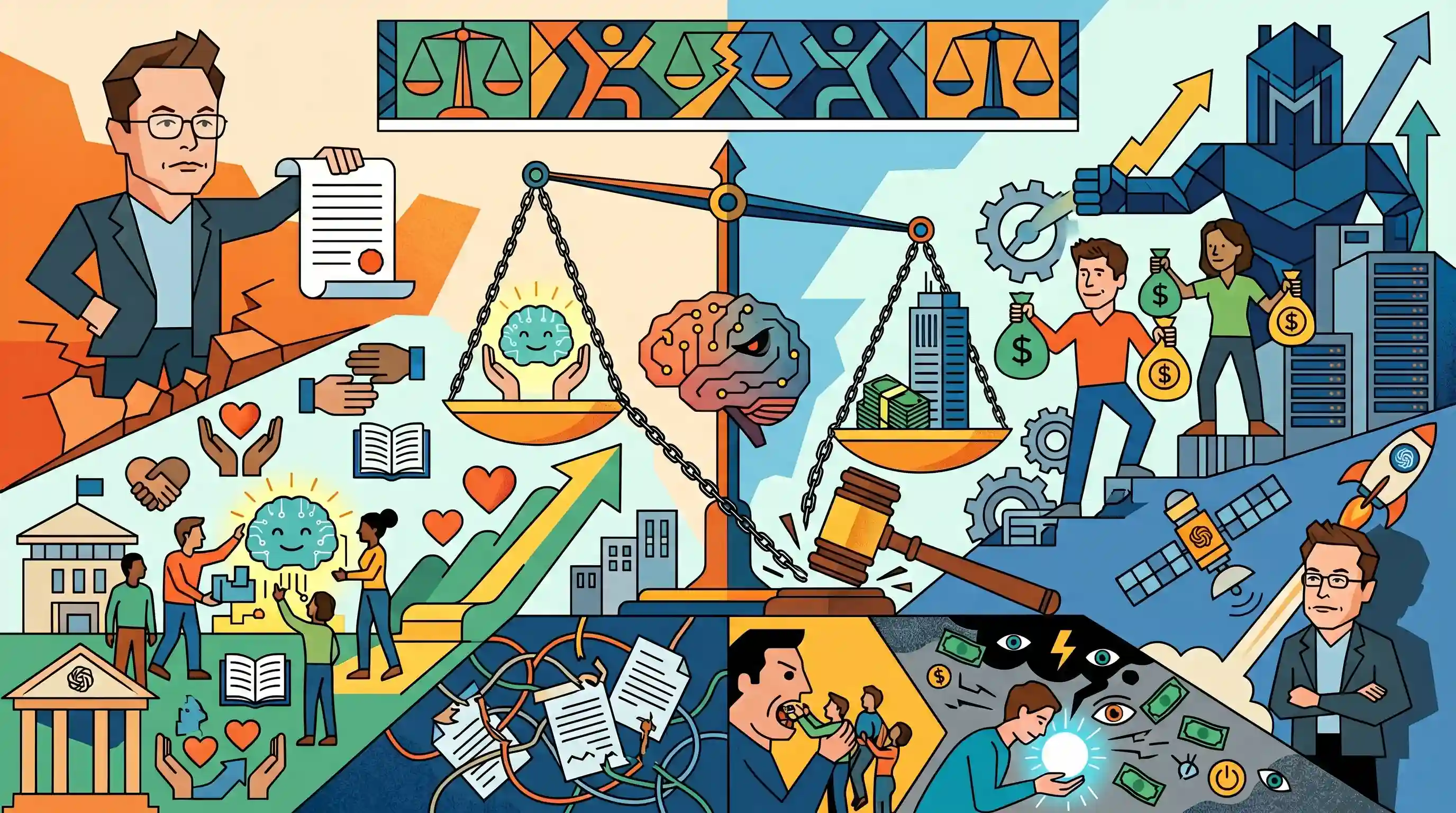
The high-profile trial between Elon Musk and OpenAI centers on whether the AI giant illegally abandoned its original non-profit mission. Musk alleges that OpenAI, under CEO Sam Altman, breached its charitable trust by transitioning to a for-profit model (Public Benefit Corporation) to enrich itself and its partner Microsoft, instead of developing Artificial General Intelligence (AGI) safely for humanity. OpenAI defends its structural changes as necessary to raise the billions required for AI development, while accusing Musk of hypocrisy and using the lawsuit to boost his competing AI firm, xAI. The trial's outcome will have major implications for corporate governance in the tech sector, the regulation of AI monopolies, and the balance between ethical obligations and profitability.
Key Points
- Elon Musk's lawsuit against OpenAI and its leadership alleges a breach of charitable trust, claiming the company abandoned its founding non-profit mission to develop Artificial General Intelligence (AGI) for humanity's benefit.
- Musk accuses OpenAI of unjust enrichment, arguing it shifted to a for-profit model to enrich itself and its major partner, Microsoft.
- Musk is seeking $150 billion in damages to be directed to OpenAI's charitable arm and the reversal of its recent transition to a Public Benefit Corporation (PBC).
- OpenAI counters that Musk previously supported a for-profit transition provided he had absolute control, and alleges the lawsuit is a tactic to favor his rival AI startup, xAI (Grok).
- The case underscores crucial issues regarding AI ethics, corporate governance, the capital-intensive nature of AI research, and the legal obligations of public charitable trusts transitioning into for-profit entities.
Important Terms
Artificial General Intelligence (AGI)

A theoretical form of AI where machines possess the ability to understand, learn, and perform any intellectual task a human can, moving beyond task-specific "narrow AI."
UPSC context
GS Paper 3 (S&T); tests awareness of disruptive technologies and their long-term societal and security impacts.
Corporate Governance
The system of rules, practices, and processes by which a company is directed, ensuring accountability, transparency, and the balancing of interests among all stakeholders.
UPSC context
GS Paper 4 (Ethics) and GS Paper 2 (Governance); central to administrative ethics and business accountability.
Public Benefit Corporation (PBC)
A for-profit legal entity obligated to pursue a public benefit and consider the impact of its decisions on society and the environment alongside shareholder returns.
UPSC context
GS Paper 4 (Business Ethics); relevant for debates on Corporate Social Responsibility (CSR) and mission-driven business models.
OpenAI
A leading AI research organization that transitioned from a non-profit mission to a commercial model, now at the center of global debates on AI safety and monopoly.
UPSC context
GS Paper 3 (IT & S&T); a case study for the evolution of private sector influence in global tech.
Ethics in AI
The branch of ethics examining the moral, safety, and transparency implications of AI, focusing on preventing harm to humanity and ensuring equitable access.
UPSC context
GS Paper 4 (Ethics); vital for evaluating the regulation of emerging technologies and human-centric development.
Microsoft
A global technology giant whose multi-billion dollar partnership with OpenAI is a primary focus of the trial regarding the commercialization of AI research.
UPSC context
GS Paper 3 (Economy); concerns tech monopolies, foreign investment dynamics, and global innovation dominance.
xAI
Elon Musk's AI company, often cited by OpenAI as the competitive motivation behind Musk's lawsuit, highlighting potential conflicts of interest in the tech sector.
UPSC context
GS Paper 4 (Ethics); serves as an example for discussing professional integrity and competitive conflict of interest.
Prelims Trap
"A Public Benefit Corporation is a legally recognized non-profit structure."
A PBC is actually a for-profit entity that legally mandates balancing shareholder financial returns with a defined positive societal impact.
Static Concepts Connected
What is the difference between Narrow AI and AGI?
- Narrow AI: Operates within pre-defined parameters for specific tasks like text generation or image recognition. It lacks adaptable, generalized cognitive understanding.
- AGI (Strong AI): A theoretical paradigm where a machine can understand, learn, and perform any intellectual task across domains at or beyond human capabilities.
How does a Section 8 Company function in India?
- Core Purpose: Established under the Companies Act, 2013, specifically to promote arts, commerce, charity, education, or social welfare.
- Dividend Prohibition: Profits cannot be distributed to shareholders as dividends; they must be reinvested solely into promoting the company's stated objectives.
- Non-Profit Nature: Unlike US Public Benefit Corporations which can balance shareholder profit and public purpose, Section 8 entities are strictly non-profit.
Cross-Topic Patterns
AI Ethics + Corporate Governance
The OpenAI board crisis illustrates how dual-structure governance models often fail to balance fiduciary duties to investors with ethical public safety commitments.
Compute Capital + Anti-trust
The billions needed to train AGI models force startups into alliances with Big Tech, accelerating digital monopolies and prompting scrutiny from regulators like the CCI.

GS-3 Mains: Expect questions analyzing how massive compute costs of AGI naturally lead to tech monopolies and ethical compromises.
Linked PYQs · 3
Linked PYQs · 3
- 2023MainsGS3
Introduce the concept of Artificial Intelligence (AI). How does Al help clinical diagnosis? Do you perceive any threat to privacy of the individual in the use of Al in healthcare?
- 2024MainsGS4
ABC Incorporated is a technological company named which is the second largest worldwide, situated in the Third World. You are the Chief Executive Officer and the majority shareholder of this company. The fast technological improvements have raised worries among environmental activists, regulatory authorities, and the general public over the sustainability of this scenario. You confront substantial issues about the business's environmental footprint. In 2023, your organization had a significant increase of 48% in greenhouse gas emissions compared to the levels recorded in 2019. The significant rise in energy consumption is mainly due to the surging energy requirements of your data centers, fuelled by the exponential expansion of Artificial Intelligence (AI). AI-powered services need much more computational resources and electrical energy compared to conventional online activities, notwithstanding their notable gains. The technology's proliferation has led to a growing concern over the environmental repercussions, resulting in an increase in warnings. Al models, especially those used in extensive machine learning and data processing, exhibit much greater energy consumption than conventional computer tasks, with an exponential increase. Although there is already a commitment and goal to achieve net zero emissions by 2030, the challenge of lowering emissions seems overwhelming as the integration of Al continues to increase. To achieve this goal, substantial investments in renewable energy use would be necessary. The difficulty is exacerbated by the competitive environment of the technology sector, where rapid innovation is essential for preserving market standing and shareholders' worth. To achieve a balance between innovation, profitability and sustainability, a strategic move is necessary that is in line with both, business objectives and ethical obligations. (a) What is your immediate response to the challenges posed in the above case? (b) Discuss the ethical issues involved in the above case. (c) Your company has been identified to be penalized by technological giants. What logical and ethical arguments will you put forth to convince about its necessity? (d) Being a conscience being, what measures would you adopt to maintain balance between AI innovation and environmental footprint?
- 2024MainsGS2
Public charitable trusts have the potential to make India's development more inclusive as they relate to certain vital public issues. Comment.
