SpaceX Starship Reusable Launch Vehicle and Deep Space Exploration
Source:Indian Express ↗
આ શા માટે મહત્વનું છે
The development of fully reusable, heavy-lift rockets like Starship significantly reduces the cost of accessing space and deploying mega-constellations. This is highly relevant for UPSC aspirants as it demonstrates the cutting-edge of space technology, the increasing dominance of private sector players in space exploration, and the technological architecture underpinning global initiatives like the Artemis Accords, which India has signed.
સારાંશ
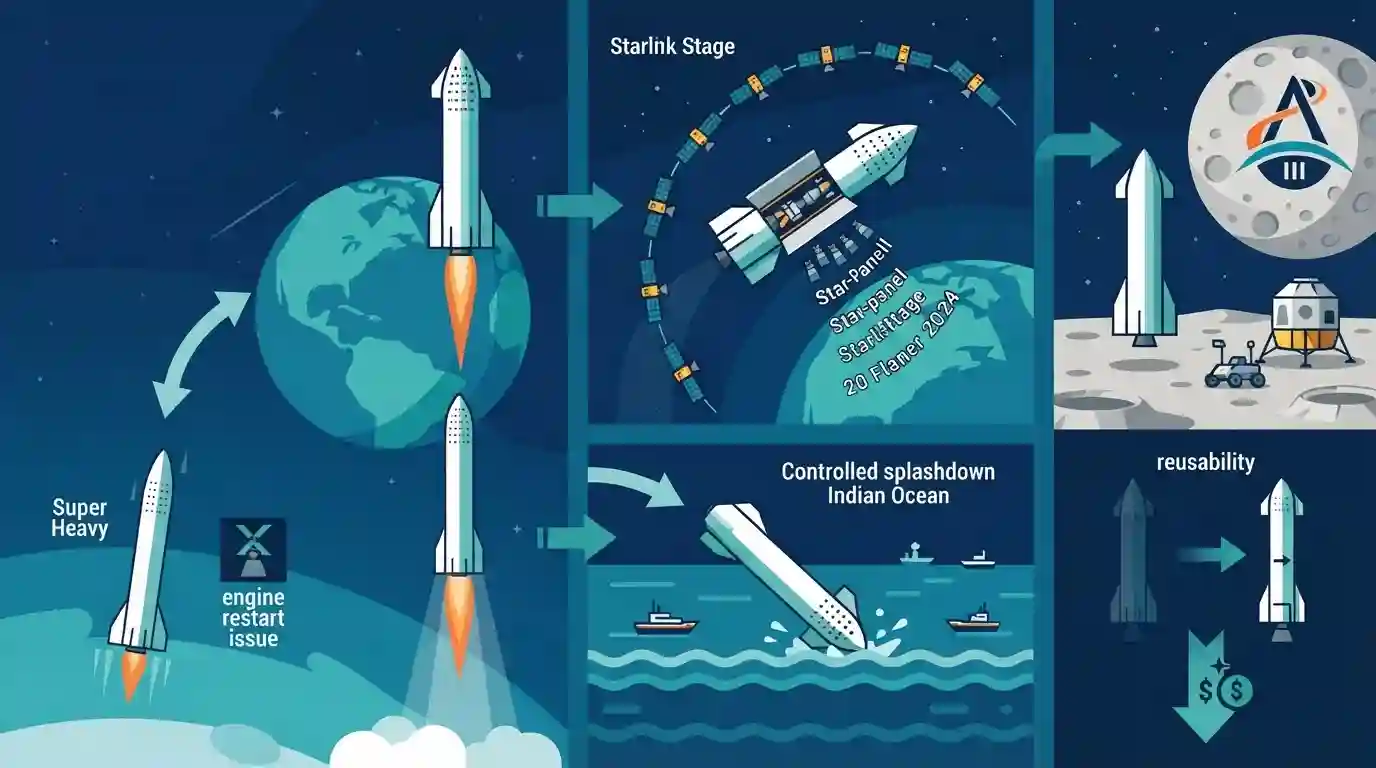
SpaceX achieved a major milestone in space exploration as its Starship rocket—the largest and most powerful launch vehicle ever built—successfully completed its 13th test flight, ending with a controlled, intact splashdown in the Indian Ocean. During the mission, it deployed 20 Starlink satellites into orbit. While the Super Heavy booster failed to return safely due to an engine restart issue, the overall success of the Starship upper stage is a critical step forward. This development is vital for deep-space exploration, particularly NASA's Artemis III lunar mission, and highlights the transformative role of fully reusable launch vehicles in making space travel more affordable.
મુખ્ય મુદ્દા
- SpaceX's 407-foot Starship, the world's most powerful rocket, successfully completed its 13th test flight, splashing down intact in the Indian Ocean.
- The flight successfully deployed 20 next-generation Starlink satellites into low Earth orbit.
- The Super Heavy booster experienced a technical glitch during its return burn, crashing into the Gulf of Mexico instead of achieving a controlled catch.
- NASA is relying on a modified Starship to serve as the lunar lander for the upcoming Artemis III mission to return humans to the Moon.
- The successful test of this fully reusable heavy-lift vehicle brings SpaceX closer to its goal of drastically reducing spaceflight costs and enabling crewed missions to Mars.
મહત્વપૂર્ણ શબ્દો
Artemis programme

A NASA-led international spaceflight initiative aiming to land humans, including the first woman and person of color, back on the Moon and establish a sustainable, long-term lunar presence.
UPSC context
GS Paper III (Science & Technology). Tests understanding of international space exploration collaborations and their strategic significance for India.
Artemis III
The planned third mission of NASA’s Artemis program, scheduled to land astronauts, including the first woman and person of color, on the lunar South Pole.
UPSC context
GS Paper III (Science & Tech). Tests awareness of landmark human spaceflight milestones, deep space exploration, and searching for lunar water-ice.
Reusable Launch Vehicle (RLV)
A spacecraft or rocket system designed to return to Earth intact, allowing for multiple launches, which significantly reduces the cost of space transportation compared to expendable systems.
UPSC context
GS Paper III (Science & Technology). Evaluates space transport technology, cost-reduction mechanisms, and India's indigenous RLV developments.
SpaceX
A private American aerospace manufacturer and space transport company that pioneered reusable rocket technologies like Falcon 9 and Starship, transforming the economics of spaceflight.
UPSC context
GS Paper III (Science & Tech). Tests knowledge of private sector innovation in space technology and commercial outer space exploration models.
NASA
The independent civilian space agency of the United States government, responsible for aerospace research, scientific exploration of Earth and space, and lead organizer of the Artemis lunar missions.
UPSC context
GS Paper III (Science & Tech). Tests awareness of major international space agencies, global scientific programs, and bilateral partnerships with India.
Privatisation of Space
The paradigm shift of allowing private companies and startups to design, build, and operate space technologies, reducing government monopoly and promoting commercialization and innovation.
UPSC context
GS Paper III (Indian Economy & Space). Tests knowledge of space sector reforms, private players, and boosting India's global space economy share.
Starlink
A satellite internet constellation operated by SpaceX in Low Earth Orbit (LEO) to provide high-speed, low-latency broadband internet access globally, especially to remote or underserved areas.
UPSC context
GS Paper III (Science & Tech). Evaluates satellite communication technology, Low Earth Orbit constellations, and associated national security implications.
પ્રિલિમ્સ ટ્રેપ
India's amended space FDI policy permits 100% foreign investment under the automatic route across all segments, including launch vehicles.
Launch vehicles and spaceports only allow up to 49% FDI under the automatic route; beyond 49% requires government approval.
સંલગ્ન સ્થિર ખ્યાલો
What is the Outer Space Treaty (1967) and its basic mandates?
- No Sovereignty: Prohibits national appropriation of outer space, including the Moon, by claim of sovereignty, use, occupation, or any other means.
- Peaceful Use: Bans weapons of mass destruction in orbit and celestial bodies, dedicating space exploration solely to peaceful purposes.
How do Cryogenic and Semi-Cryogenic engine propellants differ?
- Cryogenic Systems: Use liquid hydrogen (-253°C) as fuel and liquid oxygen (-183°C) as oxidizer, requiring complex, ultra-cold storage.
- Semi-Cryogenic Systems: Use refined kerosene or methane instead of liquid hydrogen, resulting in higher propellant density and easier storage at ambient temperatures.
આંતર-વિષય પેટર્ન
Space FDI + Strategic Autonomy
Liberalizing private space sector investments under automatic FDI routes creates tensions between accelerating technology transfer and safeguarding indigenous security-sensitive space defense capabilities.
Mega-constellations + Space debris governance
Rapid deployment of massive satellite constellations like Starlink amplifies the risk of Kessler syndrome, testing the limits of non-binding UN space debris mitigation guidelines.

Project Soorya (NGLV) and private-led space commercialization paradigms are likely to be tested via a multi-statement question in Prelims 2026.
સંલગ્ન PYQ · 3
સંલગ્ન PYQ · 3
- 2016MainsGS3
Discuss India's achievements in the field of Space Science and Technology. How the application of this technology has helped India in its socio-economic development?
- 2018PrelimsGS1
With reference to India's satellite launch vehicles, consider the following statements: 1. PSLVs launch the satellites useful for Earth resources monitoring whereas GSLVs are designed mainly to launch communication satellites. 2. Satellites launched by PSLV appear to remain permanently fixed in the same position in the sky, as viewed from a particular location on Earth. 3. GSLV Mk III is a four-staged launch vehicle with the first and third stages using solid rocket motors; and the second and fourth stages using liquid rocket engines. Which of the statements given above is/are correct?
- 2014PrelimsGS1
Which of the following pairs is/are correctly matched? Spacecraft Purpose 1. Cassini-Huygens : Orbiting the Venus and transmitting data to the Earth 2. Messenger : Mapping and investigating the Mercury 3. Voyager 1 and 2 : Exploring the outer solar system Select the correct answer using the code given below.
