High Crude Prices Threaten Current Account Deficit and Inflation
Source:The Hindu ↗
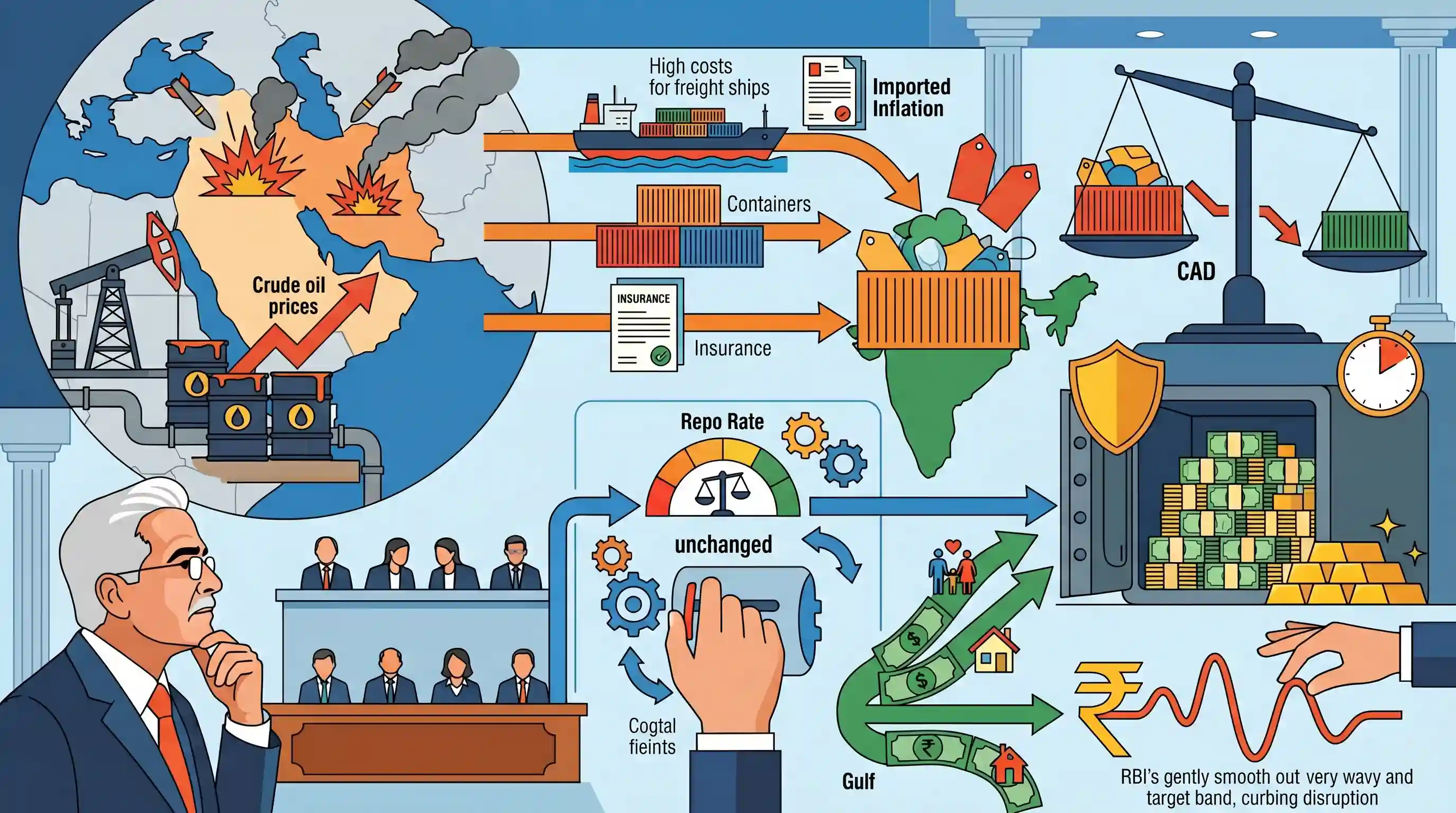
Why It Matters
This article provides a comprehensive real-world application of core macroeconomic concepts frequently tested by UPSC. It clearly links geopolitical events (West Asia tensions) to domestic economic outcomes like imported inflation, CAD widening, and currency depreciation. Understanding the RBI's policy responses—such as holding the repo rate via the MPC, utilizing forex reserves for import cover, and intervening to manage Rupee volatility—is essential for answering questions on macroeconomic stability in both Prelims and Mains (GS Paper 3).
Summary
RBI Governor Sanjay Malhotra warned that escalating geopolitical tensions in West Asia could sustain elevated crude oil prices, thereby increasing imported inflation and widening India's Current Account Deficit (CAD). Consequently, the Monetary Policy Committee (MPC) has kept the repo rate unchanged at 5.25% to manage inflationary pressures arising from higher energy, freight, and insurance costs. Despite these external headwinds, India's macroeconomic fundamentals remain resilient, bolstered by strong foreign exchange reserves of $697.1 billion (providing 11 months of import cover) and steady remittances from the Gulf. Furthermore, the RBI continues its policy of intervening in the forex market strictly to curb disruptive volatility in the Indian Rupee, without targeting a specific exchange rate band.
Key Points
- Elevated crude oil prices due to West Asian geopolitical tensions threaten to increase imported inflation and widen India's Current Account Deficit (CAD).
- The Monetary Policy Committee (MPC) opted to keep the benchmark repo rate unchanged at 5.25% to counteract inflationary pressures stemming from higher energy, freight, and insurance costs.
- India holds robust foreign exchange reserves of $697.1 billion, ensuring an adequate import cover of roughly 11 months, which buffers against external shocks.
- The RBI maintains a flexible exchange rate policy, intervening in the forex market only to smoothen disruptive volatility rather than targeting a specific value for the Rupee.
- Remittances from Gulf countries remain resilient and are expected to stay stable or potentially increase despite regional conflicts.
Important Terms
Monetary Policy Committee (MPC)

A statutory six-member body under the RBI Act, 1934, mandated to determine the benchmark interest rate (repo rate) to achieve the inflation target while supporting economic growth.
UPSC context
GS-III (Economy); central to topics on inflation targeting, interest rate mechanisms, and the institutional framework of the RBI.
Current Account Deficit (CAD)
A component of the Balance of Payments (BoP) representing the gap where a country's total import value for goods, services, and transfers exceeds its total export earnings.
UPSC context
GS-III (External Sector); a vital indicator for assessing currency stability, external vulnerability, and macroeconomic health.
Imported Inflation
Domestic price increases caused by rising costs of imported commodities (like crude oil) or a depreciating local currency, effectively acting as a form of cost-push inflation.
UPSC context
GS-III (Inflation); tests the ability to link global geopolitical shocks to domestic price stability and monetary policy responses.
Repo Rate
The benchmark interest rate at which the RBI lends money to commercial banks against government securities to manage liquidity and control the prevailing inflation rate.
UPSC context
GS-III (Monetary Policy); the primary tool for managing money supply and influencing the cost of credit in the economy.
Foreign Exchange (Forex) Reserves
Assets held by the central bank in foreign currencies, gold, Special Drawing Rights (SDRs), and the IMF reserve tranche to ensure stability and meet international obligations.
UPSC context
GS-III (External Sector); serves as a buffer against external shocks and is key to exchange rate management.
Import Cover
An economic indicator measuring the number of months of imports a country's forex reserves can finance, reflecting the adequacy of its external stability buffers.
UPSC context
GS-III (External Sector); specifically tests knowledge of resilience against Balance of Payments (BoP) crises and external debt adequacy.
Prelims Trap
The RBI actively intervenes to keep the Rupee within a specific pre-announced exchange rate band.
India follows a 'managed float' regime. The RBI intervenes only to smooth disruptive volatility, not to target or defend a specific currency value or band.
Static Concepts Connected
What are the primary components of a country's Current Account Deficit (CAD)?
- Trade Deficit: The difference between merchandise exports and imports. In India, crude oil and gold imports are structurally the largest contributors to this deficit.
- Net Invisibles: Includes trade in services (like software exports, which run a surplus), net transfers (such as remittances), and net income (interest, dividends).
How does a 'Managed Floating' exchange rate system function?
- Market Determined: The baseline exchange rate is dynamically determined by the market forces of demand and supply for foreign exchange.
- Central Bank Intervention: The central bank buys or sells foreign currency to prevent excessive volatility and speculative attacks, without defending a fixed parity.
Cross-Topic Patterns
Maritime Chokepoints & Imported Inflation
Geopolitical conflicts affecting maritime chokepoints like the Strait of Hormuz directly spike India's crude import and freight costs, leading to cost-push imported inflation.
Remittances as BoP Stabilizers
While Gulf tensions risk widening the CAD via oil prices, stable diaspora remittances act as a crucial invisible surplus counterweight in the Balance of Payments.

Expect a multi-statement question interlinking managed floating exchange rates, import cover logic, and drivers of CAD in Prelims 2026.
Linked PYQs · 5
Linked PYQs · 5
- 2013PrelimsGS1
Which one of the following groups of items is included in India's foreign-exchange reserves?
- 2017PrelimsGS1
Which of the following statements is/are correct regarding the Monetary Policy Committee (MPC)? 1. It decides the RBI's benchmark interest rates. 2. It is a 12-member body including the Governor of RBI and is reconstituted every year. 3. It functions under the chairmanship of the Union Finance Minister. Select the correct answer using the code given below:
- 2022PrelimsGS1
In India, which one of the following is responsible for maintaining price stability by controlling inflation?
- 2022PrelimsGS1
With reference to the Indian economy, consider the following statements: 1. An increase in Nominal Effective Exchange Rate (NEER) indicates the appreciation of rupee. 2. An increase in the Real Effective Exchange Rate (REER) indicates an improvement in trade competitiveness. 3. An increasing trend in domestic inflation relative to inflation in other countries is likely to cause an increasing divergence between NEER and REER. Which of the above statements are correct?
- 2018MainsGS3
How would the recent phenomena of protectionism and currency manipulations in world trade affect macroeconomic stability of India?
