Crude oil prices imported inflation and current account deficit
स्रोत:द हिंदू ↗
क्यों मायने रखता है
The article deals with core macroeconomic concepts (CAD, imported inflation, FDI/FPI, exchange rate management) which are frequently tested in UPSC Prelims and Mains GS3. It illustrates the real-world impact of geopolitical events on India's economic stability and the central bank's policy responses.
सारांश
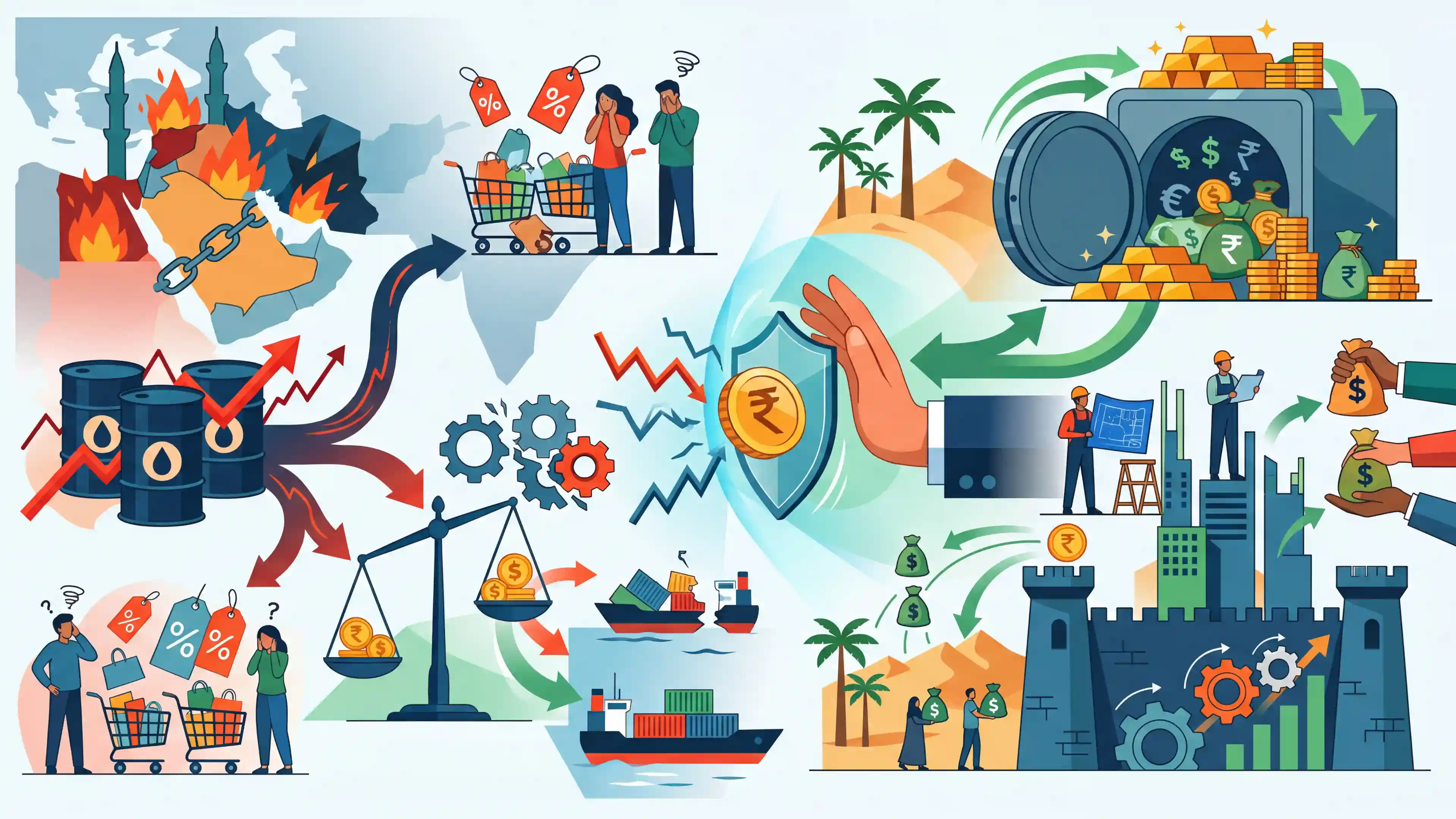
Reserve Bank of India (RBI) Governor Sanjay Malhotra highlighted that while India's macroeconomic fundamentals remain strong, elevated crude oil prices due to West Asian geopolitical tensions could increase imported inflation and widen the Current Account Deficit (CAD). Supply chain disruptions and energy market volatility pose risks to domestic output and external demand. However, robust forex reserves ($697.1 billion), strong Foreign Direct Investment (FDI), and stable remittances from the Gulf region provide a buffer. The RBI maintains its stance of intervening in the forex market only to curb excessive volatility in the Rupee, rather than targeting a specific exchange rate.
मुख्य बिंदु
- Elevated crude oil prices driven by geopolitical tensions in West Asia threaten to increase India's imported inflation and widen its Current Account Deficit (CAD).
- Despite global uncertainties and potential supply chain disruptions, India's macroeconomic fundamentals remain strong and resilient.
- Inward remittances are expected to remain stable or increase, driven by a rising demand for migrant workers in the Gulf region.
- India's forex reserves stand at a robust $697.1 billion (providing 11 months of import cover), supported by strong Foreign Direct Investment (FDI), even as Foreign Portfolio Investment (FPI) recorded net outflows.
- The RBI continues to intervene in the foreign exchange market to smoothen excessive volatility in the Rupee, without targeting a specific exchange rate level.
महत्वपूर्ण शब्द
Imported Inflation

Inflation caused by rising costs of imported goods (e.g., crude oil) or currency depreciation, which increases domestic production costs and consumer prices.
UPSC context
GS-III Economy (Inflation). Tests understanding of external shocks and cost-push factors on domestic price stability.
Current Account Deficit (CAD)
A measurement within the Balance of Payments where a country's total imports of goods, services, and transfers exceed its total exports.
UPSC context
GS-III Economy (External Sector). Vital for analyzing India's trade resilience and currency stability.
Foreign Exchange (Forex) Reserves
Assets held by the RBI (Foreign Currency Assets, Gold, SDRs, and IMF Reserve Position) to back the currency and manage external obligations.
UPSC context
GS-III Economy (External Sector). Tests knowledge of economic buffers and RBI's exchange rate management.
Monetary Policy Committee (MPC)
A six-member statutory body (3 from RBI, 3 Government-appointed) responsible for fixing the benchmark interest rate (Repo Rate) to target inflation.
UPSC context
GS-III Economy (Monetary Policy). Key for understanding institutional frameworks for price stability and growth.
Foreign Direct Investment (FDI)
Long-term capital investment (typically >=10% equity) by a foreign entity into domestic businesses, involving significant management control and technology transfer.
UPSC context
GS-III Economy (Investment Models). Tests understanding of stable capital flows versus volatile portfolio investments.
Remittances
Money sent by migrants to their home country; India is the world's largest recipient, providing a crucial buffer for the Current Account.
UPSC context
GS-III Economy (External Sector). Tests awareness of non-debt capital inflows and diaspora contributions.
प्रारंभिक ट्रैप
The RBI actively buys and sells foreign currency to maintain a specific, targeted exchange rate for the Rupee.
India follows a 'managed float' system. The RBI intervenes in the forex market only to curb excessive volatility, not to defend or target a specific exchange rate level.
संबंधित अवधारणाएँ
What are the primary components of India's Current Account in the BoP?
- Visible Trade: Export and import of physical goods (merchandise), which primarily dictates the trade deficit.
- Invisible Trade: Includes the export and import of services such as software, travel, and transportation.
- Income & Transfers: Encompasses investment income (profits, interest, dividends) and unilateral transfers like inward remittances from the diaspora.
What is the mechanism and impact of 'Imported Inflation'?
- Cost-Push Nature: It acts as cost-push inflation, where rising global raw material prices (like crude oil) drive up domestic production costs.
- Currency Effect: A depreciating domestic currency worsens imported inflation, as more Rupees are required to buy the same volume of dollar-denominated imports.
अंतर-विषय पैटर्न
West Asian Geopolitics & Macro-Stability
Instability in West Asia forces India to diversify crude oil sourcing, directly linking foreign policy and strategic petroleum reserves to domestic inflation control and external sector resilience.
Remittances & External Sector Resilience
Gulf migration trends directly stabilize India's Balance of Payments, highlighting how diaspora policies and international labor mobility act as a crucial buffer against widening merchandise trade deficits.

Expect a multi-statement Prelims question linking crude oil price shocks to CAD widening, imported inflation, and currency depreciation.
संबद्ध PYQ · 4
संबद्ध PYQ · 4
- 2022PrelimsGS1
With reference to the Indian economy, consider the following statements: 1. An increase in Nominal Effective Exchange Rate (NEER) indicates the appreciation of rupee. 2. An increase in the Real Effective Exchange Rate (REER) indicates an improvement in trade competitiveness. 3. An increasing trend in domestic inflation relative to inflation in other countries is likely to cause an increasing divergence between NEER and REER. Which of the above statements are correct?
- 2021PrelimsGS1
Consider the following statements : The effect of devaluation of a currency is that it necessarily 1. improves the competitiveness of the domestic exports in the foreign markets 2. increases the foreign value of domestic currency 3. improves the trade balance Which of the above statements is/are correct?
- 2019PrelimsGS1
Which one of the following is not the most likely measure the Government/RBI takes to stop the slide of Indian rupee?
- 2016MainsGS3
Justify the need for FDI for the development of the Indian economy. Why there is gap between MOUs signed and actual FDIs? Suggest remedial steps to be taken for increasing actual FDIs in India.
