Wild Elephant Sighting at 2900m in Pauri Garhwal Surprises Experts
Source:newindianexpress ↗
Why It Matters
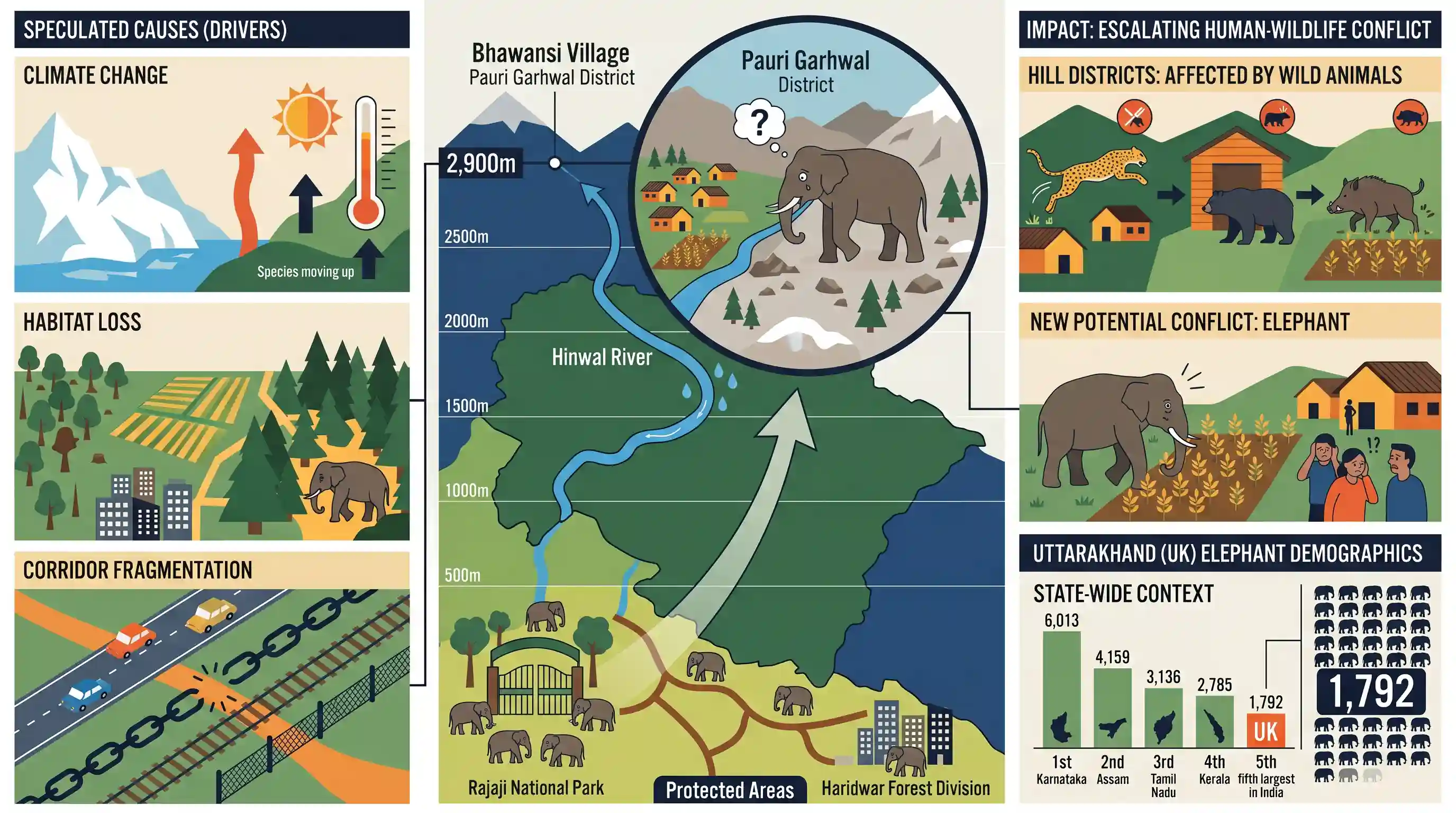
This ecological phenomenon highlights the direct impacts of climate change, corridor disruption, and habitat fragmentation in the fragile Himalayan region. Understanding these upward animal migrations is critical for addressing emerging human-wildlife conflict zones and managing conservation strategies in Uttarakhand's sub-alpine regions.
Summary
An adult wild elephant was spotted at an unprecedented altitude of nearly 2,900 metres in Bhawansi village, Pauri Garhwal district, Uttarakhand. Wildlife experts speculate that the elephant migrated uphill from Rajaji National Park or the Haridwar forest division along the Hinwal river basin, likely due to climate change, habitat loss, or corridor fragmentation. This highly unusual sighting raises concerns over escalating human-wildlife conflicts in Uttarakhand's hill districts, where communities are already affected by other wild animals. Uttarakhand currently hosts India's fifth-largest wild elephant population with 1,792 individuals.
Key Points
- A mature adult elephant was spotted at an unusual high altitude of nearly 2,900 metres (specifically around 2,982m) near Bhawansi village in the Dugadda block of Pauri Garhwal, Uttarakhand.
- Elephants in Uttarakhand are traditionally found in the lowland plains and foothill forest belts, such as Haridwar, Rajaji National Park, and the Corbett landscape.
- Senior wildlife scientist Dr. Dinesh Chandra Bhatt suggests the elephant may have migrated uphill from the Haridwar forest division or Rajaji National Park, traveling along the Hinwal river valley (a tributary of the Ganga).
- Experts attribute this unprecedented upward migration to habitat pressure, search for food, climate-induced weather pattern shifts, or disruption of traditional corridors.
- This migration could escalate human-wildlife conflict in hill villages, which are already struggling with crop and livestock losses from leopards, bears, wild boars, and monkeys.
- According to the latest national report, India has 22,446 wild elephants, with Karnataka holding the highest population (6,013), followed by Assam, Tamil Nadu, and Kerala. Uttarakhand has the fifth-largest population with 1,792 elephants.
- Between 2001 and June 2026, Uttarakhand recorded 542 elephant deaths, of which 168 were unnatural (52 electrocutions, 32 train hits, 73 road accidents, and 9 poaching cases), while human-elephant conflicts claimed 151 human lives over the past 15 years.
Important Terms
All India Synchronised Elephant Estimation Report

A national census of wild elephants conducted every five years. The 2021–25 cycle introduced the country's first DNA-based mark-recapture methodology, establishing a baseline of 22,446 elephants.
UPSC context
GS Paper III (Biodiversity & Conservation); tests wildlife monitoring techniques, population demographics, and state-level elephant distribution.
Project Tiger
A flagship centrally sponsored conservation scheme launched in 1973 to ensure viable tiger populations, which was merged with Project Elephant in 2023 under an integrated administrative framework.
UPSC context
GS Paper III (Ecology and Environment); tests core flagship conservation schemes and institutional mergers under MoEFCC.
Rajaji National Park
A national park and tiger reserve spanning Dehradun, Haridwar, and Pauri Garhwal in Uttarakhand, famous for its elephants and formed by merging Chilla, Motichur, and Rajaji sanctuaries.
UPSC context
GS Paper III (Protected Areas); tests geographical locations, river systems, and major fauna of Himalayan foothill ecosystems.
Human-Wildlife Conflict
Negative interactions between humans and wild animals leading to loss of life, crops, or property, driven by habitat fragmentation, corridor blockage, and climate stress.
UPSC context
GS Paper III (Conservation & Disaster Management); tests mitigation strategies, legal provisions, and socio-economic impacts on communities.
Gurukul Kangri University
A deemed university in Haridwar, Uttarakhand, founded in 1902 by Swami Shraddhanand to revive the ancient Indian Gurukula education system as an indigenous alternative to British colonial education.
UPSC context
GS Paper I (Modern Indian History); tests socio-religious reform movements, Swami Shraddhanand, and Arya Samaj's educational contributions.
Uttarakhand Forest Department
The state government agency responsible for managing forestry, wildlife sanctuaries, and national parks in Uttarakhand, and handling regional human-wildlife conflicts and census operations.
UPSC context
GS Paper III (Environmental Governance); tests state-level forest conservation, regional species protection, and practical execution of federal directives.
Prelims Trap
Asian elephants are ecologically restricted to lowland plains and cannot survive or migrate to high-altitude sub-alpine regions above 2,000 meters.
Elephants have been recorded migrating up to 3,000m in Bhutan and Uttarakhand, proving their physiological adaptability to higher altitudes.
Static Concepts Connected
What is the legal and conservation status of the Asian Elephant in India?
- Legal Protection: Listed under Schedule I of the Wildlife (Protection) Act, 1972, granting it the highest level of legal protection.
- Global Status: Classified as 'Endangered' on the IUCN Red List and listed under Appendix I of CITES.
- National Status: Designated as India's National Heritage Animal in 2010 to elevate its conservation profile.
What are ecological corridors and how does fragmentation trigger Human-Wildlife Conflict?
- Definition: Ecological corridors are structural landscape links that connect fragmented habitats, allowing wildlife movement and gene flow.
- Conflict Trigger: Fragmentation by roads and railways forces herds into agricultural lands, escalating crop damage and human casualties.
- Smart Mitigation: Technologies like optical-fiber Intrusion Detection Systems (IDS) on railway tracks provide real-time alerts to prevent accidents.
Cross-Topic Patterns
Climate Change and Altitudinal Range Shifts
Rising global temperatures force species to seek cooler thermal niches at higher altitudes, disrupting high-altitude ecosystems and changing community dynamics.
Infrastructure Development vs. Eco-sensitive Zones
Linear projects in ecologically fragile zones fragment critical corridors, turning contiguous wildlife habitats into active human-wildlife conflict zones.

Himalayan altitudinal migration of megafauna and the use of IDS tech for corridor protection will likely be framed in UPSC 2026.
Linked PYQs · 3
Linked PYQs · 3
- 2024UKPSC_PRELIMSGS1
Which of the following National Park of Uttarakhand has been included in Project Tiger Scheme in 2015 ?
- 2016UKPSC_PRELIMSGS1
Which of the following National Parks of Uttarakhand has been included in 'Project Tiger Scheme' in 2016?
- 2025UKPSC_PRELIMSGS1
Consider the following statements and select the correct answer from the options given below : Statement 1 : Uttarakhand is highly vulnerable to climate change. Statement 2 : Climate change is causing water stress and depleting biodiversity in Uttarakhand.
