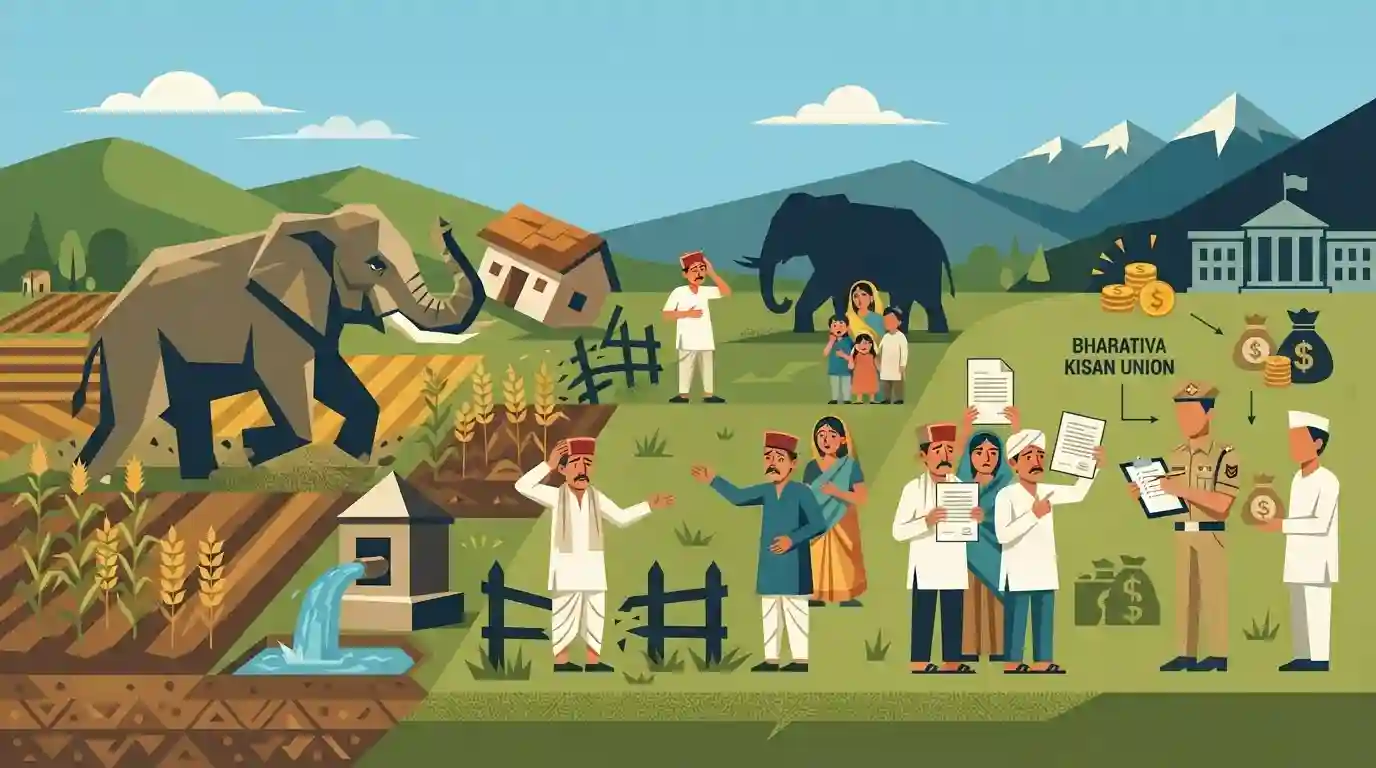
Wild Elephant Rampage Destroys Crops and Homes in Paonta Sahib
Source:theprint ↗
Why It Matters
Human-animal conflict is a persistent issue in India with direct ecological and socio-economic consequences. Understanding the geography of wildlife habitats in states like Himachal Pradesh and the challenges surrounding species conservation and farmer livelihoods is crucial for HPAS Prelims.
Summary
Wild elephants have been rampaging through villages in the Paonta subdivision of Himachal Pradesh, destroying crops, damaging homes and tubewells, and causing widespread fear among local farmers. The Bharatiya Kisan Union has urged the Forest Department to take immediate preventive measures and provide adequate compensation for the damages.
Key Points
- A herd of wild elephants has been causing severe damage in several villages of the Paonta subdivision in Himachal Pradesh's Sirmaur district.
- The elephants have destroyed cash crops including paddy, cherry, and banana, and caused structural damage to houses and agricultural tubewells.
- Locals in villages such as Bahral and Satiwala are living in fear due to nocturnal raids by the elephants, which also target livestock.
- The Sirmaur unit of the Bharatiya Kisan Union has demanded immediate action from the Forest Department to prevent further intrusions and provide compensation to the affected farmers.
Important Terms
Bharatiya Kisan Union

A prominent non-partisan farmers' representative organization in India advocating for agricultural rights, crop pricing, and compensation for farming losses, including those from wildlife damages.
UPSC context
Relevant for GS-II (Pressure Groups) and GS-III (Agriculture), testing knowledge of agrarian movements and farmers' welfare advocacy.
Forest Department
The state government agency tasked with the conservation of forests, wildlife management, enforcing environmental laws, and mitigating human-wildlife conflicts through preventive measures.
UPSC context
Important for GS-III (Environment & Ecology), evaluating administrative responses and state strategies for wildlife conservation.
Human-Wildlife Conflict
Negative interactions between wild animals and humans that result in detrimental outcomes, such as crop destruction, property damage, livestock loss, and threats to life.
UPSC context
A key focus area in GS-III (Environment & Biodiversity), assessing strategies for ecological balance and mitigation policies.
Project Elephant
A centrally sponsored scheme launched in 1992 to protect elephants, their habitats, and corridors, and to address issues of man-animal conflict through financial and technical support.
UPSC context
Essential for GS-III (Wildlife Conservation), evaluating government initiatives for protecting endangered species and managing wildlife corridors.
Paonta Subdivision
A subdivision in the Sirmaur district of Himachal Pradesh, recently noted as a hotspot for increasing human-elephant conflicts and agricultural damage by migrating herds.
UPSC context
Relevant for Himachal Pradesh-specific geography and environment questions in HPAS Prelims and GS papers.
Prelims Trap
"Wild Asian elephants are distributed across the mid-Himalayan districts of Himachal Pradesh."
Elephants in HP are exclusively confined to the Shivalik foothills (Sirmaur district bordering Uttarakhand), not the mid-Himalayan or alpine zones.
Static Concepts Connected
What are the key geographical features of the Paonta Valley (Kyarda Dun)?
- Location: Located entirely within the Shivalik foothills in Sirmaur, separated from Dehradun by the Yamuna river.
- Biodiversity Corridor: Houses Simbalbara National Park, acting as a crucial contiguous habitat and wildlife corridor extending from Uttarakhand's Rajaji National Park.
- Agricultural Profile: A highly fertile flat valley known for intensive agriculture and cash crops, making it vulnerable to crop depredation.
What is the conservation and legal framework for the Asian Elephant in India?
- WPA 1972: Protected under Schedule I of the Wildlife (Protection) Act, 1972, prohibiting hunting and ensuring the highest legal protection.
- IUCN Status: Listed as 'Endangered' on the IUCN Red List due to habitat loss, fragmentation, and human-wildlife conflict.
- Project Elephant: Launched in 1992 as a Centrally Sponsored Scheme to protect elephants, secure corridors, and mitigate human-animal conflict.
Cross-Topic Patterns
Wildlife Corridors + Agricultural Distress
The movement of elephants from Uttarakhand into HP's Sirmaur highlights the necessity of securing cross-border wildlife corridors (like the Rajaji-Simbalbara link) to mitigate escalating agricultural distress and human-wildlife conflict.
State Compensation Policy + Schedule I Damage
Farmer protests over wildlife depredation directly link to the HP Forest Department's compensation policies and standard operating procedures for crop/property damage caused by Schedule I wild animals.

Expect a spatial matching question linking specific wildlife (elephants, snow leopards) to restricted geographic ranges (Shivaliks) in HP.
Linked PYQs · 3
Linked PYQs · 3
- 2023HPAS_PRELIMSGS1
Given below are two statements : Statement I : Most species in the world go extinct because humans kill them. Statement II : The Western Ghats region harbours the largest global population of Asian elephant. In the light of the above statements, choose the most appropriate answer from the options given below :
- 2025HPAS_PRELIMSGS1
Match List I with List II : | List-I (Wildlife Sanctuary) | List-II (District) | |---|---| | (a) Kias | (i) Kullu | | (b) Tarla | (ii) Shimla | | (c) Tundah | (iii) Chamba | | (d) Bandli | (iv) Mandi | Choose the correct answer from the options given below : Code: (a) (b) (c) (d)
- 2018HPAS_PRELIMSGS1
Which of the following national parks/sanctuaries of H.P. occupies 1171 sq. km. of area ?
