Wildlife Conservation Accountability and Forest Governance
Source:Indian Express ↗
Why It Matters
Provides a stark, real-world case study for GS-4 on the ethical bankruptcy and dereliction of duty by public officials, as well as highlighting critical grassroots governance failures in GS-3 wildlife conservation.
Summary
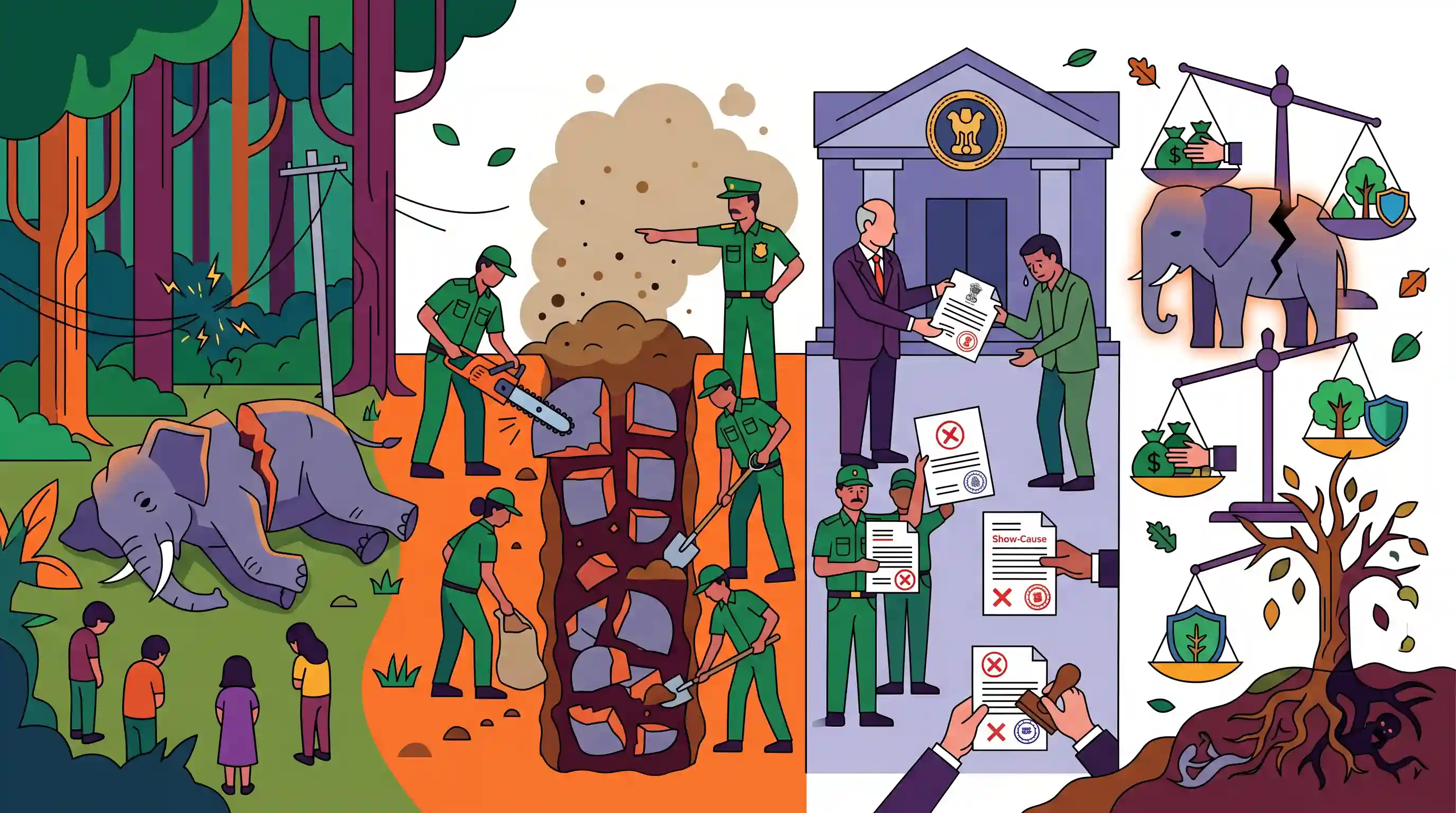
In a shocking incident of a wildlife crime cover-up in Odisha, forest department personnel allegedly chopped a dead elephant into 32 pieces and buried the remains to conceal the death. The Odisha government has issued a show-cause notice to the Divisional Forest Officer (DFO) for gross supervisory negligence and suspended several frontline staff. The incident, which likely points to an unnatural death such as electrocution or poaching, highlights profound ethical lapses, dereliction of duty, and corruption within the forest department, significantly undermining India's wildlife conservation efforts like Project Elephant.
Key Points
- A deceased elephant in Odisha was mutilated into 32 pieces and buried by forest guards attempting to hide the incident from higher authorities.
- The Odisha state government has intervened, issuing a notice to the Divisional Forest Officer for supervisory failure and suspending multiple lower-level staff.
- The extreme cover-up suggests the elephant likely died of unnatural causes (such as poaching or electrocution), which the staff tried to conceal to avoid accountability.
- The incident exposes critical challenges in wildlife governance, including a severe lack of environmental ethics, dereliction of duty, and systemic corruption at the grassroots level of conservation.
Important Terms
Project Elephant

A centrally sponsored scheme launched in 1992 to protect elephants, habitats, and corridors. In 2023, it was merged with Project Tiger into a unified 'Project Tiger & Elephant' division for funding.
UPSC context
GS Paper III (Environment); tests species-specific conservation strategies and administrative reforms in wildlife governance.
Wildlife Protection Act, 1972
India's primary legal framework for wildlife conservation. It establishes protection schedules, regulates trade in wildlife products, and mandates harsh penalties for hunting or harming protected species like elephants.
UPSC context
GS Paper II (Governance) and III (Environment); tests statutory frameworks for biodiversity and wildlife crime.
Divisional Forest Officer (DFO)
The executive head of a forest division responsible for managing conservation projects, enforcing forest laws, and supervising field staff to prevent illegal activities like poaching or habitat encroachment.
UPSC context
GS Paper IV (Ethics) and GS Paper II (Governance); highlights administrative accountability and professional integrity.
Schedule I (WPA, 1972)
The highest protection category under the WPA 1972. Species listed here, including Asian elephants, receive absolute protection; offenses involving them attract the most severe legal penalties.
UPSC context
GS Paper III (Environment); tests knowledge of legal gradations in species protection and conservation priority.
Asian Elephant (Elephas maximus)
India's 'National Heritage Animal,' listed as Endangered on the IUCN Red List. They are a flagship species for conservation, primarily threatened by habitat fragmentation and electrocution.
UPSC context
GS Paper III (Environment); focuses on flagship species conservation and ecological significance.
Dereliction of Duty
A deliberate or negligent failure by a public official to perform their legal or professional responsibilities, often leading to disciplinary actions like show-cause notices or suspensions.
UPSC context
GS Paper IV (Ethics); central to topics of administrative integrity and accountability in public service.
Prelims Trap
Carcasses of wild animals are the property of the local community or the landowner if found outside protected forest areas.
Under Section 39 of the Wildlife (Protection) Act, 1972, all wild animals and their carcasses are the absolute property of the State or Central Government.
Static Concepts Connected
How does the WPA 1972 treat wildlife carcasses?
- Absolute Property: Under Section 39, all wild animals, animal articles, and trophies are the exclusive property of the State or Central Government.
- Strict Liability: Unauthorized disposal, burial, or mutilation of a carcass constitutes the illegal destruction of government property and tampering with evidence.
- Mandatory Reporting: Anyone finding a wildlife carcass must report it to an authorized officer or the nearest police station within 48 hours.
What is the official MoEFCC SOP for elephant mortalities?
- Veterinary Autopsy: A mandatory post-mortem by a veterinary team is required to investigate the exact cause of death, ruling out electrocution, poisoning, or poaching.
- Scientific Disposal: Carcasses must be buried deep with lime or incinerated to prevent the spread of zoonotic diseases like Anthrax.
- Tusk Security: Tusks must be officially extracted, documented, and safely deposited in the government treasury to prevent illegal ivory trafficking.
Cross-Topic Patterns
Vicarious liability in public administration
The DFO's show-cause notice exemplifies how supervisory officers are held accountable for systemic failures of subordinates, testing the GS4 concept of 'interlocking accountability' and ethical leadership.
Linear infrastructure and wildlife deaths
Cover-ups by ground staff often aim to hide unnatural mortalities caused by sagging power lines, train hits, or retaliatory poisoning, linking GS3 wildlife ecology with infrastructure planning and man-animal conflict.

GS4 case studies on conservation cover-ups or Prelims statements testing Section 39 (State property) of the WPA 1972 are highly likely.
Linked PYQs · 3
Linked PYQs · 3
- 2020PrelimsGS1
With reference to Indian elephants, consider the following statements: 1. The leader of an elephant group is a female. 2. The maximum gestation period can be 22 months. 3. An elephant can normally go on calving till the age of 40 years only. 4. Among the States in India, the highest elephant population is in Kerala. Which of the statements given above is/are correct?
- 2022PrelimsGS1
With reference to Indian laws about wildlife protection, consider the following statements : 1. Wild animals are the sole property of the government. 2. When a wild animal is declared protected, such animal is entitled for equal protection whether it is found in protected areas or outside. 3. Apprehension of a protected wild animal becoming a danger to human life is sufficient ground for its capture or killing. Which of the statements given above is/are correct?
- 2019MainsGS4
"Non-performance of duty by a public servant is a form of corruption". Do you agree with this view? Justify your answer.
