WhatsApp early warning systems mitigate elephant conflicts
Source:indiawildlifenews ↗
Why It Matters
Human-wildlife conflict, particularly involving elephants, is a significant conservation challenge in India. Awareness of technological interventions (like WhatsApp EWS), key geographical corridors, and NGO initiatives like 'Right of Passage' is essential for civil services aspirants studying environmental conservation and sustainable development.
Summary
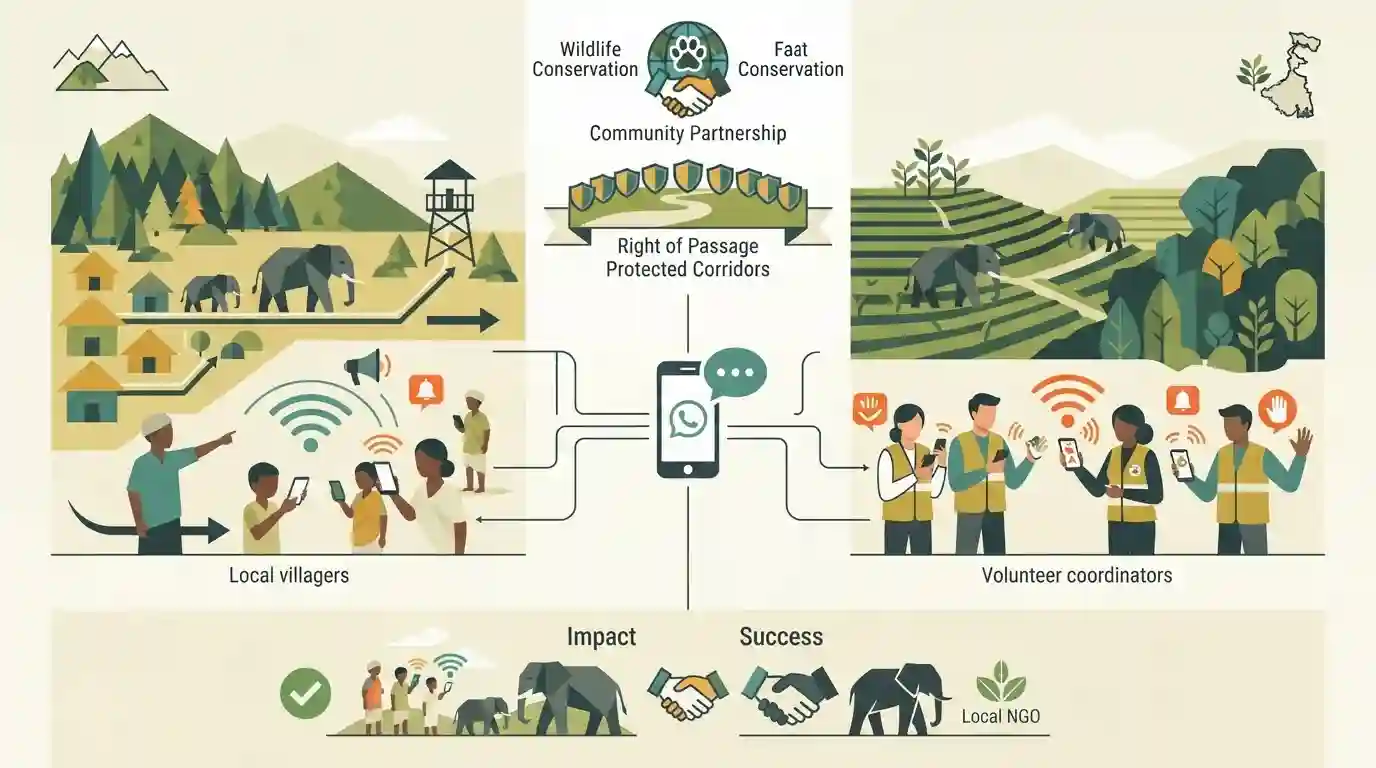
To mitigate human-elephant conflict (HEC), local communities in Uttarakhand and West Bengal are utilizing WhatsApp-based early warning systems. In Uttarakhand's Nawabwala village, near the Teen Pani and Kasurbhatkot corridors, the 'Gaj Vaani' group alerts residents about elephant movements. Similarly, in the Dooars tea gardens of Jalpaiguri, West Bengal, volunteers coordinate via WhatsApp to prevent fatal encounters. These community-led initiatives are supported by the Wildlife Trust of India's (WTI) 'Right of Passage' program, which works with local NGOs like Nature's Buddy and SPOAR to safeguard India's 101 identified elephant corridors.
Key Points
- A WhatsApp-based early warning system named 'Gaj Vaani' has been introduced in Nawabwala village (Uttarakhand) to alert residents of wild elephant movements and mitigate human-elephant conflict.
- The Wildlife Trust of India (WTI), under its 'Right of Passage' initiative, has partnered with grassroots NGOs like Nature's Buddy and SPOAR to secure and monitor vital elephant corridors.
- In the tea gardens of West Bengal's Dooars region (Jalpaiguri), similar community-driven WhatsApp networks and physical patrols help protect workers from accidental encounters with migrating elephants.
- WTI's recent mappings identify 101 critical elephant corridors across India, underscoring the importance of community involvement in maintaining ecological connectivity.
- These tech-enabled, grassroots efforts were highlighted in the context of World Elephant Day (August 12), focusing on harmonious human-wildlife coexistence.
Important Terms
Project Elephant

A Centrally Sponsored Scheme launched in 1992 by the MoEFCC to protect elephants, their habitats, and corridors, while addressing human-elephant conflict and the welfare of captive elephants.
UPSC context
Crucial for UKPSC GS Paper 3 (Environment). Tests knowledge of flagship central conservation schemes and human-wildlife conflict mitigation.
Right of Passage Initiative
A flagship project by the Wildlife Trust of India (WTI) designed to identify, legally secure, and protect 101 crucial elephant corridors across India to ensure safe, unhindered wildlife migration.
UPSC context
Relevant for UKPSC GS Paper 3. Tests knowledge of habitat connectivity and key NGO-led national conservation programs.
Wildlife Trust of India (WTI)
A prominent Indian nature conservation organization that collaborates with communities and governments to protect endangered species, secure wildlife corridors, and address human-wildlife conflicts.
UPSC context
Important for UKPSC GS Paper 3; highlights the role of major non-governmental stakeholders in India's biodiversity conservation and policy.
Gaj Vaani (WhatsApp Network)
A WhatsApp-based early warning network launched in Uttarakhand's Nawabwala village. It rapidly circulates verified elephant sightings and safety alerts among residents and forest staff to prevent dangerous encounters.
UPSC context
High-yield for UKPSC State-Specific General Studies. Showcases the integration of accessible technology (WhatsApp) in localized human-wildlife conflict mitigation.
Nature's Buddy
A grassroots NGO based in Uttarakhand focusing on environmental conservation. It partners with WTI to implement community-led initiatives like the "Gaj Vaani" early warning system to safeguard elephant corridors.
UPSC context
Pertinent to UKPSC State-Specific GS; highlights local civil society efforts in Uttarakhand's environmental and wildlife protection.
Society for Protecting Ophiofauna & Animal Rights (SPOAR)
A Jalpaiguri-based NGO serving as WTI's local partner in West Bengal. It works to mitigate human-elephant conflict and secure safe wildlife passages, particularly through the Dooars tea estates.
UPSC context
Useful for GS Paper 3 (Conservation) to illustrate regional NGO models in managing human-wildlife coexistence in challenging landscapes.
Prelims Trap
'Right of Passage' is a statutory scheme of the Government of India.
Aspirants often confuse NGO initiatives with official government schemes. 'Right of Passage' is a publication and initiative by the Wildlife Trust of India (WTI), not the MoEFCC.
Static Concepts Connected
What are the key features of Project Elephant and Uttarakhand's elephant reserves?
- Project Elephant (1992): A Centrally Sponsored Scheme launched to protect elephants, their habitats, and corridors, while addressing issues of human-elephant conflict and welfare of captive elephants.
- Shivalik Elephant Reserve: Notified in 2002, it is Uttarakhand's premier elephant reserve, encompassing key protected areas like Rajaji National Park and Corbett Tiger Reserve within the Terai Arc.
- Legal Protection: Asian elephants are listed in Schedule I of the Wildlife (Protection) Act, 1972, and Appendix I of CITES, ensuring the highest degree of legal protection.
What defines an Elephant Corridor and why is it critical?
- Corridor Definition: A narrow strip of forested or contiguous land connecting two larger habitats, enabling safe movement and ensuring genetic diversity among isolated elephant populations.
- Fragmentation Threat: Linear infrastructure like roads, canals, and railways fragments habitats, forcing elephants into human-dominated landscapes, thereby severely increasing incidents of human-elephant conflict (HEC).
Cross-Topic Patterns
Tech in Wildlife Conservation
Community-driven tech like 'Gaj Vaani' on WhatsApp complements official tools such as the MoEFCC's 'Haathi' app and AI-based railway early warning systems to mitigate human-wildlife conflict.
Terai Arc Connectivity
The Teen Pani and Kasurbhatkot corridors emphasize the importance of the Shivalik-Terai landscape, which provides vital contiguous habitat for both elephants and tigers in Uttarakhand.

Expect a match-the-following on 'Gaj Vaani' (Uttarakhand) or a statement identifying WTI as the publisher of the 'Right of Passage' report.
Linked PYQs · 2
Linked PYQs · 2
- 2024UKPSC_PRELIMSGS1
Which of the following National Park of Uttarakhand has been included in Project Tiger Scheme in 2015 ?
- 2016UKPSC_PRELIMSGS1
Which of the following National Parks of Uttarakhand has been included in 'Project Tiger Scheme' in 2016?
