Amaravati Underground Power Grid Project for Smart Infrastructure
Source:etv-bharat ↗
Why It Matters
Highlights significant state-level investments in modern urban infrastructure and disaster-resilient utilities for Amaravati. This aligns with themes of sustainable city building, state economic development, and energy infrastructure, which are crucial for APPSC Group 1 state-specific current affairs.
Summary
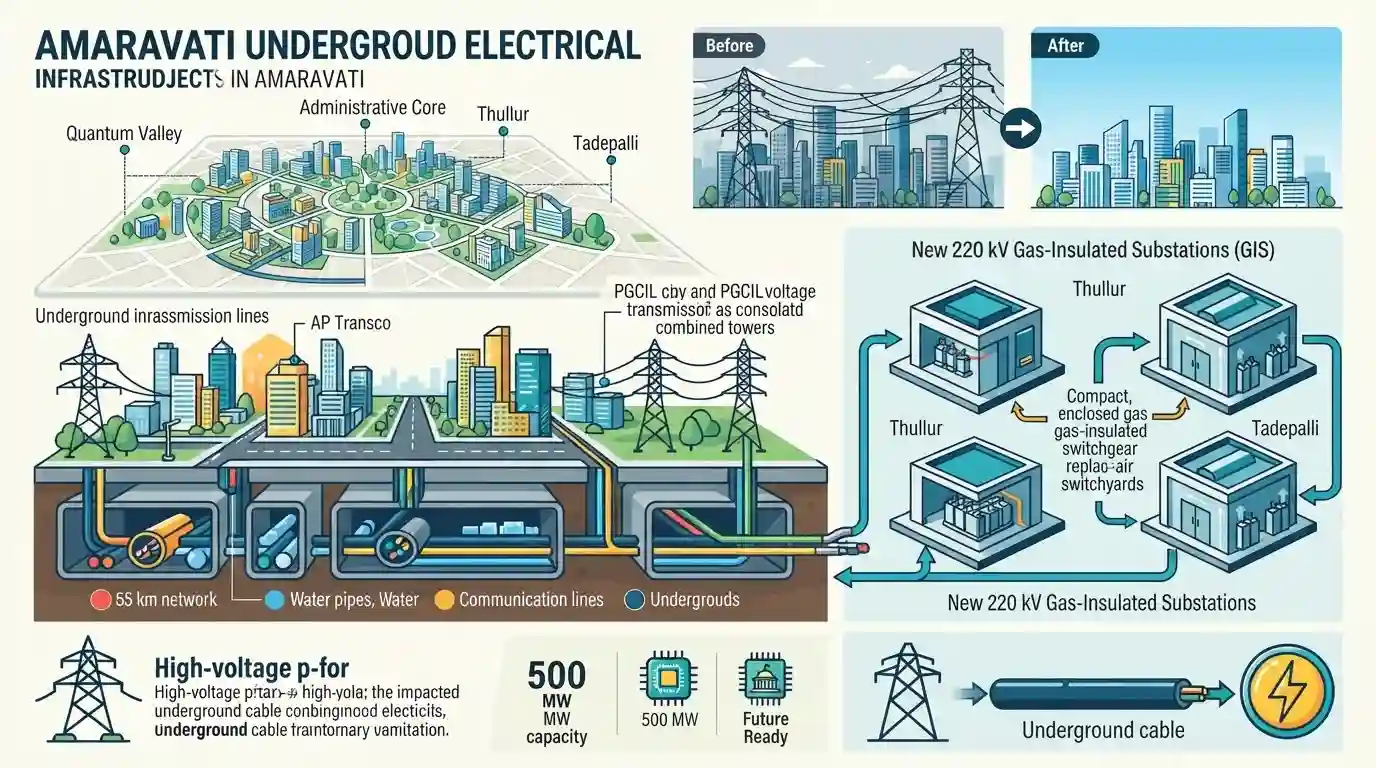
The Andhra Pradesh government is executing a Rs 1,979 crore project to develop advanced underground electrical infrastructure in Amaravati, aiming for an overhead-line-free capital city. The initiative includes rerouting high-voltage AP Transco and PGCIL transmission lines onto combined towers and laying approximately 55 km of underground cables through extensive utility ducts. To ensure a highly reliable supply of around 500 MW for critical future developments like Quantum Valley and administrative centers, four new 220 kV Gas-Insulated Substations (GIS) are being established at key locations including Thullur and Tadepalli.
Key Points
- The Andhra Pradesh government is investing Rs 1,979 crore to build a modern, overhead line-free electricity grid in the Amaravati capital region.
- AP Transco and PGCIL high-voltage transmission lines (400 kV and 220 kV) are being rerouted and consolidated onto combined towers to clear space for urban development.
- Around 55 km of underground power distribution cables are being laid via dedicated underground utility ducts to ensure storm-resilient supply.
- Four new 220 kV Gas-Insulated Substations (GIS) are planned at Thullur, Tadepalli, Lingayapalem, and Nelapadu to manage an estimated 500 MW power load.
- The underground infrastructure is specifically designed to support upcoming strategic zones like Quantum Valley, central government offices, and educational institutions without causing visual or spatial clutter.
Important Terms
Power Grid Corporation of India Ltd (PGCIL)

A Maharatna Central Public Sector Enterprise under the Ministry of Power, responsible for planning, implementing, and operating India's inter-state and national electrical transmission network.
UPSC context
Crucial for GS Paper 3 (Energy/Infrastructure), testing knowledge of central institutions driving national grid stability and renewable energy integration.
AP Transco
The state transmission utility of Andhra Pradesh, responsible for developing, maintaining, and operating the intra-state electricity grid and high-voltage transmission networks.
UPSC context
Relevant for GS Paper 3 (Infrastructure), highlighting the role of state-level bodies in executing large-scale power distribution and urban projects.
Gas-Insulated Substations (GIS)
Compact electrical substations where critical components are housed in metal enclosures insulated by sulfur hexafluoride (SF6) gas, drastically reducing land requirements and environmental vulnerability.
UPSC context
Vital for GS Paper 3 (Infrastructure), testing awareness of modern, space-efficient smart city technologies and climate-resilient urban infrastructure.
Underground Utility Ducts
Specially constructed underground pathways used to lay power cables and other utility lines, eliminating overhead wires to enhance urban aesthetics, safety, and disaster resilience.
UPSC context
Important for GS Paper 1 and 3 (Urbanization, Disaster Management), focusing on sustainable urban planning and modern smart city infrastructure.
Prelims Trap
Gas-Insulated Substations (GIS) are entirely climate-friendly as SF6 gas has zero global warming potential.
SF6 is heavily used in modern substations for insulation, but it is one of the most potent greenhouse gases (GWP ~23,500) under the Kyoto Protocol.
Static Concepts Connected
What is Sulfur Hexafluoride (SF6) and its environmental impact?
- Industrial Insulator: Used heavily in high-voltage electrical equipment like GIS because it prevents electrical arcing.
- Massive GWP: Possesses a Global Warming Potential 23,500 times that of CO2, persisting for thousands of years.
- Kyoto Protocol: Regulated under Annex A of the Kyoto Protocol as a major greenhouse gas.
What are the core targets of the National Quantum Mission (NQM)?
- Qubit Target: Aims to build intermediate-scale quantum computers with 50-1000 physical qubits within an 8-year timeframe.
- Four Verticals: Focuses on Quantum Computing, Communication, Sensing, and Materials through dedicated Thematic Hubs (T-Hubs).
- Secure Communications: Seeks to achieve secure quantum communications over 2000 km in India.
Cross-Topic Patterns
Quantum Mission dictates urban planning
Amaravati's Quantum Valley demonstrates how emerging tech policies like the NQM dictate specialized urban planning, demanding heavy-duty, highly reliable localized power infrastructure.
Infrastructure resilience vs climate goals
Undergrounding cables reduces cyclone vulnerability in coastal states, but utilizing GIS increases reliance on SF6, highlighting a trade-off between grid resilience and climate mitigation.

Expect a 2026 Prelims statement linking SF6 gas in modern electrical substations (GIS) to its massively high Global Warming Potential.
Linked PYQs · 2
Linked PYQs · 2
- 2019APPSC_PRELIMSGS1
What is the name of the project launched with the objective of computerization of Urban, Local bodies ?
- 2019APPSC_PRELIMSGS1
Which sector comprises water supply?
