Electoral Reforms Needed to Ensure Free and Fair Polls
Source:The Hindu ↗
Why It Matters
Highlights critical systemic issues within India's electoral democracy, offering specific reform proposals (proportional representation, caretaker government via President's Rule) and flagging the ongoing federal debate regarding constituency delimitation and its demographic penalty on Southern States.
Summary
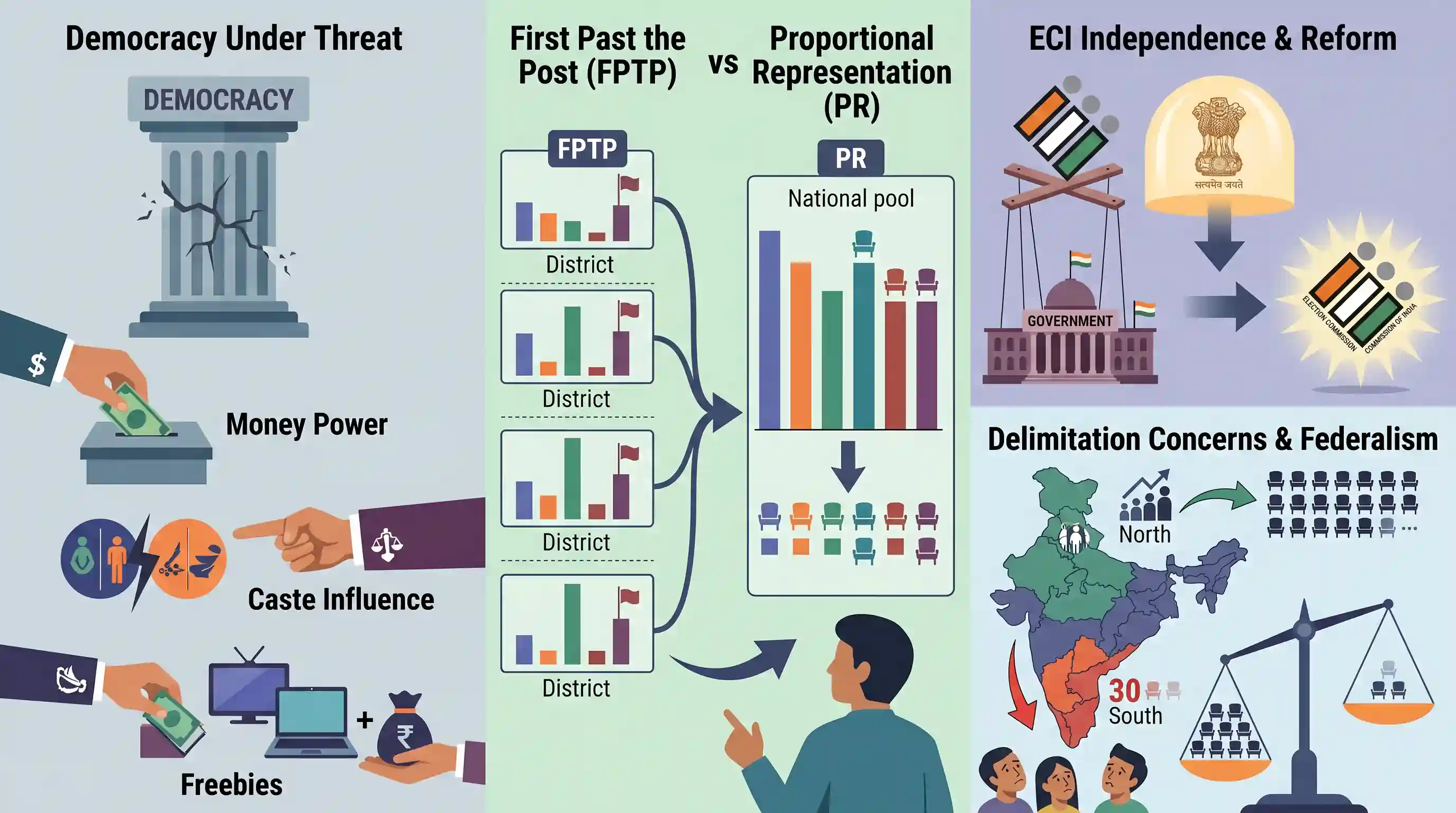
Former Special Chief Secretary of Andhra Pradesh, P.V. Ramesh, expressed concerns over the weakening of Indian democracy, citing the influence of money power, caste, and freebies in elections. Speaking at a Jana Chaitanya Vedika event, he recommended adopting a proportional representation electoral system and imposing President's Rule prior to elections to guarantee the Election Commission's independence. Additionally, concerns were raised regarding the potential loss of 30 Lok Sabha seats for Southern States in upcoming delimitation exercises, highlighting growing anxieties around federalism and political representation.
Key Points
- Former Andhra Pradesh Special Chief Secretary P.V. Ramesh argued that Indian elections are undermined by money power, caste, religion, and the promise of financially unviable freebies.
- Ramesh advocated for a proportional representation system, noting that under the First Past the Post system, parties with less than 33% of the vote share often secure power.
- To ensure free and fair polls without political interference, it was suggested that President's Rule be imposed three months prior to elections.
- Jana Chaitanya Vedika warned that Southern States could lose up to 30 Lok Sabha seats if the delimitation of constituencies proceeds, raising federalism concerns.
Important Terms
Election Commission of India (ECI)

A permanent constitutional body (Article 324) responsible for administering Union and State election processes, including Parliament, State Legislatures, and the offices of President and Vice-President.
UPSC context
GS Paper II: Polity & Governance; tests knowledge of institutional autonomy and electoral integrity.
Delimitation Commission
A high-power statutory body established under Articles 82 and 170 to redraw the boundaries of Lok Sabha and State Assembly constituencies based on the latest census data.
UPSC context
GS Paper II: Federalism & Representation; relevant to debates on population-based seat allocation and regional representation.
Proportional Representation (PR)
An electoral system where parties gain seats in proportion to the total number of votes they receive, ensuring that a party's legislative presence reflects its popular vote share.
UPSC context
GS Paper II: Electoral reforms; tests understanding of alternative democratic frameworks compared to the current system.
First-Past-The-Post (FPTP)
A voting system where the candidate with the most votes in a constituency wins, even if they do not secure an absolute majority of total votes cast.
UPSC context
GS Paper II: Salient features of the Representation of People's Act and Indian electoral mechanics.
President's Rule (Article 356)
The suspension of state government and imposition of direct Union rule under Article 356 when the constitutional machinery of a state is deemed to have failed.
UPSC context
GS Paper II: Federal structure; tests understanding of emergency provisions and Union-State relations.
Federalism
A constitutional system where power is divided between a central authority and regional units; Indian federalism is often described as "quasi-federal" with a unitary bias.
UPSC context
GS Paper II: Basic structure of the Constitution; essential for issues regarding decentralization and state autonomy.
Prelims Trap
"Promising 'freebies' in an election manifesto constitutes a 'corrupt practice' under Section 123 of the Representation of the People Act, 1951."
The SC (Subramaniam Balaji case) ruled manifesto promises do not amount to "corrupt practices" under the RPA. They are instead regulated by the ECI's Model Code of Conduct.
Static Concepts Connected
How does the Constitution regulate the delimitation of parliamentary constituencies?
- Article 82: Mandates Parliament to enact a Delimitation Act after every census to readjust constituency boundaries and seat allocations.
- 84th Amendment: Froze the total number of Lok Sabha seats based on 1971 census data until the first census figures published after the year 2026.
- Federal balance: The freeze was intended to avoid politically penalizing states (like Southern states) that effectively implemented family planning and population control measures.
Where is Proportional Representation used in the Indian electoral system?
- FPTP dominance: Direct elections to the Lok Sabha and State Legislative Assemblies use the First-Past-The-Post system for its simplicity and tendency to produce stable governments.
- PR application: Proportional Representation (Single Transferable Vote) is constitutionally restricted to indirect elections: President, Vice-President, Rajya Sabha, and Legislative Councils.
- Reform proposals: The Law Commission's 170th Report recommended experimenting with a Mixed-Member Proportional Representation system to bridge the gap between vote share and seat share.
Cross-Topic Patterns
Delimitation & Fiscal Federalism
Southern states' fear of losing Lok Sabha seats mirrors their grievances regarding Finance Commission terms of reference, which use modern census data and theoretically reduce their share of the divisible tax pool.
Freebies & State Fiscal Deficits
The political promise of unviable freebies directly links to macroeconomic stability concerns, tying into RBI warnings about off-budget borrowings and mounting State-level debt-to-GDP ratios.

The looming post-2026 delimitation makes the 84th Amendment and Article 82 prime targets for a 2026 Prelims multi-statement question.
Linked PYQs · 5
Linked PYQs · 5
- 2024MainsGS2
Examine the need for electoral reforms as suggested by various committees with particular reference to "one nation one election" principle.
- 2025MainsGS2
Discuss the 'corrupt practices' for the purpose of the Representation of the People Act, 1951. Analyze whether the increase in the assets of the legislators and/or their associates, disproportionate to their known sources of income, would constitute 'undue influence' and consequently a corrupt practice.
- 2020MainsGS2
There is a need for simplification of procedure for disqualification of persons found guilty of corrupt practices under the Representation of Peoples Act". Comment.
- 2017MainsGS2
To enhance the quality of democracy in India the Election Commission of India has proposed electoral reforms in 2016. What are the suggested reforms and how far are they significant to make democracy successful?
- 2022MainsGS2
Discuss the role of the Election Commission of India in the light of the evolution of the Model Code of Conduct.
