State finances growth jobs and fiscal federalism challenges
Source:Indian Express ↗
Why It Matters
Understanding state-level economic indicators such as fiscal deficit, debt-to-GDP ratio, and unemployment is crucial for UPSC aspirants. It forms the basis of questions on cooperative federalism, the FRBM Act, regional economic disparities, and the challenge of jobless growth in GS Papers 2 and 3.
Summary
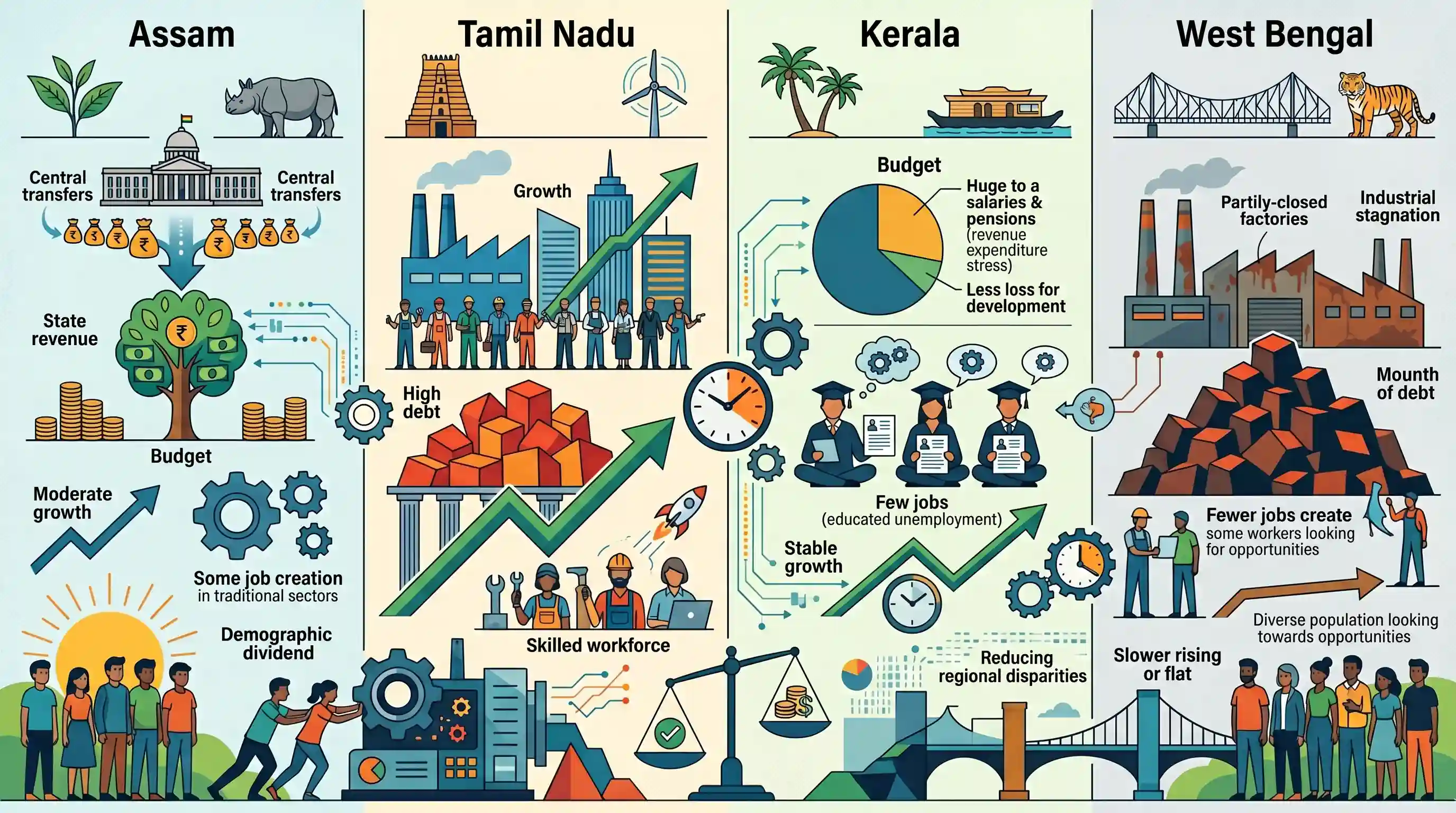
An analysis of the state economies of Assam, Tamil Nadu, Kerala, and West Bengal ahead of the 2026 elections reveals diverse macroeconomic challenges. While Tamil Nadu shows strong growth, it faces debt concerns. Kerala struggles with high educated unemployment and revenue expenditure stress. West Bengal faces industrial stagnation and high debt burdens, whereas Assam relies heavily on central transfers. The comparative fiscal health, job creation records, and growth trajectories of these states highlight the broader national challenges of maintaining fiscal prudence, reducing regional disparities, and leveraging the demographic dividend.
Key Points
- The economic performance of Assam, Tamil Nadu, Kerala, and West Bengal provides crucial insights into state-level growth trajectories ahead of the 2026 assembly elections.
- Tamil Nadu exhibits robust industrial and economic growth but faces challenges in debt management and fiscal deficit.
- Kerala maintains high human development indicators but grapples with high educated unemployment and fiscal stress driven by substantial revenue expenditure.
- West Bengal struggles with industrial stagnation, inadequate job creation, and a high debt burden, limiting its capacity for capital expenditure.
- Assam remains heavily dependent on central government transfers and agriculture, highlighting the necessity to enhance local revenue generation and industrialize.
- Across these states, balancing fiscal prudence under FRBM guidelines while generating sufficient employment remains a defining electoral and governance challenge.
Important Terms
Fiscal Responsibility and Budget Management (FRBM) Act

A 2003 law aimed at ensuring fiscal discipline by setting targets for the government to reduce fiscal deficits and eliminate revenue deficits over time.
UPSC context
GS Paper 3: Indian Economy. Crucial for understanding fiscal policy, deficit management, and state-level financial discipline.
Finance Commission
A constitutional body (Article 280) that determines the formula for sharing central tax revenues with states and recommends grants-in-aid to balance vertical and horizontal fiscal imbalances.
UPSC context
GS Paper 2 & 3: Governance and Economy. Key for fiscal federalism and resource allocation between Center and States.
Fiscal Federalism
The economic framework governing the distribution of financial powers and responsibilities between the Union and State governments, focusing on tax sharing and grants.
UPSC context
GS Paper 2: Constitution and Polity. Central to discussions on cooperative federalism and regional economic disparities.
Revenue Expenditure
Government spending on operational requirements like salaries, pensions, and interest payments which do not result in the creation of permanent assets.
UPSC context
GS Paper 3: Indian Economy. Tests understanding of budget components and the quality of government spending.
Reserve Bank of India (RBI)
India's central bank which acts as a banker to State governments, manages their market borrowings, and monitors their debt sustainability.
UPSC context
GS Paper 3: Indian Economy. Relevant for monetary policy and its role in managing public debt.
Prelims Trap
Higher revenue expenditure by state governments reflects higher state capacity for infrastructure and capital asset creation.
Revenue expenditure covers day-to-day needs (salaries, pensions, subsidies) and creates no physical assets. When it balloons, it severely "crowds out" funds available for productive capital expenditure.
Static Concepts Connected
What are the key FRBM targets for state governments?
- Fiscal Deficit: Generally capped at 3% of Gross State Domestic Product (GSDP), with temporary conditional relaxations (e.g., tied to power sector reforms).
- Revenue Deficit: States are mandated to eliminate revenue deficits entirely and build revenue surpluses.
- Debt-to-GSDP Ratio: The NK Singh Committee recommended capping the debt-to-GSDP ratio at 20% for state governments.
What is the difference between Vertical and Horizontal fiscal imbalance?
- Vertical Imbalance: The structural mismatch where the Centre holds broader tax-raising powers while States bear heavier expenditure responsibilities (health, policing).
- Horizontal Imbalance: The disparity in economic capacity, historical development, and resource availability among different states (e.g., industrialized Tamil Nadu vs agrarian Assam).
Cross-Topic Patterns
Demographic dividend vs educated unemployment
Kerala's high HDI combined with high educated unemployment perfectly illustrates how social development without corresponding industrial/manufacturing growth fails to capture the demographic dividend.
Fiscal Federalism + Finance Commission criteria
Assam's reliance on Central transfers underscores the ongoing debate over the 16th Finance Commission's formula for balancing equity (horizontal imbalance) with efficiency (rewarding states like TN).

Expect a Mains question linking state HDI paradoxes to educated unemployment, and how rising revenue expenditure crowds out capex.
Linked PYQs · 5
Linked PYQs · 5
- 2025MainsGS3
Explain how the Fiscal Health Index (FHI) can be used as a tool for assessing the fiscal performance of states in India. In what way would it encourage the states to adopt prudent and sustainable fiscal policies?
- 2022MainsGS3
Economic growth in the recent past has been led by increase in labour productivity." Explain this statement. Suggest the growth pattern that will lead to creation of more jobs without compromising labour productivity.
- 2014MainsGS3
While we flaunt India's demographic dividend, we ignore the dropping rates of employability. What are we missing while doing so? Where will the jobs that India desperately needs come from? Explain.
- 2015MainsGS2
The concept of cooperative federalism has been increasingly emphasized in recent years. Highlight the drawbacks in the existing structure and the extent to which cooperative federalism would answer the shortcomings.
- 2025MainsGS2
Examine the evolving pattern of Centre-State financial relations in the context of planned development in India. How far have the recent reforms impacted the fiscal federalism in India?
