Supreme Court Examines Election Commissioners Appointment Law
Source:Indian Express ↗
Why It Matters
It touches upon the core principles of democracy, institutional independence of the Election Commission of India, and the checks and balances between the judiciary and the legislature.
Summary
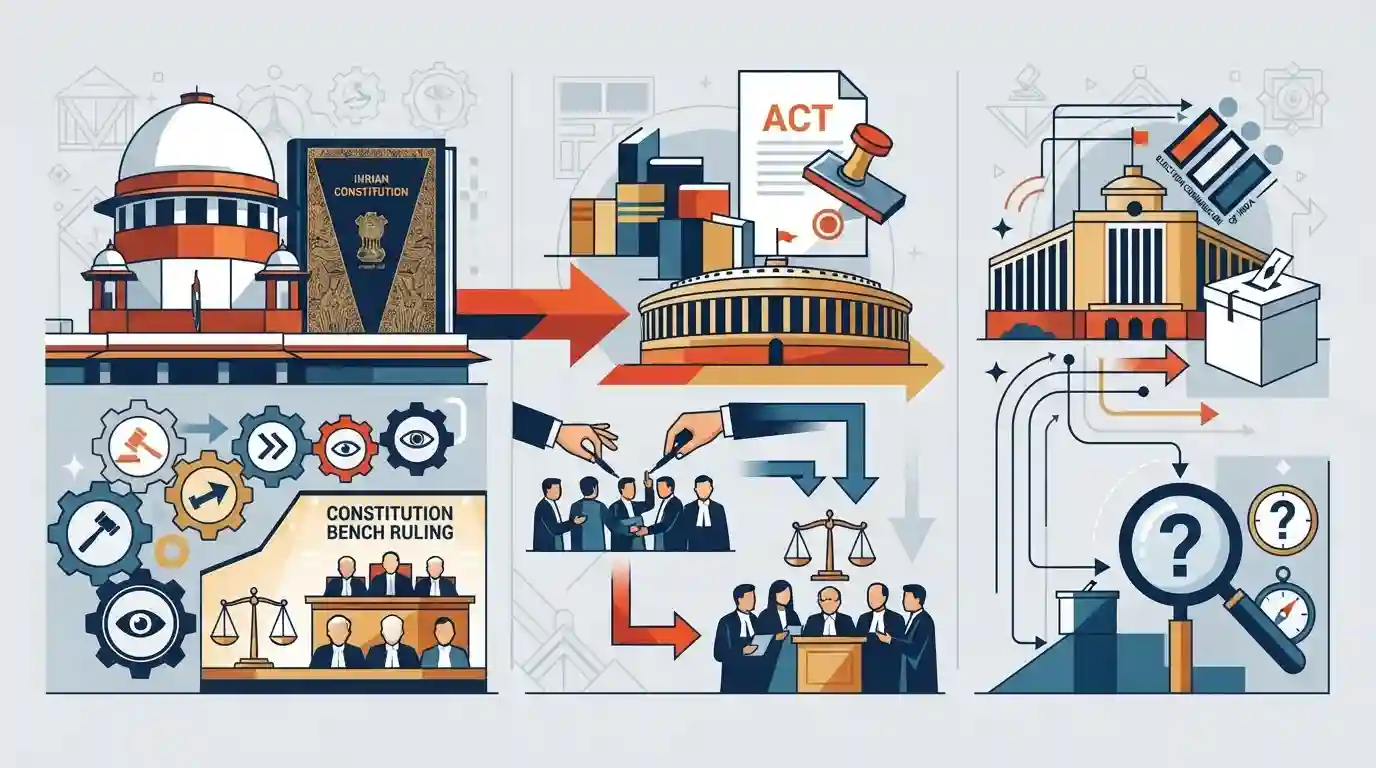
An analysis of the legal and constitutional dimensions surrounding the appointment of Election Commissioners, following challenges before the Supreme Court against the legislative framework enacted by Parliament modifying the selection committee composition previously mandated by a Constitution Bench.
Key Points
- The Supreme Court examined challenges to the law governing the appointment of Election Commissioners (ECs) and the Chief Election Commissioner (CEC).
- The case traces back to a landmark Constitution Bench judgment that sought to insulate the poll panel's appointment from executive dominance by including the CJI in the selection committee.
- Subsequent legislative action by Parliament modified the composition of the selection committee, sparking fresh legal debates concerning institutional independence and separation of powers.
Important Terms
Chief Election Commissioner and other Election Commissioners (Appointment, Conditions of Service and Term of Office) Act, 2023

A 2023 legislation that regulates the appointment, conditions of service, and term of office of the Chief Election Commissioner and other Election Commissioners, altering the selection committee by replacing the Chief Justice of India with a Union Cabinet Minister.
UPSC context
UPSC GS Paper II (Polity and Governance): Tests statutory provisions, separation of powers, and institutional independence of constitutional bodies.
Election Commission of India
An independent constitutional body established under Article 324 of the Constitution to superintend, direct, and control the conduct of free and fair elections in India.
UPSC context
UPSC GS Paper II: Essential constitutional body; tests functions, powers, autonomy, and appointment mechanisms of electoral watchdogs.
Supreme Court
The apex judicial tribunal of India and the final interpreter of the Constitution, possessing powers of judicial review over legislative enactments and executive actions.
UPSC context
UPSC GS Paper II: Tests judicial review, basic structure doctrine, constitutional interpretation, and checks and balances between organs of the state.
Static Concepts Connected
What are the constitutional provisions regarding the composition and removal of the Election Commission of India?
- Constitutional Basis: Article 324 provides for the ECI, consisting of the CEC and such number of other ECs as the President may fix from time to time.
- Appointment Power: Article 324(2) states appointments are made by the President, subject to any law made by Parliament.
- Removal of CEC: The CEC can be removed from office only in like manner and on the like grounds as a Judge of the Supreme Court.
- Removal of ECs: Other ECs can be removed only upon the recommendation of the Chief Election Commissioner.
Cross-Topic Patterns
Election Appointments vs. Basic Structure Doctrine
The debate on ECI appointments ties directly into the 'Basic Structure' doctrine and the separation of powers between Parliament's statutory authority and judicial review.

Expect a statement-based prelims question pairing Article 324(2) provisions with the exact composition of the 2023 Selection Committee.
Linked PYQs · 2
Linked PYQs · 2
- 2022MainsGS2
Discuss the role of the Election Commission of India in the light of the evolution of the Model Code of Conduct.
- 2023MainsGS2
“Constitutionally guaranteed judicial independence is a prerequisite of democracy.” Comment.
