Supreme Court Constitution Bench Reviews Election Commissioners Law
Source:Indian Express ↗
Why It Matters
Crucial for understanding the delicate balance of power between the judiciary, executive, and legislature in maintaining the autonomy of independent constitutional bodies like the Election Commission of India.
Summary
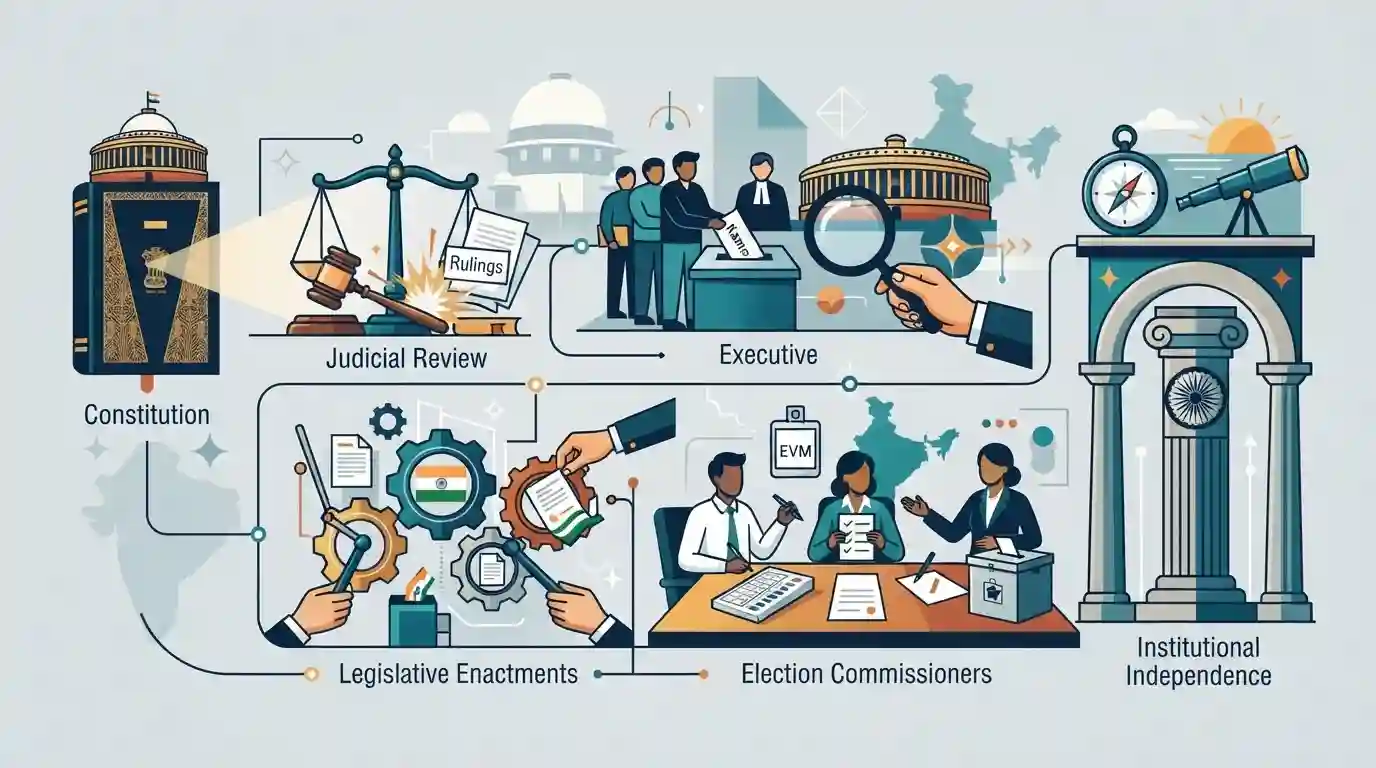
An analysis of the legal and constitutional dimensions surrounding the appointment of Election Commissioners in India, reviewing Supreme Court rulings, legislative enactments, and institutional independence.
Key Points
- The Supreme Court examined the legal framework and constitutional bench rulings regarding the appointment of Election Commissioners.
- Debates continue around the composition of selection panels for election watchdogs to ensure institutional autonomy.
- Article 324(2) empowers Parliament to enact laws regulating the appointment of Election Commissioners in the absence of a permanent legislative framework.
Important Terms
Chief Election Commissioner and other Election Commissioners (Appointment, Conditions of Service and Term of Office) Act

A 2023 statute governing the appointment and service conditions of top election officials, which notably replaced the Chief Justice of India with a Union Cabinet Minister on the selection panel.
UPSC context
GS Paper II (Polity & Governance) - Statutory bodies, separation of powers, executive oversight, and independence of constitutional authorities.
Article 324 of the Constitution
The constitutional provision empowering the Election Commission with the superintendence, direction, and control of elections in India, subject to provisions of any law made by Parliament.
UPSC context
GS Paper II (Indian Constitution - Historical Underpinnings, Features, Amendments, Significant Provisions). Tests understanding of constitutional offices.
Election Commission of India
A permanent independent constitutional body responsible for administering election processes in India for Lok Sabha, Rajya Sabha, State Legislative Assemblies, and the offices of the President and Vice-President.
UPSC context
GS Paper II (Constitutional Bodies) - Roles, responsibilities, institutional independence, and current challenges in electoral governance.
Supreme Court of India
The apex judicial body of India with the power of judicial review, responsible for interpreting the Constitution and checking legislative or executive overreach.
UPSC context
GS Paper II (Judiciary) - Judicial review, basic structure doctrine, constitutional interpretation, and separation of powers.
Prelims Trap
The Constitution of India under Article 324(2) mandates that Election Commissioners must be appointed on the advice of a collegium including the Chief Justice of India.
Article 324(2) itself does not mandate a collegium with the CJI; it explicitly makes appointments subject to any law made by Parliament. The CJI inclusion was an interim judicial arrangement until Parliament legislated.
Static Concepts Connected
What are the constitutional provisions and safeguards regarding the Election Commission of India under the Indian Constitution?
- Article 324 Mandate: Article 324 vests superintendence, direction, and control of elections in an Election Commission consisting of the Chief Election Commissioner and such number of other Commissioners as the President may fix.
- Removal Safeguard: Chief Election Commissioner is provided security of tenure akin to a Supreme Court judge and cannot be removed except through impeachment.
- Other Commissioners: Other Election Commissioners can be removed only upon the recommendation of the Chief Election Commissioner.
- Service Conditions: Conditions of service of the CEC shall not be varied to their disadvantage after their appointment.
Cross-Topic Patterns
ECI Independence & Central Bureaucracy Appointments
The debate over EC appointment panels mirrors the broader struggle for insulation of autonomous investigative and regulatory bodies from executive dominance.
Judicial Activism vs. Parliamentary Supremacy
The 2023 legislative override of the Supreme Court's interim formula illustrates the classic friction between judicial standard-setting and parliamentary sovereignty under Article 324.

Article 324(2) + Anoop Baranwal ruling + 2023 Act composition (PM, Cabinet Minister, LoP) is prime fodder for a statement-based prelims question.
Linked PYQs · 2
Linked PYQs · 2
- 2024MainsGS2
Examine the need for electoral reforms as suggested by various committees with particular reference to "one nation one election" principle.
- 2017PrelimsGS1
Consider the following statements: 1. The Election Commission of India is a five-member body. 2. Union Ministry of Home Affairs decides the election schedule for the conduct of both general elections and bye-elections. 3. Election Commission resolves the disputes relating to splits/mergers of recognised political parties. Which of the statements given above is/are correct?
