Election commission measures for free and fair elections in bengal
Source:The Hindu ↗
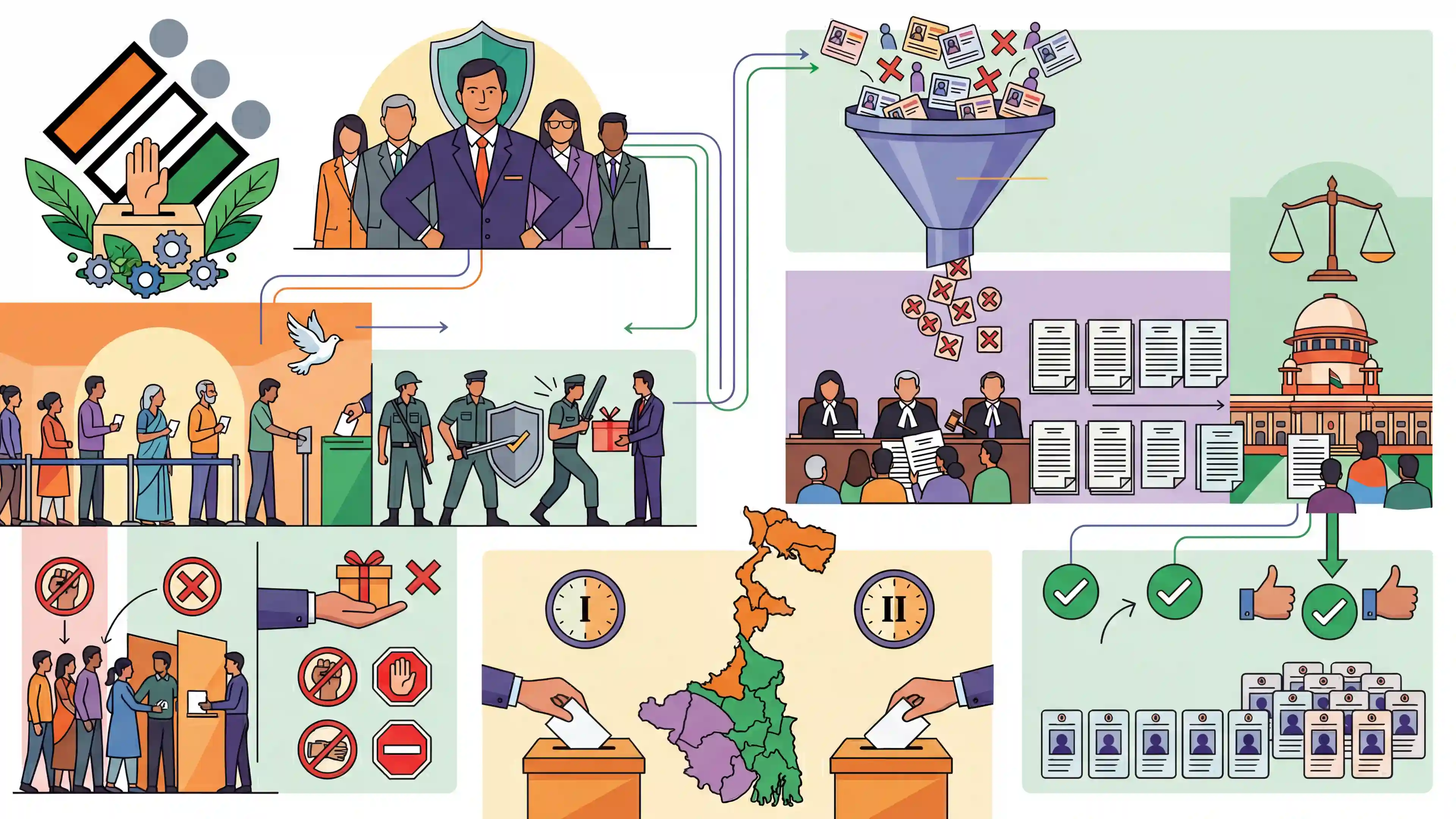
Why It Matters
Demonstrates the functional autonomy and proactive role of the Election Commission of India under Article 324 in safeguarding democratic processes. It highlights the practical challenges of maintaining accurate electoral rolls and the mechanisms available for resolving electoral disputes and ensuring fair representation.
Summary
The Election Commission of India (ECI), led by Chief Election Commissioner Gyanesh Kumar, has guaranteed a "free, fair, and transparent" two-phase Assembly election in West Bengal. The Commission has pledged a zero-tolerance approach toward electoral malpractices, ensuring the polls are free from fear, violence, intimidation, inducement, and booth-jamming. Additionally, the ECI has addressed controversies surrounding the Special Intensive Revision of electoral rolls—which resulted in over 90 lakh deletions—by establishing special tribunals. These tribunals, sanctioned by the Supreme Court, are reviewing around 27 lakh appeals and clearing eligible voters for inclusion in supplementary lists.
Key Points
- The Election Commission of India (ECI) has pledged to ensure completely "free, fair, and transparent" Assembly elections in West Bengal.
- Chief Election Commissioner Gyanesh Kumar stated that the elections would be fear-free, violence-free, intimidation-free, and inducement-free, specifically checking malpractices like booth-jamming.
- To ensure impartiality, strict instructions were issued to prevent any interference by state government, local, or autonomous bodies during the electoral process.
- Following a contentious Special Intensive Revision where over 90 lakh names were deleted from electoral rolls, the ECI set up special tribunals to handle appeals.
- With the Supreme Court's permission, approximately 27 lakh appeals were reviewed, and cleared individuals are being included in supplementary electoral lists.
Important Terms
Election Commission of India (ECI)

A permanent, independent constitutional body established under Article 324 to conduct elections for Parliament, State Legislatures, and the offices of the President and Vice-President of India.
UPSC context
GS II: Constitutional Bodies. Core topic for understanding electoral governance and the independence of democratic institutions.
Model Code of Conduct (MCC)
A set of non-statutory guidelines issued by the ECI to regulate political parties and candidates during elections, ensuring a level playing field and preventing the misuse of official machinery.
UPSC context
GS II: Electoral Reforms. Tests knowledge of administrative powers and ethical conduct in the democratic process.
Representation of the People Act (RPA)
Twin legislations (1950 and 1951) forming the legal backbone of Indian elections; they govern voter registration, seat allocation, conduct of polls, and disqualification of representatives.
UPSC context
GS II: Salient features of the RPA. A mandatory syllabus topic for electoral law and candidate qualifications.
Special Intensive Revision (SIR)
A rigorous ECI-led exercise to purify electoral rolls by removing ineligible, deceased, or duplicate entries through door-to-door verification and judicial adjudication of claims and objections.
UPSC context
GS II: Governance/Elections. Relevant for issues concerning voter disenfranchisement, data integrity, and the constitutional right to vote.
Free and Fair Elections
A fundamental principle and part of the 'Basic Structure' of the Constitution, ensuring that the electoral process is transparent, impartial, and free from fear or malpractice.
UPSC context
GS II: Indian Constitution. Central to understanding democratic integrity and the judiciary's role in protecting the electoral process.
Prelims Trap
The RPA 1951 governs electoral roll revisions, and civil courts can adjudicate appeals against mass voter deletions.
Preparation and revision of electoral rolls are governed by RPA 1950, not 1951. Furthermore, Section 30 of RPA 1950 explicitly bars civil courts from hearing registration disputes.
Static Concepts Connected
What is the core difference between RPA 1950 and RPA 1951?
- RPA 1950: Deals with delimitation of constituencies, allocation of seats, and the preparation/revision of electoral rolls.
- RPA 1951: Deals with the actual conduct of elections, qualifications/disqualifications, corrupt practices (like booth capturing), and election disputes.
How does the Constitution empower the ECI to ensure free and fair elections?
- Article 324: Vests the power of superintendence, direction, and control of elections solely in the Election Commission.
- Basic Structure: The Supreme Court has repeatedly held that "free and fair elections" are a part of the Basic Structure of the Constitution.
- Plenary Powers: Under Article 324, the ECI has plenary powers to issue orders and ensure fair polls in areas where enacted laws are silent.
Cross-Topic Patterns
Electoral Rolls & the Right to Vote
Mass electoral roll deletions touch upon Article 326 (Right to Vote). UPSC often tests the nature of this right (a constitutional/statutory right, not fundamental) alongside RPA provisions.
ECI Independence vs Executive Control
The ECI's pledge for impartiality in state elections is highly relevant for Mains GS2, especially when contrasted with the recent CEC and ECs (Appointment) Act, 2023, which altered the selection panel.

Expect a Prelims question testing the exact statutory boundaries between RPA 1950 (electoral rolls) and 1951 (corrupt practices).
Linked PYQs · 4
Linked PYQs · 4
- 2022MainsGS2
Discuss the role of the Election Commission of India in the light of the evolution of the Model Code of Conduct.
- 2024MainsGS2
Examine the need for electoral reforms as suggested by various committees with particular reference to "one nation one election" principle.
- 2017PrelimsGS1
Consider the following statements: 1. The Election Commission of India is a five-member body. 2. Union Ministry of Home Affairs decides the election schedule for the conduct of both general elections and bye-elections. 3. Election Commission resolves the disputes relating to splits/mergers of recognised political parties. Which of the statements given above is/are correct?
- 2022MainsGS2
Discuss the procedures to decide the disputes arising out of the election of a Member of the Parliament or State Legislature under The Representation of the People Act, 1951. What are the grounds on which the election of any returned candidate may be declared void ? What remedy is available to the aggrieved party against the decision ? Refer to the case laws.
