Election Commission Special Summary Revision of Electoral Rolls
Source:Indian Express ↗
Why It Matters
Understanding the mechanics of electoral roll updates and the role of the Election Commission is vital for evaluating administrative processes ensuring free and fair elections in Indian democracy.
Summary
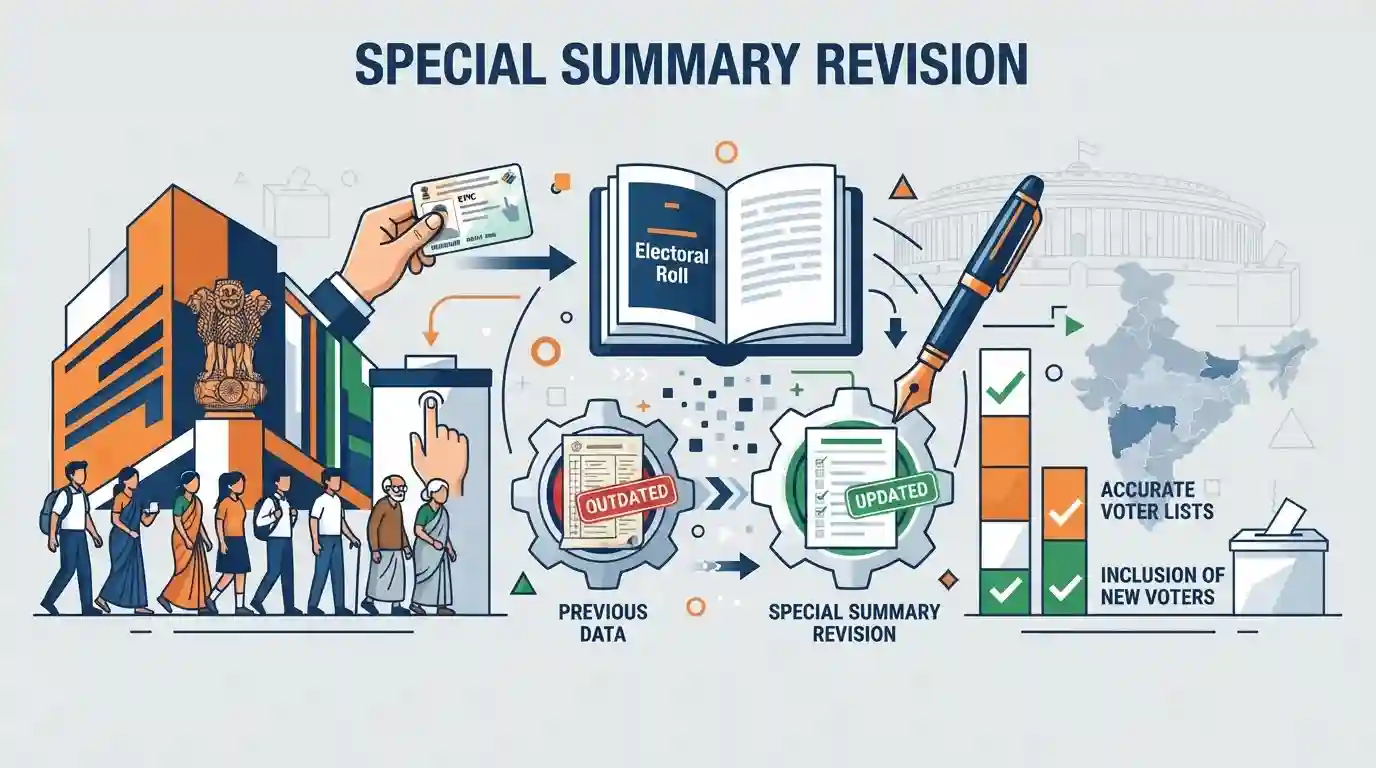
The Election Commission of India has announced the commencement of the Special Summary Revision of electoral rolls in states where the Special Intensive Revision (SIR) cycle has been completed, aimed at maintaining accurate and updated voter lists.
Key Points
- The Election Commission of India initiated the Special Summary Revision of electoral rolls in states where the intensive revision (SIR) phase has concluded.
- The process ensures the purification of voter rolls, addition of eligible new voters, and removal of discrepancies or deceased/shifted voters.
- Regular summary revisions are crucial for maintaining the integrity and credibility of democratic electoral processes in India.
Important Terms
Election Commission of India

An autonomous constitutional authority responsible for administering election processes in India, including superintendence, direction, and control of elections to Parliament, State Legislatures, and the offices of the President and Vice-President.
UPSC context
UPSC CSE Prelims and Mains (GS Paper II): Statutory, regulatory, and quasi-judicial bodies; tests understanding of constitutional mandates and democratic administration.
Representation of the People Act
Parliamentary legislation that provides the legal framework for the allocation of seats, delimitation of constituencies, qualifications for voters, and preparation of electoral rolls in India.
UPSC context
UPSC CSE Prelims and Mains (GS Paper II): Features of Indian Constitution and governance; tests statutory provisions regulating elections and electoral rolls.
Special Summary Revision
A periodic administrative exercise conducted by the ECI to update, cleanse, and correct existing electoral rolls by adding newly eligible voters and removing ineligible entries.
UPSC context
UPSC CSE Prelims and Mains (GS Paper II): Elections and representation; tests knowledge of electoral processes and voter list management.
Static Concepts Connected
What are the constitutional provisions and statutory framework governing electoral rolls in India?
- Constitutional Mandate:: Vested in the Election Commission of India under Article 324 for superintendence, direction, and control of all elections.
- RPA 1950:: Provides for the allocation of seats and delimitation of constituencies for Lok Sabha and State Legislative Assemblies.
- RPA 1951:: Governs the preparation and revision of electoral rolls, qualifications, and disqualifications of electors.
- Registration Rules:: Details the machinery, registration officers, and procedural rules for claims and objections during roll revisions.
Cross-Topic Patterns
Electoral Rolls + Citizenship & Federalism
Electoral roll revisions intersect with citizenship verification drives, constitutional federalism, and the delimitation exercise, testing executive oversight versus independent constitutional bodies.

Article 324 powers + RPA 1950 qualification dates likely to be tested via a multi-statement assertion-reasoning question.
Linked PYQs · 5
Linked PYQs · 5
- 2024PrelimsGS1
As per Article 368 of the Constitution of India, the Parliament may amend any provision of the Constitution by way of : 1. Addition 2. Variation 3. Repeal Select the correct answer using the code given below:
- 2023PrelimsGS1
Consider the following statements in respect of election to the President of India: 1. The members nominated to either House of the Parliament or the Legislative Assemblies of States are also eligible to be included in the Electoral College. 2. Higher the number of elective Assembly seats, higher is the value of vote of each MLA of that State. 3. The value of vote of each MLA of Madhya Pradesh is greater than that of Kerala. 4. The value of vote of each MLA of Puducherry is higher than that of Arunachal Pradesh because the ratio of total population to total number of elective seats in Puducherry is greater as compared to Arunachal Pradesh. How many of the above statements are correct?
- 2020PrelimsGS1
Consider the following statements: 1. According to the Constitution of India, a person who is eligible to vote can be made a minister in a State for six months even if he/she is not a member of the Legislature of that State. 2. According to the Representation of People Act, 1951, a person convicted of a criminal offence and sentenced to imprisonment for five years is permanently disqualified from contesting an election even after his release from prison. Which of the statements given above is/are correct?
- 2024MainsGS2
Examine the need for electoral reforms as suggested by various committees with particular reference to "one nation one election" principle.
- 2020MainsGS2
Recent amendments to the Right to Information Act will have profound impact on the autonomy and independence of the Information Commission". Discuss.
