Election Commission Voter Registration and Judicial Accountability
Source:Indian Express ↗
આ શા માટે મહત્વનું છે
It touches upon the constitutional sanctity of the right to vote, the administrative accountability of the Election Commission of India, and the role of judicial review in safeguarding democratic processes.
સારાંશ
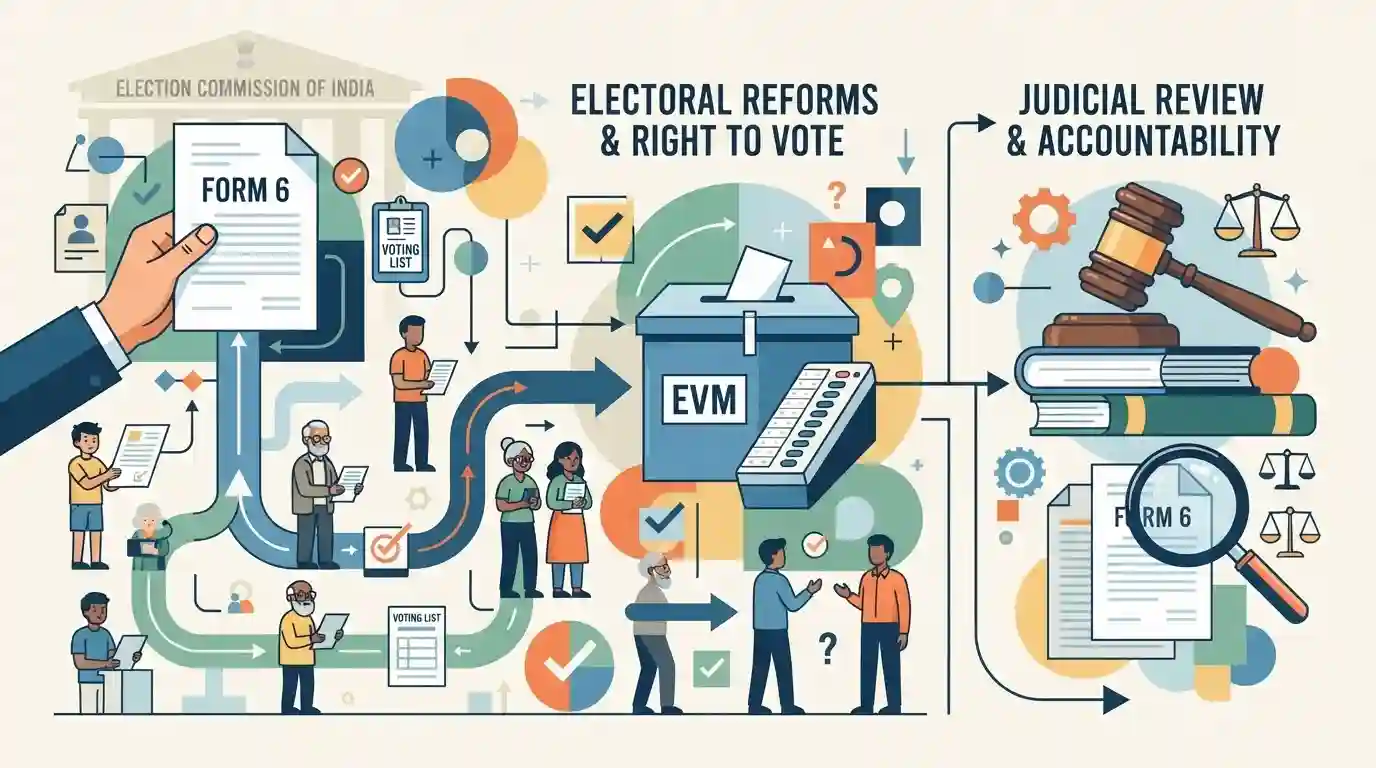
The article and associated judicial hearings focus on the Election Commission of India's handling of voter registration procedures, specifically concerning Form 6 and the protection of citizens' right to vote. It underscores the critical balance between administrative discretion by the poll panel and judicial oversight to ensure universal adult suffrage and institutional accountability.
મુખ્ય મુદ્દા
- The editorial and Supreme Court proceedings examine the mechanisms and accountability associated with the Election Commission of India (ECI) regarding voter registration and the right to vote via Form 6.
- Safeguarding the democratic right to vote requires transparent administrative processes and robust judicial oversight over electoral authorities.
- Concerns surrounding the ease of voter registration, potential disenfranchisement, and institutional trust form the core of debates on electoral governance in India.
મહત્વપૂર્ણ શબ્દો
Form 6

The official application form prescribed by the Election Commission of India for new voter registration and inclusion of names in the electoral rolls.
UPSC context
Important for GS Paper II (Polity and Governance - Electoral Process, ECI functioning, and voter rights).
Representation of the People Act
Key legislative enactments (1950 and 1951) passed by Parliament under Article 327 to regulate electoral rolls, conduct of elections, qualifications, and disqualifications.
UPSC context
Essential for GS Paper II (Polity and Governance - Statutory bodies, electoral laws, and framework).
Election Commission of India
An autonomous constitutional body established under Article 324 responsible for administering free and fair elections to Parliament, State Legislatures, and the offices of President and Vice-President.
UPSC context
Crucial for GS Paper II (Constitutional Bodies, Separation of Powers, and Democratic Governance).
Supreme Court of India
The apex judicial tribunal of the country empowered under Articles 32 and 136 to protect fundamental rights and exercise judicial review over administrative and statutory actions.
UPSC context
Core to GS Paper II (Judiciary, Judicial Review, Basic Structure Doctrine, and Checks and Balances).
પ્રિલિમ્સ ટ્રેપ
The right to vote is an absolute fundamental right under Part III of the Constitution.
Aspirants often assume the right to vote is a fundamental right (Part III) or solely a statutory right, missing its dual status as a constitutional right (Art 326) and statutory right.
સંલગ્ન સ્થિર ખ્યાલો
What is the constitutional and statutory status of the right to vote in India?
- Article 326: Constitutional Right: Derived from Article 326 of the Constitution, which provides for adult suffrage for Lok Sabha and Legislative Assembly elections.
- RPA & Rules: Statutory Right: Detailed and operationalized through provisions of the Representation of the People Act, 1950 and 1951, and the Registration of Electors Rules, 1960.
- Judicial Stance: Legal Nature: It is not a fundamental right under Part III, but a constitutional and statutory right subject to regulation by valid laws.
આંતર-વિષય પેટર્ન
Constitutional Rights vs. Statutory Electoral Rules
While Art. 326 guarantees adult suffrage, statutory registration via RPA 1950 and administrative rules determine actual access, balancing fraud prevention against citizen rights.
Judicial Review vs. Constitutional Body Autonomy
Judicial oversight of independent constitutional bodies like the ECI tests the doctrine of checks and balances in administrative law.

Expect a statement-based prelims question combining Art 326 (constitutional right) with RPA 1950 and statutory forms like Form 6.
સંલગ્ન PYQ · 2
સંલગ્ન PYQ · 2
- 2022MainsGS2
Discuss the role of the Election Commission of India in the light of the evolution of the Model Code of Conduct.
- 2017PrelimsGS1
Right to vote and to be elected in India is a
