Election Commission Special Intensive Revision and Internal Objections
Source:Indian Express ↗
Why It Matters
Important for understanding the internal functioning, administrative autonomy, and decision-making mechanisms of the Election Commission of India, which is critical for free and fair elections.
Summary
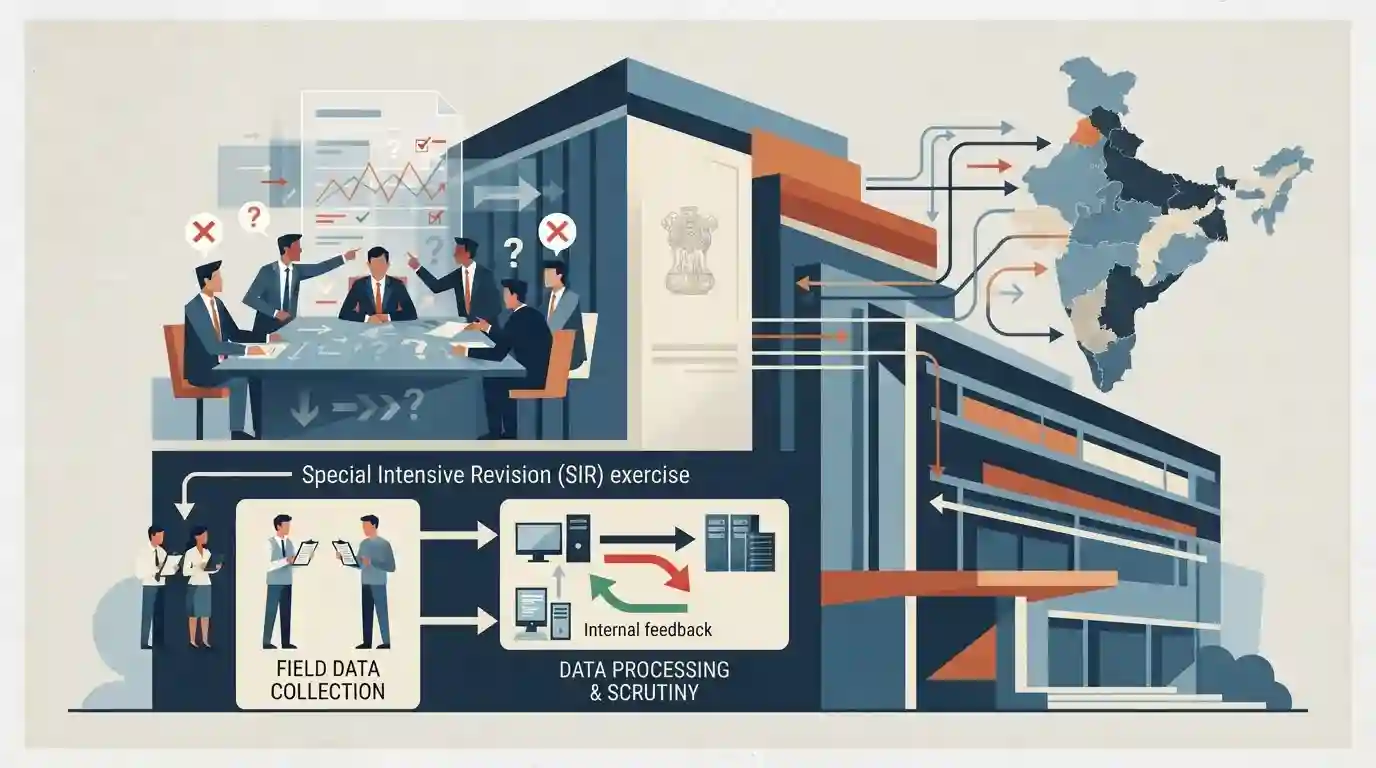
The article reports on internal dissent and objections raised by officials regarding the Election Commission's Special Intensive Revision (SIR) exercise, throwing light on the administrative challenges and decision-making dynamics within India's electoral body.
Key Points
- The Election Commission of India faced internal disagreements and objections regarding the Special Intensive Revision (SIR) exercise.
- Senior election officials, including election commissioners/officials, raised administrative and procedural concerns over the implementation of the SIR framework.
- The controversy highlights tensions within electoral management bodies regarding large-scale voter list revisions and transparency.
Important Terms
Special Intensive Revision (SIR)

A sweeping verification drive conducted across India to update electoral rolls by eliminating ineligible entries, correcting details, and ensuring accuracy ahead of elections.
UPSC context
UPSC Prelims/Mains (Polity & Governance): Tests understanding of electoral roll administration, voter registration procedures, and electoral reforms in India.
Election Commission of India (ECI)
An independent constitutional body under Article 324 of the Constitution responsible for administering all electoral processes in India, including Parliament and State Legislatures.
UPSC context
UPSC Prelims/Mains (Polity & Governance): Tests structural features, independence, powers, and controversies surrounding constitutional bodies.
Prelims Trap
All orders of the Election Commission must be unanimous under constitutional provisions governing multi-member bodies.
Aspirants might assume decisions by the Election Commission require absolute unanimity by law; however, the Constitution provides for majority decisions, and rules permit dissent recording.
Static Concepts Connected
What are the constitutional provisions and composition of the Election Commission of India under Article 324?
- Article 324: Constitutional Basis: Article 324 establishes an independent Election Commission to superintend, direct, and control elections to Parliament, State Legislatures, and offices of President and Vice-President.
- Multi-member Body: Composition: Originally a single-member body, it became a multi-member body in 1989 with a Chief Election Commissioner (CEC) and Election Commissioners (ECs).
- Decision Making: Decision Making: Business is transacted collectively, with provisions for majority decision-making in case of differences of opinion among the CEC and ECs.
- Tenure & Removal: Removal & Tenure: CEC can be removed like a Supreme Court judge, whereas ECs can be removed on the recommendation of the CEC.
Cross-Topic Patterns
ECI Dissent + Article 324 Independence
Internal dissent within the ECI intersects with debates on judicial review of independent constitutional bodies and transparency under Article 324.
SIR Exercise + Grassroots Voter Disenfranchisement
Mass voter roll revisions trigger administrative overload and potential disenfranchisement, linking electoral reforms with grassroots governance and bureaucratic accountability.

Expect a multi-statement question on the constitutional powers under Article 324 and decision-making dynamics within the Election Commission.
Linked PYQs · 2
Linked PYQs · 2
- 2022MainsGS2
Discuss the role of the Election Commission of India in the light of the evolution of the Model Code of Conduct.
- 2024MainsGS2
Examine the need for electoral reforms as suggested by various committees with particular reference to "one nation one election" principle.
