Supreme Court Directive On Electoral Roll Deletions And Transparency
Source:Indian Express ↗
Why It Matters
This article is crucial for GS2 as it highlights the interplay between the Judiciary and the Election Commission in safeguarding electoral rights. It illustrates the practical challenges in maintaining accurate electoral rolls and the mechanisms available to prevent voter disenfranchisement, which is fundamental to a functioning democracy.
Summary
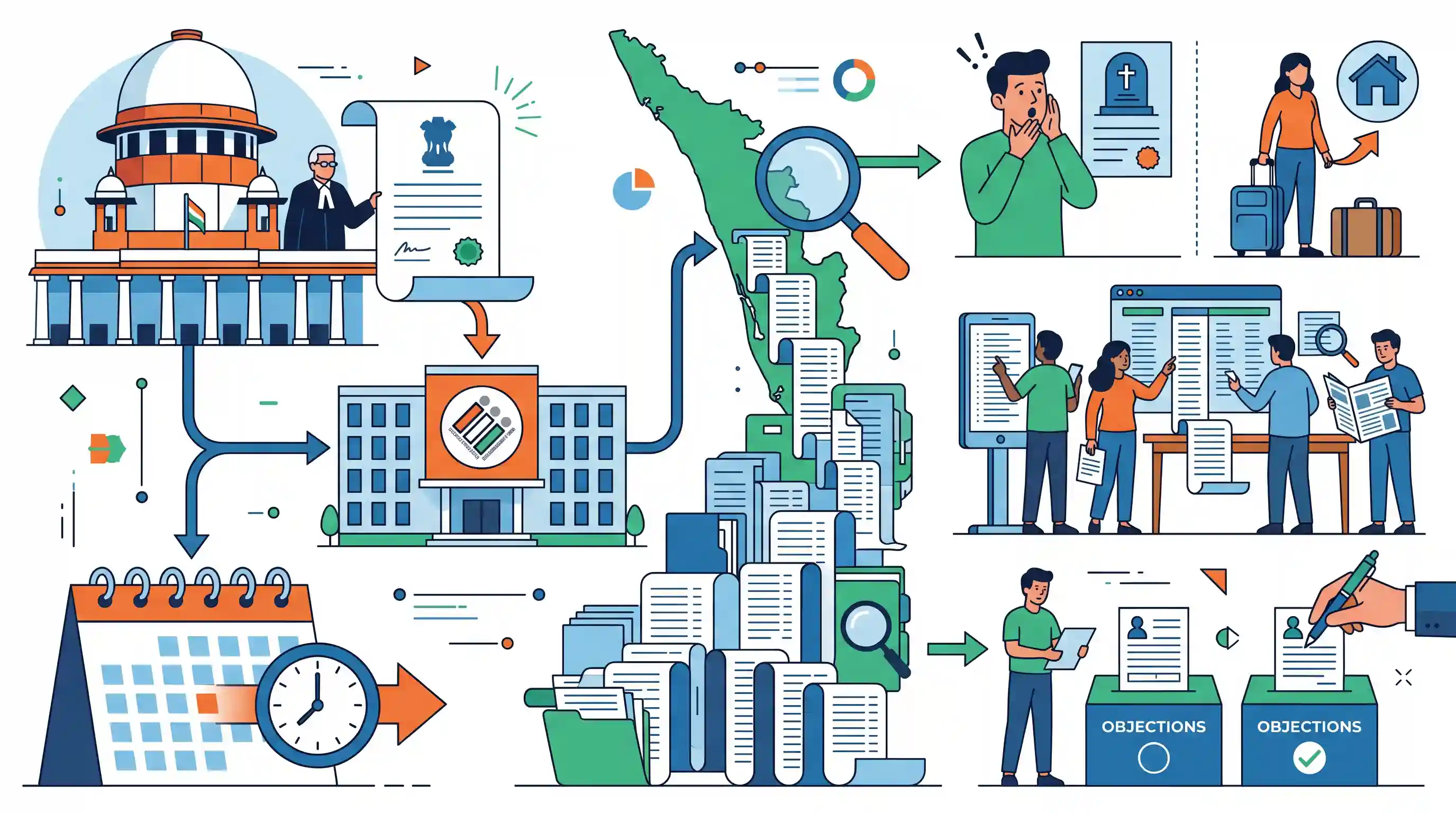
The Supreme Court of India has ordered the Election Commission (EC) to publish the names of approximately 24 lakh voters who were removed from the draft electoral rolls in Kerala following a Special Incident Revision (SIR). A bench comprising Chief Justice of India Surya Kant and Justice Joymalya Bagchi issued the directive to allow affected voters to verify their exclusion and file objections if they were erroneously removed, such as being incorrectly marked as deceased or relocated. The Court also suggested that the EC consider extending the deadline for submitting these claims to ensure fair opportunities for the voters.
Key Points
- The Supreme Court directed the Election Commission to publish the names of voters deleted from Kerala's draft electoral rolls.
- Around 24 lakh names were excluded during a Special Incident Revision (SIR) exercise.
- The publication is necessary to allow affected individuals to verify their exclusion and file objections.
- Petitioners argued that several voters were erroneously removed by being wrongly categorized as deceased or shifted.
- The Supreme Court also advised the EC to consider extending the deadline for filing claims and objections to prevent voter disenfranchisement.
Important Terms
Election Commission of India (ECI)

A permanent constitutional body (Article 324) responsible for administering and supervising elections to India’s Parliament, State Legislatures, and the offices of the President and Vice-President.
UPSC context
GS Paper II (Polity): Constitutional bodies. Tests understanding of electoral administration and Article 324 powers.
Supreme Court of India
The highest judicial authority in India and guardian of the Constitution, possessing the power of judicial review to ensure executive and legislative actions adhere to constitutional mandates.
UPSC context
GS Paper II (Polity): Judiciary. Tests the scope of judicial oversight over constitutional bodies.
Special Intensive Revision (SIR)
A rigorous door-to-door verification process used by the Election Commission to update voter lists by identifying and removing deceased, relocated, or duplicate entries.
UPSC context
GS Paper II (Polity): Electoral reforms. Focuses on procedural fairness in maintaining accurate voter lists.
Electoral Rolls
The official list of individuals in a specific constituency who are registered and eligible to exercise their right to vote in an election.
UPSC context
GS Paper II (Polity): Representation of People Act. Tests knowledge of voter eligibility and democratic participation.
Article 324
The constitutional provision that vests the superintendence, direction, and control of elections in the Election Commission of India, ensuring its independence and authority.
UPSC context
GS Paper II (Polity): Essential for questions regarding the constitutional basis of India’s electoral framework.
Representation of the People Act (RPA), 1950
An act of Parliament providing the legal framework for seat allocation, constituency delimitation, and the preparation and revision of electoral rolls.
UPSC context
GS Paper II (Polity): Specifically listed in the syllabus; tests administrative aspects of the election process.
Prelims Trap
"Article 329 completely bars courts from interfering in the preparation or revision of electoral rolls."
False. Article 329 bars interference only after the election process has commenced. Pre-election stages like draft roll revisions are subject to judicial review.
Static Concepts Connected
What are the key differences between RPA 1950 and RPA 1951?
- RPA 1950: Governs seat allocation, delimitation of constituencies, voter qualifications, and the preparation/revision of electoral rolls.
- RPA 1951: Governs the actual conduct of elections, qualifications and disqualifications of candidates, corrupt practices, and election dispute mechanisms.
How is the 'Right to Vote' classified in the Indian legal framework?
- Constitutional Basis: Classified as a Constitutional Right derived from Article 326 (universal adult suffrage), rather than a Fundamental Right.
- Statutory Execution: The conditions for exercising this right, including roll registration and deletion, are governed by the Representation of the People Act, 1950.
Cross-Topic Patterns
Article 329 vs Judicial Review
The tension between the Election Commission's plenary powers under Article 324 and the Supreme Court's judicial review is a recurring Mains GS2 theme.
Aadhaar linking and voter exclusion
Mass voter deletion controversies often intersect with the Election Laws (Amendment) Act, 2021, which allowed Aadhaar-voter ID linking to weed out duplicates, raising privacy and exclusion concerns.

Questions on RPA 1950 vs 1951 regarding electoral roll revision and the Art 329 bar on judicial interference are highly probable in 2026.
Linked PYQs · 5
Linked PYQs · 5
- 2017MainsGS2
To enhance the quality of democracy in India the Election Commission of India has proposed electoral reforms in 2016. What are the suggested reforms and how far are they significant to make democracy successful?
- 2024MainsGS2
Examine the need for electoral reforms as suggested by various committees with particular reference to "one nation one election" principle.
- 2004PrelimsGS1
Consider the following tasks: 1. Superintendence, direction and conduct of free and fair elections. 2. Preparation of electoral rolls for all elections to the Parliament, State Legislatures and the Office of the President and the Vice-president. 3. Giving recognition to political parties and allotting election symbols to political parties and individuals contesting the election. 4. Proclamation of final verdict in the case of election disputes. Which of the above are the functions of the Election Commission of India?
- 2017PrelimsGS1
Right to vote and to be elected in India is a
- 2017PrelimsGS1
Consider the following statements: 1. The Election Commission of India is a five-member body. 2. Union Ministry of Home Affairs decides the election schedule for the conduct of both general elections and bye-elections. 3. Election Commission resolves the disputes relating to splits/mergers of recognised political parties. Which of the statements given above is/are correct?
