Election Commission Commences Counting for 2026 Assembly Elections
Source:Indian Express ↗
Why It Matters
State assembly elections determine regional governance and impact India's federal dynamics. The procedural aspects of vote counting (EVMs, postal ballots) and the constitutional role of the Election Commission of India are fundamental topics under the Polity syllabus.
Summary
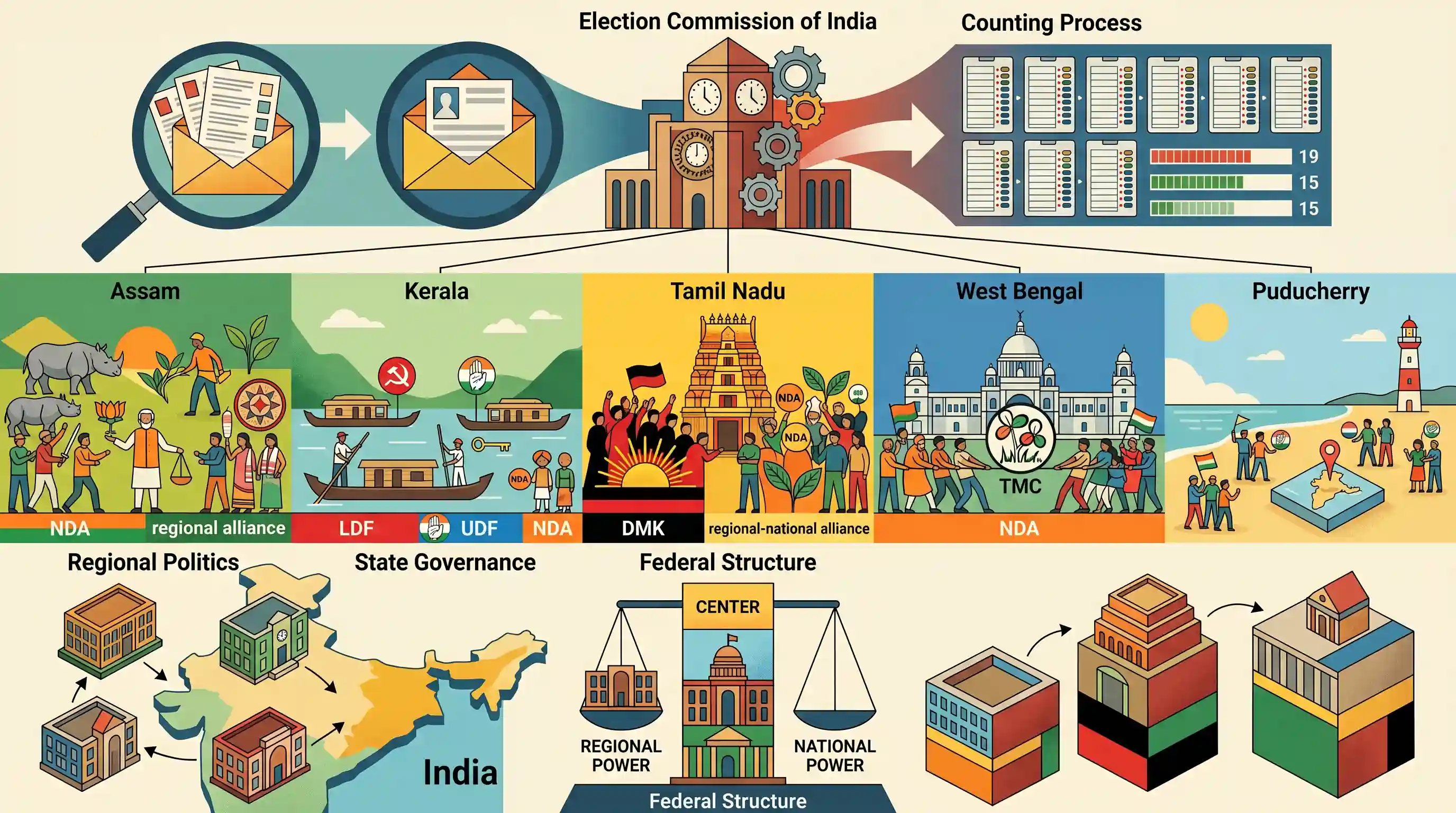
The Election Commission of India is conducting the counting of votes for the 2026 Assembly elections in Assam, Kerala, Tamil Nadu, West Bengal, and the Union Territory of Puducherry. Following standard electoral protocols, the counting begins with postal ballots before transitioning to Electronic Voting Machines (EVMs). The elections reflect diverse regional political dynamics, featuring significant battles between national and regional alliances such as the NDA, LDF, UDF, TMC, and DMK, which will shape state-level governance and the broader federal structure.
Key Points
- The Election Commission of India (ECI) has commenced vote counting for the 2026 Assembly elections in four states (Assam, Kerala, Tamil Nadu, West Bengal) and the UT of Puducherry.
- The vote-counting protocol dictates that postal ballots are counted first, followed by votes recorded on Electronic Voting Machines (EVMs).
- Assam and Kerala are witnessing traditional bipolar contests between major alliances, while Tamil Nadu features a multi-cornered fight with new political entrants.
- West Bengal remains a high-stakes battleground for the TMC, BJP, and the Left-Congress alliance, testing regional incumbency against national parties.
Important Terms
Election Commission of India (ECI)

An autonomous constitutional body under Article 324 responsible for conducting free and fair elections for the Union and State legislatures, and the offices of President and Vice-President.
UPSC context
GS Paper II; Constitutional Bodies. Essential for questions on electoral reforms and the integrity of the democratic process.
National Democratic Alliance (NDA)
A center-right political coalition led by the BJP, established in 1998, representing a significant shift towards pre-poll alliances and coalition governance in India's parliamentary system.
UPSC context
GS Paper II; Federalism and Governance. Tests understanding of multi-party systems and the evolution of political alliances.
Left Democratic Front (LDF)
A major alliance of left-wing parties in Kerala, led by the CPI(M), emphasizing socialist policies and alternating power in the state's bi-polar political landscape.
UPSC context
GS Paper II; Regional Politics. Important for studying state-level political trends and the impact of ideological coalitions.
United Democratic Front (UDF)
A coalition of centrist and center-left parties in Kerala, led by the Indian National Congress (INC), serving as the principal rival to the LDF.
UPSC context
GS Paper II; Polity. Illustrates the dynamics of regional power-sharing and the role of national parties in state coalitions.
Trinamool Congress (TMC)
A powerful regional party in West Bengal, founded by Mamata Banerjee, known for its strong grassroots presence and its role in shaping state-level governance and federal relations.
UPSC context
GS Paper II; Federalism. Relevant for topics on the emergence of regional parties and criteria for national party status.
DMK (Dravida Munnetra Kazhagam)
A leading Dravidian party in Tamil Nadu and Puducherry, focused on social justice, state autonomy, and linguistic identity, significantly influencing the state's socio-economic policies.
UPSC context
GS Paper II; Regional Aspirations. Tests knowledge of the role of sub-nationalism and regional identity in Indian democracy.
Prelims Trap
The 'vote-from-home' postal ballot facility is available to senior citizens above 80 years of age.
The ECI recently amended the Conduct of Elections Rules, raising the eligibility age for the senior citizen postal ballot facility from 80 to 85 years.
Static Concepts Connected
What is the statutory sequence for counting votes in India?
- Postal Ballots First: Under Rule 54A, counting of postal ballots must begin first. EVM counting can only commence 30 minutes after postal ballot counting starts.
- EVM Penultimate Round: The penultimate round of EVM counting cannot begin until the counting of all postal ballots at the centre is completely finished.
- VVPAT Verification: Slips from five randomly selected polling stations per constituency are verified only after the EVM vote counting from Control Units is completed.
How does Puducherry's legislative setup function under the Constitution?
- Article 239A: Parliament created a legislature and Council of Ministers for Puducherry under this article, unlike states whose legislatures are directly established by the Constitution.
- Legislative Powers: Puducherry can legislate on all State List subjects, whereas Delhi (Article 239AA) faces explicit constitutional restrictions regarding Police, Public Order, and Land.
Cross-Topic Patterns
Party splits and ECI powers
ECI's authority under the Election Symbols Order 1968 to adjudicate faction disputes directly intersects with the Speaker's anti-defection powers under the Tenth Schedule.
Asymmetric Federalism in UTs
The contrast between Puducherry's Article 239A legislative setup and Delhi's Article 239AA framework reflects India's asymmetric federal structure, a favorite theme in UPSC Mains.

Expect a Prelims 2026 multi-statement question on EVM/VVPAT counting sequences and the revised 85+ age limit for postal ballots.
Linked PYQs · 3
Linked PYQs · 3
- 2022MainsGS2
Discuss the role of the Election Commission of India in the light of the evolution of the Model Code of Conduct.
- 2018MainsGS2
In the light of recent controversy regarding the use of Electronic Voting Machines (EVM), what are the challenges before the Election Commission of India to ensure the trustworthiness of elections in India?
- 2017PrelimsGS1
Right to vote and to be elected in India is a
