Election Commission Electoral Reforms and Administrative Decisions
Source:Indian Express ↗
हे का महत्त्वाचे आहे
Understanding institutional reforms by the Election Commission is vital for GS2 Polity and Governance, specifically regarding electoral integrity, administrative transparency, and democratic processes in India.
सारांश
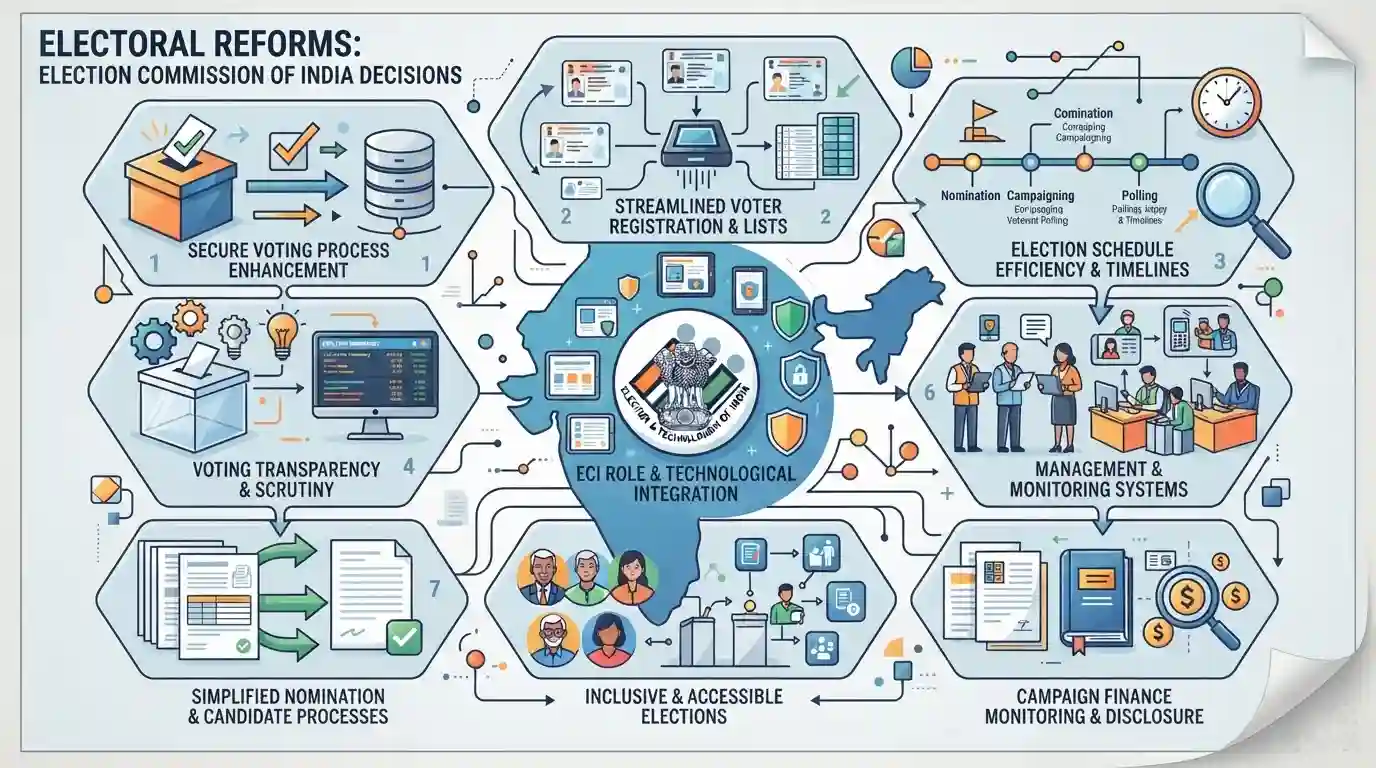
The article discusses nine new decisions rolled out by the Election Commission of India to reform and streamline the electoral process, focusing on what changes and what remains the same in terms of election management and transparency.
मुख्य मुद्दे
- The Election Commission of India (ECI) introduced nine new decisions aimed at reforming and streamlining electoral processes.
- These measures address transparency, operational efficiency, and accountability in election administration.
- The changes seek to modernize how the ECI functions while maintaining constitutional integrity and trust in the electoral system.
महत्त्वाच्या संज्ञा
Election Commission of India

An autonomous constitutional body responsible for administering Union and State election processes in India, ensuring free and fair elections under Article 324 of the Constitution.
UPSC context
UPSC GS Paper II: Polity and Governance – Constitutional Bodies, their powers, functions, and responsibilities in managing Indian elections.
Electoral Reforms
Changes made to the rules, procedures, and institutional frameworks governing elections to make the democratic process more transparent, inclusive, and efficient.
UPSC context
UPSC GS Paper II: Salient features of the Representation of People Act, Electoral Reforms, and challenges in the electoral system.
ECINet and ERONet
The ECI's integrated digital platform and database used nationwide for voter registration, maintenance of electoral rolls, and election-related administrative workflows.
UPSC context
UPSC GS Paper II / Science & Technology: Role of e-governance initiatives and technology in streamlining public service delivery and election administration.
पूर्वपरीक्षा सापळा
The Chief Election Commissioner holds veto power over decisions made by other Election Commissioners in the multi-member body.
Aspirants often assume the Chief Election Commissioner has a casting or veto vote over fellow Election Commissioners, whereas decisions are strictly by majority vote.
संबंधित स्थिर संकल्पना
What are the constitutional provisions governing the Election Commission of India under Part XV?
- Article 324 mandate: Article 324 provides for the superintendence, direction, and control of elections to be vested in an Election Commission.
- No discrimination: Article 325 ensures no person to be ineligible for inclusion in electoral rolls on grounds of religion, race, caste or sex.
- Adult suffrage: Article 326 provides for adult suffrage for elections to the Lok Sabha and Legislative Assemblies of States.
आंतर-विषय नमुने
Electoral Reforms + Digital Governance Standards
Electoral technology reforms connect directly to e-governance initiatives and data protection frameworks under the Digital Personal Data Protection Act, 2023.
Constitutional Bodies + Institutional Accountability
Internal accountability measures in independent constitutional bodies mirror institutional checks and balances seen in the judiciary and CAG.

Expect a statement-based prelims question on ECI's multi-member decision-making (majority rule vs. CEC veto) and technical audits.
संबंधित PYQ · 2
संबंधित PYQ · 2
- 2022MainsGS2
Discuss the role of the Election Commission of India in the light of the evolution of the Model Code of Conduct.
- 2024MainsGS2
Examine the need for electoral reforms as suggested by various committees with particular reference to "one nation one election" principle.
