Autonomy of Constitutional Bodies and Democratic Checks
Source:The Hindu ↗
Why It Matters
The autonomy of constitutional bodies such as the Election Commission and parliamentary officers is foundational to India's democratic framework. Allegations of institutional compromise, partisan application of electoral rules, and executive overreach in parliamentary matters raise critical questions about the separation of powers and the health of democratic checks and balances.
Summary
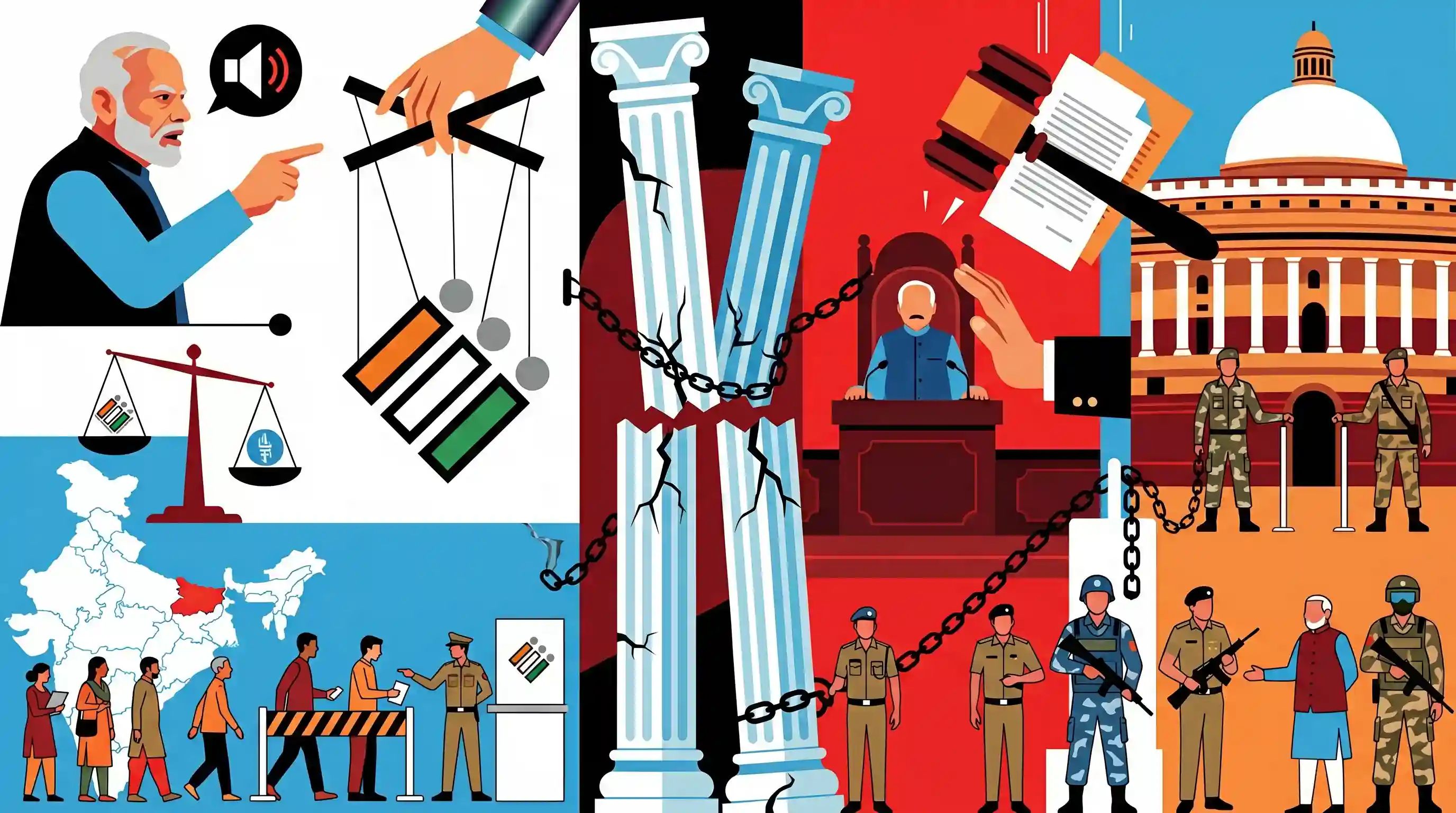
Congress president Mallikarjun Kharge launched a strong critique against the central government, accusing it of undermining constitutional institutions. Speaking at the 'Constitution Samman Sammelan', he labeled the Election Commission of India (ECI) a "puppet" of Prime Minister Narendra Modi, alleging bias in implementing the Model Code of Conduct and intentional disenfranchisement of minority voters in Bihar. Beyond electoral concerns, Kharge raised alarms over institutional capture by citing alleged pressure on Vice-President Jagdeep Dhankhar to resign over a judicial removal motion, and condemned the deployment of the CISF for Parliament security as an infringement on parliamentary autonomy.
Key Points
- Congress President Mallikarjun Kharge accused the Election Commission of India (ECI) of acting as a 'puppet' of the Prime Minister, alleging selective enforcement of the Model Code of Conduct.
- Kharge claimed deliberate disenfranchisement of marginalized communities and minority voters from electoral rolls in Bihar to benefit the ruling NDA alliance.
- He highlighted a broader threat to institutional autonomy, alleging that Vice-President Jagdeep Dhankhar faced government pressure to resign after admitting a motion to remove Justice Yashwant Varma.
- The transition of Parliament security from the internal Parliament Security Services to the CISF was criticized as undermining parliamentary sovereignty and disrespecting MPs.
- Kharge characterized the ruling party's actions as a continuous 'gaslighting of the Republic' and a concerted attack on federalism and constitutional principles.
Important Terms
Election Commission of India (ECI)

An autonomous constitutional authority established under Article 324 to manage Union and State election processes, ensuring free and fair polls and supervising the preparation of electoral rolls.
UPSC context
GS II: Statutory, regulatory, and various quasi-judicial bodies. Essential for topics on electoral integrity and institutional independence.
Model Code of Conduct (MCC)
A set of non-statutory guidelines issued by the ECI to regulate political parties and candidates during elections, aiming to ensure a level playing field and prevent executive misuse of power.
UPSC context
GS II: Electoral reforms. Tests understanding of the ECI's regulatory powers and the ethics of political campaigning.
Chairman of Rajya Sabha
The Vice-President of India, acting ex-officio under Article 64, who presides over the Upper House, maintains decorum, and ensures proceedings follow the Constitution and Rules of Procedure.
UPSC context
GS II: Parliament—structure, functioning, and the role of presiding officers in maintaining legislative autonomy.
Central Industrial Security Force (CISF)
A Central Armed Police Force (CAPF) under the Ministry of Home Affairs, primarily tasked with securing critical infrastructure and recently deployed for comprehensive Parliament security.
UPSC context
GS III: Security forces and their mandate. Tests knowledge of the transition in parliamentary security architecture.
Parliament Security Service (PSS)
An internal department responsible for access control and order within the Parliament complex, historically functioning under the Speaker’s oversight to safeguard the legislature's independence.
UPSC context
GS II: Parliamentary sovereignty and the administrative autonomy of the legislative secretariats.
Constitutionalism
The principle that government power is limited by a fundamental law, ensuring institutions like the ECI and Judiciary function independently to prevent executive overreach.
UPSC context
GS II: Indian Constitution—features and significant provisions. Tests conceptual understanding of institutional checks and balances.
Prelims Trap
"The Chairman of Rajya Sabha is bound to admit a motion for the removal of a judge if signed by 50 MPs."
The Judges (Inquiry) Act, 1968 grants the Chairman/Speaker the absolute discretionary power to either admit or refuse the removal motion, even if the requisite number of MP signatures is met.
Static Concepts Connected
What is the constitutional and statutory procedure for removing a High Court or Supreme Court Judge?
- Initiation criteria: A removal motion must be signed by at least 100 Lok Sabha MPs or 50 Rajya Sabha MPs (Judges Inquiry Act, 1968).
- Presiding Officer's discretion: The Presiding Officer (Speaker or Chairman) holds statutory discretion to either admit or reject the motion.
- Investigation phase: If admitted, a 3-member committee investigates the charges of "proved misbehaviour or incapacity."
- Special majority: Removal requires a special majority in both Houses of Parliament, followed by the President's order.
How does the Constitution ensure the independence of the Parliament Secretariat?
- Article 98 mandate: Article 98 mandates a separate secretarial staff for each House, insulating legislative administration from executive control.
- Recruitment rules: Parliament (not the executive) is empowered by law to regulate the recruitment and conditions of service for secretariat staff.
- Presiding Officer's control: The Presiding Officers hold absolute administrative control over the premises, preventing unauthorized executive intervention.
Cross-Topic Patterns
ECI Act 2023 & Institutional Independence
Allegations of ECI bias revive scrutiny on the Chief Election Commissioner Act, 2023, which controversially replaced the CJI with a Cabinet Minister in the selection panel, altering the balance of power.
Executive Security Forces in Legislature
Deploying MHA-controlled CISF for Parliament security intersects with Article 98, raising debates on legislative autonomy versus specialized executive security mandates in high-threat environments.

Expect a 2026 prelims question pairing the statutory discretion of the Speaker/Chairman in Judge removal with Article 98's Parliament staff.
Linked PYQs · 4
Linked PYQs · 4
- 2024MainsGS2
Examine the need for electoral reforms as suggested by various committees with particular reference to "one nation one election" principle.
- 2022MainsGS2
Discuss the role of the Vice-President of India as the Chairman of the Rajya Sabha.
- 2023MainsGS3
What are the internal security challenges being faced by India? Give out the role of Central Intelligence and Investigative Agencies tasked to counter such threats.
- 2023PrelimsGS1
Consider the following organizations/bodies in India: 1. The National Commission for Backward Classes 2. The National Human Rights Commission 3. The National Law Commission 4. The National Consumer Disputes Redressal Commission How many of the above are constitutional bodies?
