Local body civil registration powers and citizenship verification
Source:The Hindu ↗
Why It Matters
This development is crucial for WBCS Prelims as it touches upon the practical implementation and challenges of democratic decentralization under the 73rd and 74th Constitutional Amendments. It also highlights the mechanisms of state executive control over local bodies and the intersection of civil registration with national security and citizenship issues.
Summary
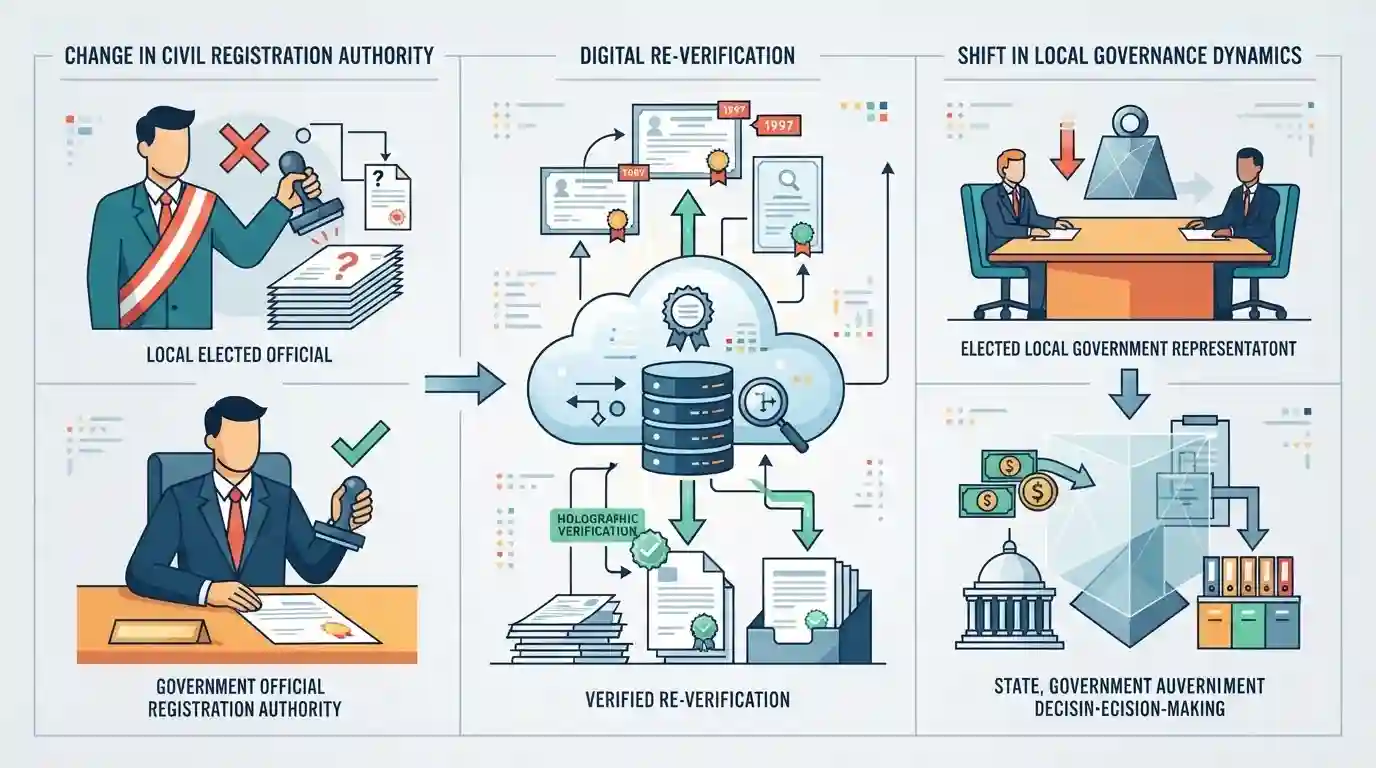
The West Bengal government has issued directives prohibiting elected representatives in panchayats and municipal bodies from issuing birth and death certificates following reports of fake certificates and irregularities. Signatory powers will now rest with designated government officials. To root out fraudulent documents—often used by illegal Bangladeshi migrants to claim citizenship—the state will digitally re-verify all certificates issued since 1997 and integrate them into a central database. Additionally, the government is proposing legislation to restrict the financial and administrative autonomy of local elected officials, marking a significant shift in local governance dynamics.
Key Points
- The West Bengal government has barred elected representatives in panchayats and civic bodies from issuing birth and death certificates to prevent the issuance of fake documents.
- Signatory authority for these certificates will be shifted from elected representatives (like panchayat pradhans) to designated government officers to ensure accountability.
- The state government plans to re-verify all birth and death certificates issued since 1997 to build an authentic database linked to a central portal.
- This move is also aimed at preventing illegal migrants from Bangladesh from illegitimately acquiring Indian citizenship documents.
- The state is drafting legislation to formally curb the financial and administrative powers of elected local representatives to ensure transparency.
Important Terms
Panchayats

Rural local self-government institutions in India, constitutionalized by the 73rd Amendment Act, 1992. They operate at village, intermediate, and district levels to execute schemes for economic development and social justice.
UPSC context
GS Paper 2 (Local Self-Government). Tests knowledge of the 73rd Amendment, democratic decentralization, and the 11th Schedule.
Municipal Bodies
Urban local self-government institutions constitutionalized by the 74th Amendment Act, 1992. They are entrusted with urban governance, public health, and socio-economic planning functions outlined in the 12th Schedule.
UPSC context
GS Paper 2 (Urban Local Bodies). Tests understanding of the 74th Amendment, functional devolution, and civic administrative autonomy.
West Bengal Government
The state-level executive and legislative authority in West Bengal. Under the Constitution's State List, it possesses the constitutional prerogative to legislate on and regulate the administrative powers of local civic bodies.
UPSC context
GS Paper 2 (Federalism). Tests the dynamics of state control over local governance and the devolution of powers.
Prelims Trap
Vital statistics and registration of births and deaths are devolved functions explicitly listed in both the 11th and 12th Schedules of the Constitution.
While explicitly listed in the 12th Schedule for Municipalities (Entry 16), vital statistics are NOT among the 29 items in the 11th Schedule for Panchayats.
Static Concepts Connected
How does the Constitution treat the devolution of vital statistics to local bodies?
- 12th Schedule: Entry 16 explicitly lists "vital statistics including registration of births and deaths" as a functional item for Urban Local Bodies.
- 11th Schedule: Registration of births and deaths is notably absent from the 29 functional items devolved to Panchayati Raj Institutions.
- State Discretion: Articles 243G and 243W leave the actual transfer of these powers, including administrative authority, entirely to the discretion of the State Legislatures.
Under which Constitutional Lists do vital statistics and citizenship fall?
- Concurrent List: "Vital statistics including registration of births and deaths" falls under Entry 30 of the Concurrent List (List III), allowing both Centre and States to legislate.
- Union List: Citizenship, naturalisation, and aliens fall exclusively under Entry 17 of the Union List (List I).
- Central Override: The Centre passed the Registration of Births and Deaths (Amendment) Act 2023, making the Central CRS portal mandatory for state registrations.
Cross-Topic Patterns
Border Security via Local Governance
Fraudulent birth certificates issued by local bodies in border states directly enable illegal migrants to secure citizenship documents, turning a local governance loophole into a major internal security threat.
Digital Centralisation vs Federalism
The RBD Amendment Act 2023 requiring states to link vital statistics to the Centre's CRS portal highlights a broader trend: using centralized digital infrastructure to enforce national standards over local administration.

Multi-statement question likely in 2026 linking the RBD Amendment Act 2023 mandates with constitutional entries in the 11th/12th Schedules.
Linked PYQs · 5
Linked PYQs · 5
- 2022WBCS_PRELIMSGS1
Which of the following constitutional amendments gives a constitutional status to the Panchayati Raj institutions?
- 2018WBCS_PRELIMSGS1
Which Amendment of the constitution provided constitutional status to the Panchayats?
- 2014WBCS_PRELIMSGS1
Panchayat system in India was introduced by the
- 2008WBCS_PRELIMSGS1
Which Amendment of the Constitution provided constitutional status to the Panchayats ?
- 2016WBCS_PRELIMSGS1
Which part of the Constitution deals with citizenship ?
