Tiger Attack Near Bandhavgarh Raises Annual Fatality Toll in MP
Source:timesofindia ↗
Why It Matters
MPPSC frequently asks questions on the geographical locations, districts, and ecological aspects of National Parks and sanctuaries in Madhya Pradesh, which holds the highest tiger population in India. The interaction of forest-fringe communities (for collecting Minor Forest Produce like Mahua) and tiger conservation is a critical governance and environmental challenge.
Summary
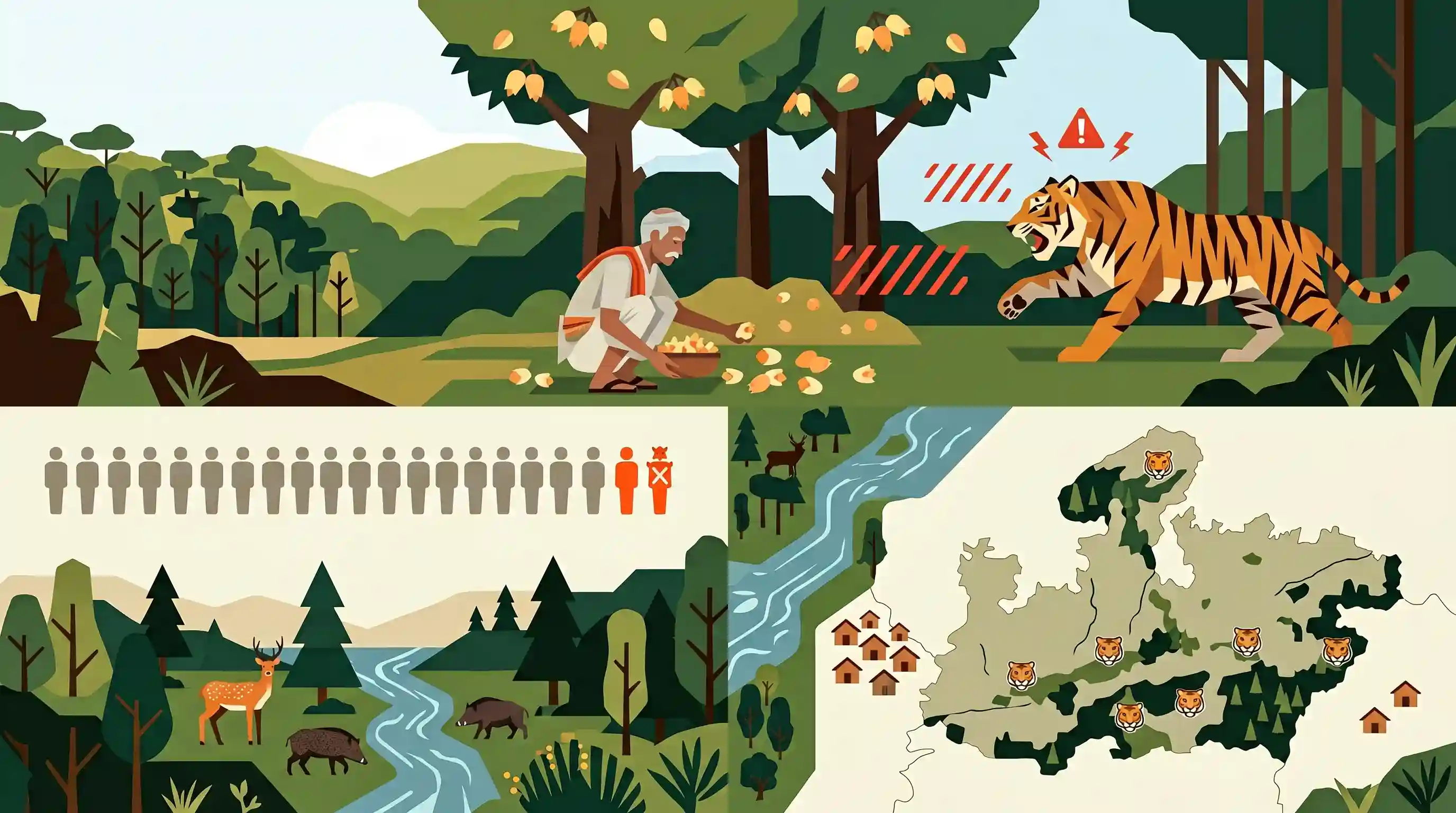
A 60-year-old man collecting mahua seeds was mauled to death by a tiger in the Panpatha buffer zone of Bandhavgarh Tiger Reserve in Umaria district, Madhya Pradesh. The death marks the 22nd tiger attack-related casualty in the state during 2026, highlighting critical challenges in managing human-wildlife conflict in MP's dense tiger landscapes.
Key Points
- A 60-year-old man, Annu Rajak, was killed in a tiger attack in the Panpatha buffer zone of Bandhavgarh Tiger Reserve (BTR) in Madhya Pradesh's Umaria district.
- The victim was attacked while collecting mahua seeds in the Uttar Paljha forest area.
- This incident marks the 22nd tiger attack fatality in Madhya Pradesh in 2026, underscoring rising human-wildlife conflict.
- This was the third fatal tiger attack in the Bandhavgarh landscape within a month, following two deaths earlier in June 2026.
- Forest department officials deployed trained elephants to conduct search operations and recover the body from dense forest bushes.
Important Terms
Bandhavgarh Tiger Reserve

A prominent protected area in Madhya Pradesh's Umaria district, renowned for hosting one of India's highest densities of Bengal tigers and containing the historic Bandhavgarh Fort.
UPSC context
GS Paper III (Biodiversity); essential for Prelims mapping of protected areas and Mains case studies on wildlife conservation.
Human-Wildlife Conflict
Negative interactions between humans and wild animals that lead to undesirable consequences such as loss of lives, crop/livestock damage, and retaliatory killing.
UPSC context
GS Paper III (Environment); relevant for analyzing ecological drivers, mitigation strategies, and human-nature coexistence frameworks.
Buffer Zone
The peripheral area of a protected zone or tiger reserve managed to absorb human impacts, allowing regulated human livelihood activities while safeguarding the core area.
UPSC context
GS Paper III (Conservation); tests core-buffer zoning under the Wildlife (Protection) Act, 1972 and eco-sensitive zone management.
Minor Forest Produce
All non-timber forest resources of plant origin, including bamboo, honey, tendu leaves, and seeds, vital for the livelihood of forest-dependent communities.
UPSC context
GS Papers II & III (Tribal Rights); central to the Forest Rights Act, 2006, and sustainable rural economic development.
Prelims Trap
Bandhavgarh Tiger Reserve is situated in the Narmada river basin, with its perennial streams draining directly into the Narmada River.
The reserve is drained by the Charanganga, Johilla, and Janadh rivers, which flow into the Son River (a major right-bank tributary of the Ganga), not the Narmada.
Static Concepts Connected
Geographical and hydrological features of Bandhavgarh Tiger Reserve
- Terrain and Location: Lies in Madhya Pradesh's Umaria district, positioned at the intersection of the Vindhya and Satpura hill ranges.
- River Systems: Drained by Charanganga, Johilla, and Janadh rivers, which ultimately empty into the Son River, a Ganga tributary.
- Historical Heritage: Features a 2,000-year-old fort linked to Vakataka and Baghel dynasties and was the historic source of India's first white tiger.
Minor Forest Produce (MFP) under Indian law
- Legal Definition: Section 2(i) of Forest Rights Act (FRA) 2006 defines MFP to include non-timber forest produce like seeds, leaves, and flowers.
- Tribal Ownership: The FRA 2006 transfers ownership, collection, and disposal rights of MFP to forest-dwelling Scheduled Tribes and traditional dwellers.
- Institutional Support: TRIFED facilitates value-addition and marketing of MFPs like Mahua to ensure sustainable livelihood security for indigenous communities.
Cross-Topic Patterns
Conservation biology vs. FRA tribal rights
Expanding tiger populations in buffer zones clash directly with tribal rights to gather Minor Forest Produce, exposing policy gaps between the Wildlife Protection Act and the Forest Rights Act.
Deciduous phenology and economic resilience
Dry-season leaf fall and flowering of species like Mahua provide critical tribal income but increase forest floor foraging, coinciding with peak tiger movement during dry seasons.

UPSC may couple Central Indian tiger reserve river systems (Son tributaries) with tribal MFP gathering rights under FRA 2006 in 2026.
Linked PYQs · 2
Linked PYQs · 2
- 2022MPPSC_PRELIMSGS1
Which of the following National Parks is the first in India to officially introduce a mascot named "Bhoorsingh the Barasingha"?
- 2024MPPSC_PRELIMSGS1
Which of the following pairs is false? Sanctuary District
