Plastic Waste Management Rules and Extended Producer Responsibility
Source:The Hindu ↗
Why It Matters
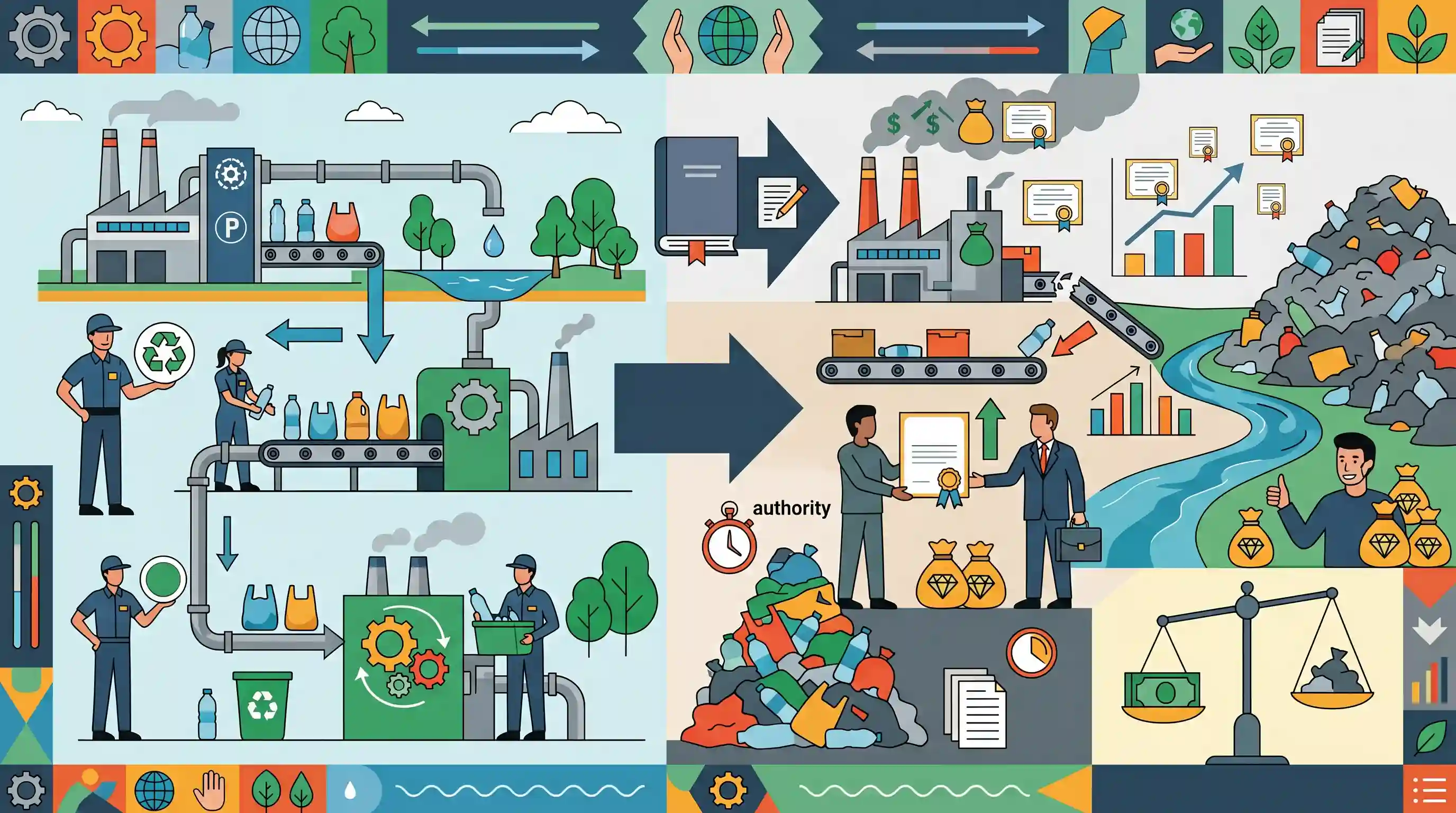
It highlights the governance and implementation challenges of environmental regulations, particularly evaluating whether market-based mechanisms (trading certificates) and flexible timelines compromise the effectiveness of India's Extended Producer Responsibility (EPR) policies.
Summary
The editorial critiques the Plastic Waste Management (Amendment) Rules, 2026 for weakening India's stance on plastic pollution by introducing flexible compliance mechanisms. While the original Extended Producer Responsibility (EPR) regime aimed for stringent collection and processing targets, the new amendments allow companies to carry forward their recycling shortfalls and rely on 'trading certificates'. The author argues that this approach commodifies environmental compliance, essentially allowing market economics to dictate the resolution of an ecological crisis rather than enforcing strict physical accountability for plastic waste.
Key Points
- The Plastic Waste Management (Amendment) Rules, 2026 introduces flexible ('elastic') compliance targets for reusing plastic packaging, diluting previous strict mandates.
- The updated norms permit companies to 'carry forward' shortfalls in meeting their plastic recycling and collection obligations for multiple years.
- The framework relies heavily on 'trading certificates', shifting the focus toward market-based compliance rather than strict physical collection and processing of waste.
- This regulatory relaxation risks undermining the core objectives of the Extended Producer Responsibility (EPR) regime, allowing market economics to override stringent environmental enforcement against plastic pollution.
Important Terms
Plastic Waste Management (Amendment) Rules, 2026

2026 update to India's plastic laws, introducing mandatory recycled content targets (e.g., 30%-60% for rigid plastic) and allowing companies to carry forward recycling shortfalls for up to three years.
UPSC context
GS Paper III: Environmental Pollution & Degradation; tests understanding of evolving waste governance and circular economy hurdles.
Extended Producer Responsibility (EPR)
A policy approach holding producers, importers, and brand owners (PIBOs) accountable for the entire lifecycle of their plastic products, specifically collection, recycling, and end-of-life disposal.
UPSC context
GS Paper III: Conservation & Pollution; critical for questions on the 'Polluter Pays' principle and waste management.
Plastic Waste Management Rules, 2016
India's foundational plastic regulation framework that introduced EPR, mandated waste segregation at source, and set minimum thickness standards for plastic carry bags to improve recyclability.
UPSC context
GS Paper II: Government Policies; forms the baseline for analyzing all subsequent environmental law amendments.
Central Pollution Control Board (CPCB)
The statutory organization under MoEFCC responsible for implementing environmental laws and managing the centralized digital portal for EPR registration and compliance monitoring in India.
UPSC context
GS Paper II: Statutory Bodies; essential for understanding the institutional framework of environmental regulation.
PIBOs
Collective term for Producers, Importers, and Brand Owners who are the primary regulated entities under India's plastic waste laws, tasked with meeting recycling and reuse targets.
UPSC context
GS Paper III: Environmental Impact Assessment; identifies key stakeholders responsible for industrial environmental compliance.
Ministry of Environment, Forest and Climate Change (MoEFCC)
The nodal central ministry responsible for planning, promoting, and coordinating environmental and forestry programs, including the notification of all Plastic Waste Management Rules.
UPSC context
GS Paper II: Ministries and Departments; the primary executive body for environmental policy-making in India.
Prelims Trap
"Under the EPR regime, producers must physically collect and recycle their own plastic waste, and trading of recycling obligations is strictly prohibited."
The 2026 amendment introduces a market-based 'Tradable Certificate Mechanism', explicitly allowing producers to buy EPR credits rather than physically processing waste themselves.
Static Concepts Connected
What is the Extended Producer Responsibility (EPR) framework in India?
- Core Principle: Holds producers, importers, and brand owners financially and physically accountable for the post-consumer lifecycle of their products.
- Legal Backing: Enforced under various waste management rules (Plastic, E-waste, Battery) derived from the Environment (Protection) Act, 1986.
- Compliance Mechanisms: Now includes physical collection targets, minimum recycled content mandates, and market-based certificate trading managed via a centralized portal.
What is the statutory mandate of the Central Pollution Control Board (CPCB)?
- Constitution: A statutory body constituted in 1974 under the Water (Prevention and Control of Pollution) Act.
- Expanded Powers: It derives additional powers from the Air (Prevention and Control of Pollution) Act, 1981, and the Environment (Protection) Act, 1986.
- EPR Administration: Maintains the centralized EPR portal for registering entities and tracking the trading of EPR compliance certificates.
Cross-Topic Patterns
EPR Credits & Carbon Trading
The shift towards 'tradable EPR certificates' mirrors India's Carbon Credit Trading Scheme (CCTS), signaling a broader governance shift from strict physical compliance to market-based environmental regulation.
Circular Economy and the LiFE Initiative
Mandating minimum recycled content in new packaging aligns with the LiFE initiative and the National Resource Efficiency Policy, shifting focus from mere waste disposal to closed-loop resource recovery.

Expect a multi-statement question in 2026 comparing the newly tradable EPR certificates with the Carbon Credit Trading Scheme.
Linked PYQs · 2
Linked PYQs · 2
- 2019PrelimsGS1
In India, 'extended producer responsibility' was introduced as an important feature in which of the following?
- 2024PrelimsGS1
Consider the following statements : Statement-I: Many chewing gums found in the market are considered a source of environmental pollution. Statement-II : Many chewing gums contain plastic as gum base. Which one of the following is correct in respect of the above statements?
