Potential El Nino emergence during upcoming Indian monsoon season
Source:The Hindu ↗
Why It Matters
The monsoon is the lifeline of India's agriculture and rural economy. El Nino, La Nina, and the Indian Ocean Dipole are fundamental geographical phenomena frequently tested in UPSC Prelims and Mains. Recognizing their impacts aids in understanding climate patterns, disaster preparedness, and agricultural planning.
Summary
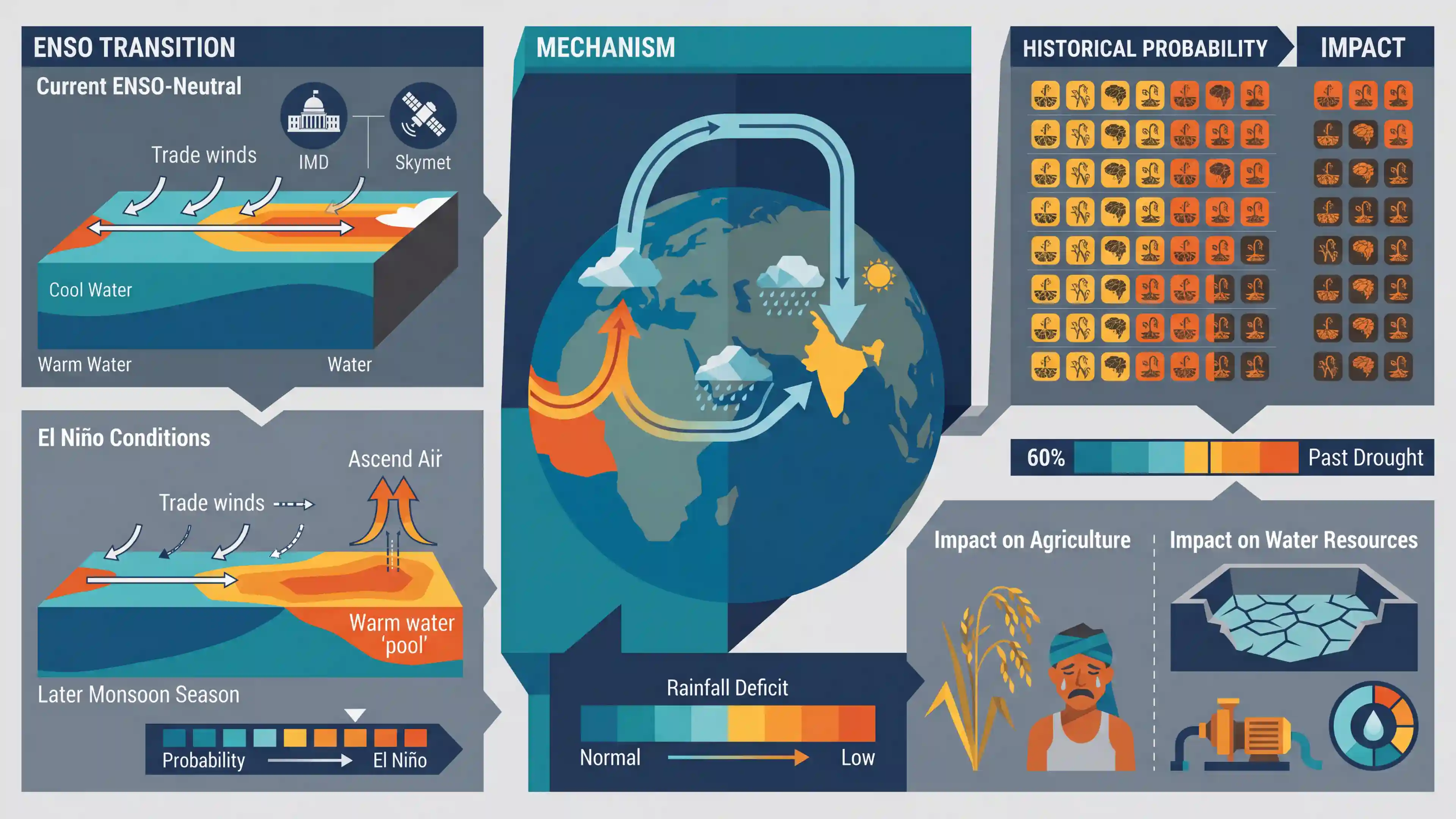
The article highlights the potential return of El Nino conditions during the later months of the upcoming Indian monsoon season, transitioning from current ENSO-neutral conditions. Both the India Meteorological Department (IMD) and private forecaster Skymet indicate a probability of Pacific warming that could disrupt rainfall. Because El Nino historically suppresses the southwest monsoon—leading to droughts in 60% of past occurrences—this forecast raises concerns over potential rainfall deficits, which would significantly impact agriculture and water resources in India.
Key Points
- Global weather models forecast a shift from ENSO-neutral conditions to a potential El Nino in the latter half of the Indian monsoon season.
- Private forecaster Skymet suggests a 20% probability of El Nino occurring, raising the risk of sub-par monsoon rains and possible drought conditions.
- Historically, 6 out of 10 El Nino years have led to depressed rainfall and drought over the Indian subcontinent.
- El Nino involves the abnormal warming of the Central Equatorial Pacific Ocean, which alters atmospheric circulation and weakens the southwest monsoon winds.
Important Terms
El Niño

A climate pattern involving the unusual warming of surface waters in the eastern tropical Pacific Ocean. It typically occurs every 2–7 years and is known to suppress the Indian southwest monsoon, often leading to droughts.
UPSC context
GS Paper I (Geography): Essential for understanding Indian climate variability and GS Paper III (Agriculture): Impact on crop yields.
ENSO (El Niño-Southern Oscillation)
A recurring climate cycle involving fluctuations in temperature between the ocean and atmosphere in the east-central Equatorial Pacific. It consists of El Niño, La Niña, and neutral phases, influencing global weather patterns.
UPSC context
GS Paper I (Physical Geography): Tests atmospheric circulation and global climatic phenomena.
India Meteorological Department (IMD)
The principal government agency under the Ministry of Earth Sciences responsible for meteorological observations, weather forecasting, and seismology. Established in 1875, it provides critical monsoon forecasts for agriculture and disaster management.
UPSC context
GS Paper I/II/III: Governance of scientific institutions and their role in disaster preparedness and agriculture.
Southwest Monsoon
India's primary rainy season from June to September, occurring when moisture-laden winds blow from the Indian Ocean. It accounts for nearly 75-80% of the country's annual rainfall and is vital for the economy.
UPSC context
GS Paper I (Indian Geography): A core topic regarding the life-blood of India's agrarian economy and water resources.
Skymet
India's leading private-sector weather forecasting company. It provides independent monsoon predictions and weather-based business solutions, often serving as a secondary reference point alongside official IMD forecasts.
UPSC context
GS Paper III (Science & Technology/Agriculture): Relevant for private-sector participation in climate services and agricultural planning.
Long Period Average (LPA)
The average rainfall recorded over a specific 50-year period, used as a benchmark to determine if a monsoon is 'normal.' The current LPA (1971–2020) for the southwest monsoon is approximately 868.6 mm.
UPSC context
GS Paper I/III: Technical metric used in Prelims and Mains to assess rainfall deficiency or surplus.
ENSO-neutral
The transitional state of the ENSO cycle when sea surface temperatures in the central and eastern Pacific are near average. During this phase, global weather is influenced by other atmospheric and oceanic factors.
UPSC context
GS Paper I (Geography): Understanding the transition phases between major climatic extremes like El Niño and La Niña.
Prelims Trap
"An El Nino event invariably leads to a drought year over the Indian subcontinent."
While historically 60% of El Nino years lead to droughts, it is not an absolute rule. Mitigating factors like a positive Indian Ocean Dipole (IOD) can yield normal rainfall.
Static Concepts Connected
What are the typical atmospheric and oceanic changes during an El Nino event?
- SST Warming: Abnormal warming of sea surface temperatures occurs in the Central and Eastern Equatorial Pacific Ocean.
- Trade Winds Weaken: Prevailing easterly trade winds weaken or occasionally reverse direction across the Equatorial Pacific.
- Walker Circulation Shift: The Walker cell shifts eastward, creating high pressure and descending air (subsidence) over the Indian landmass, suppressing rainfall.
How does the Indian Ocean Dipole (IOD) interact with the El Nino effect?
- Positive IOD: Characterized by a warmer western Indian Ocean, it brings increased moisture to India, often counteracting El Nino's drying effect.
- Negative IOD: Characterized by a cooler western Indian Ocean, it suppresses monsoon rainfall and can severely worsen the drought impacts of an El Nino.
Cross-Topic Patterns
El Nino + Food Inflation + RBI Policy
Sub-par monsoons impact Kharif crop yields, stoking food inflation. This often forces the RBI to maintain a hawkish monetary stance, linking physical geography directly to macroeconomic policy.
Dynamical Forecasting & Supercomputing
IMD's shift from statistical models to the dynamical Monsoon Mission Coupled Forecasting System (MMCFS) highlights India's investment in supercomputing to model complex ocean-atmosphere interactions.

Multi-statement Prelims questions in 2026 will likely test the combined interplay of late-season El Nino emergence, positive IOD, and MJO.
Linked PYQs · 4
Linked PYQs · 4
- 2011PrelimsGS1
La Nina is suspected to have caused recent floods in Australia. How is La Nina different from El Nino? 1. La Nina is characterised by unusually cold ocean temperature in equatorial Indian Ocean whereas El Nino is characterised by unusually warm ocean temperature in the equatorial Pacific Ocean. 2. El Nino has adverse effect on south-west monsoon of India, but La Nina has no effect on monsoon climate. Which of the statements given above is/are correct?
- 2017PrelimsGS1
With reference to 'Indian Ocean Dipole (IOD)' sometimes mentioned in the news while forecasting Indian monsoon, which of the following statements is/are correct? 1. IOD phenomenon is characterised by a difference in sea surface temperature between tropical Western Indian Ocean and tropical Eastern Pacific Ocean. 2. An IOD phenomenon can influence an El Nino's impact on the monsoon. Select the correct answer using the code given below:
- 2002PrelimsGS1
For short-term climate prediction, which one of the following events, detected in the last decade, is associated with occasional weak monsoon rains in the India subcontinent?
- 2014MainsGS1
Most of the unusual climatic happenings are explained as an outcome of the El-Nino effect. Do you agree?
