El Nino Induced Dry Spell Threatens Kerala Cardamom Cultivation
Source:The Hindu ↗
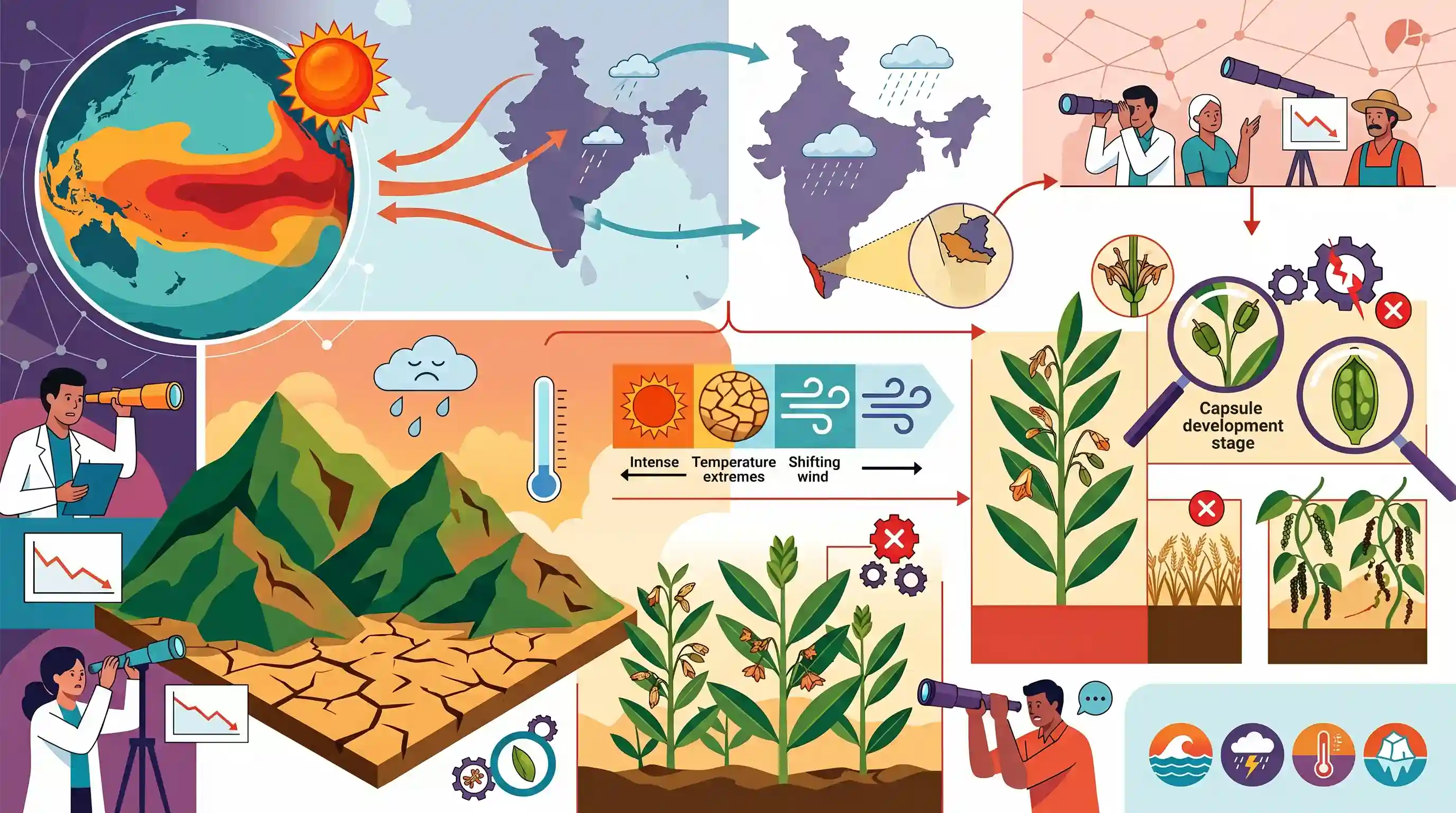
Why It Matters
This illustrates the real-world impact of global climatic phenomena (El Niño) on local micro-climates and agricultural outputs (specifically high-value plantation crops like cardamom), which is highly relevant for both GS1 (Geography/Climatology) and GS3 (Agriculture/Economy).
Summary
An El Niño-driven deficient monsoon is severely impacting Kerala's agricultural sector, particularly cardamom plantations in the Idukki district. A 38% rainfall deficiency, coupled with extreme temperature fluctuations, is disrupting the critical capsule setting stage of the cardamom crop. The India Meteorological Department attributes this delayed and weakened monsoon to El Niño conditions. Experts warn that the sustained dry spell will also reduce yields for other key regional crops like pepper and paddy, highlighting the vulnerability of India's plantation agriculture to global climatic phenomena.
Key Points
- Kerala, specifically the cardamom-producing Idukki district, is facing a severe rainfall deficit (38% deficiency) during the crucial early monsoon season.
- The dry spell and drastic temperature fluctuations are hindering the capsule setting process in cardamom plants, causing them to dry up and threatening overall yield.
- The India Meteorological Department (IMD) had earlier warned of below-normal rainfall due to the onset of El Niño conditions.
- The prolonged lack of rain is also expected to negatively impact other major plantation crops in the region, including pepper and paddy.
Important Terms
El Niño

A climate pattern involving the unusual warming of surface waters in the central and eastern equatorial Pacific Ocean, typically leading to deficient monsoon rainfall in India.
UPSC context
GS Paper 1 (Geography) and GS Paper 3 (Agriculture/Environment); tested for its mechanism and socioeconomic impact on Indian agriculture.
South-West Monsoon
India's primary rainy season from June to September, caused by moisture-laden winds from the Indian Ocean, accounting for roughly 75-80% of the country's annual rainfall.
UPSC context
GS Paper 1 (Physical Geography); critical for understanding Indian climate, agriculture cycles, and the "Monsoon-Economy" link.
India Meteorological Department (IMD)
The principal government agency under the Ministry of Earth Sciences responsible for meteorological observations, weather forecasting, and seismology.
UPSC context
GS Paper 3 (Disaster Management/S&T); essential for its role in weather alerts, crop planning, and monsoon prediction.
Spices Board
A statutory body under the Ministry of Commerce and Industry, constituted in 1987 for the export promotion and overall development of Indian spices, especially cardamom.
UPSC context
GS Paper 3 (Agriculture/Economy); relevant for statutory bodies and India’s trade position in global spice markets.
Cardamom (Small & Large)
Often called the 'Queen of Spices,' this high-value plantation crop is native to the Western Ghats; its production is highly sensitive to rainfall and temperature.
UPSC context
GS Paper 3 (Cropping Patterns); tested as a key plantation crop and for the impact of climate change on high-value exports.
Prelims Trap
"El Niño invariably leads to severe drought across the entire Indian landmass during the South-West Monsoon season."
While El Niño strongly correlates with deficient monsoons, its impact is not uniform. Factors like a positive Indian Ocean Dipole (IOD) can offset it.
Static Concepts Connected
What are the ideal geographical conditions for Cardamom cultivation?
- Altitude & Terrain: Thrives under thick forest canopy in high-altitude regions (600-1500m), notably in the Cardamom Hills of the Western Ghats.
- Climate: Requires 1500-2500 mm of evenly distributed annual rainfall and moderate temperatures (15°C–35°C). It is highly vulnerable to moisture stress.
- Soil: Prefers well-drained, highly organic forest loamy soils that are slightly acidic (pH 5.5-6.5).
How does El Niño mechanically disrupt the Indian Monsoon?
- Ocean Warming: Anomalous warming of the central and eastern equatorial Pacific Ocean reduces the trans-Pacific temperature gradient.
- Walker Cell Shift: The low-pressure system shifts eastward, weakening the trade winds that normally push moisture-laden air toward the Indian subcontinent.
- Subsidence over India: This large-scale atmospheric shift causes abnormal air subsidence over the Indian Ocean, suppressing cloud formation and delaying monsoon onset.
Cross-Topic Patterns
Climate Change & Food Inflation
Crop failures in high-value spices and paddy due to El Niño directly trigger supply-side inflation, complicating the RBI's inflation-targeting mandate.
Statutory Bodies & Export Economy
Connects to the mandate of the Spices Board (Ministry of Commerce), illustrating how export-oriented plantation economies are structurally vulnerable to shifting monsoon patterns.

Expect a 2026 prelims question linking El Niño anomalies directly to the soil and moisture requirements of specific plantation crops.
Linked PYQs · 4
Linked PYQs · 4
- 2011PrelimsGS1
La Nina is suspected to have caused recent floods in Australia. How is La Nina different from El Nino? 1. La Nina is characterised by unusually cold ocean temperature in equatorial Indian Ocean whereas El Nino is characterised by unusually warm ocean temperature in the equatorial Pacific Ocean. 2. El Nino has adverse effect on south-west monsoon of India, but La Nina has no effect on monsoon climate. Which of the statements given above is/are correct?
- 2014MainsGS1
Most of the unusual climatic happenings are explained as an outcome of the El-Nino effect. Do you agree?
- 2008PrelimsGS1
Which of the following hills are found where the Eastern Ghats and the Western Ghats meet?
- 2025MainsGS3
Explain the factors influencing the decision of the farmers on the selection of high value crops in India.
