Maharashtra Economy: Trillion Dollar Growth And Mumbai Metro Plan
Source:re-mumbai ↗
Why It Matters
For the MPSC exam, Maharashtra's economic targets, ongoing infrastructure projects like the Samruddhi Mahamarg, and major urban redevelopment schemes are critical for questions related to state geography, economy, and current affairs.
Summary
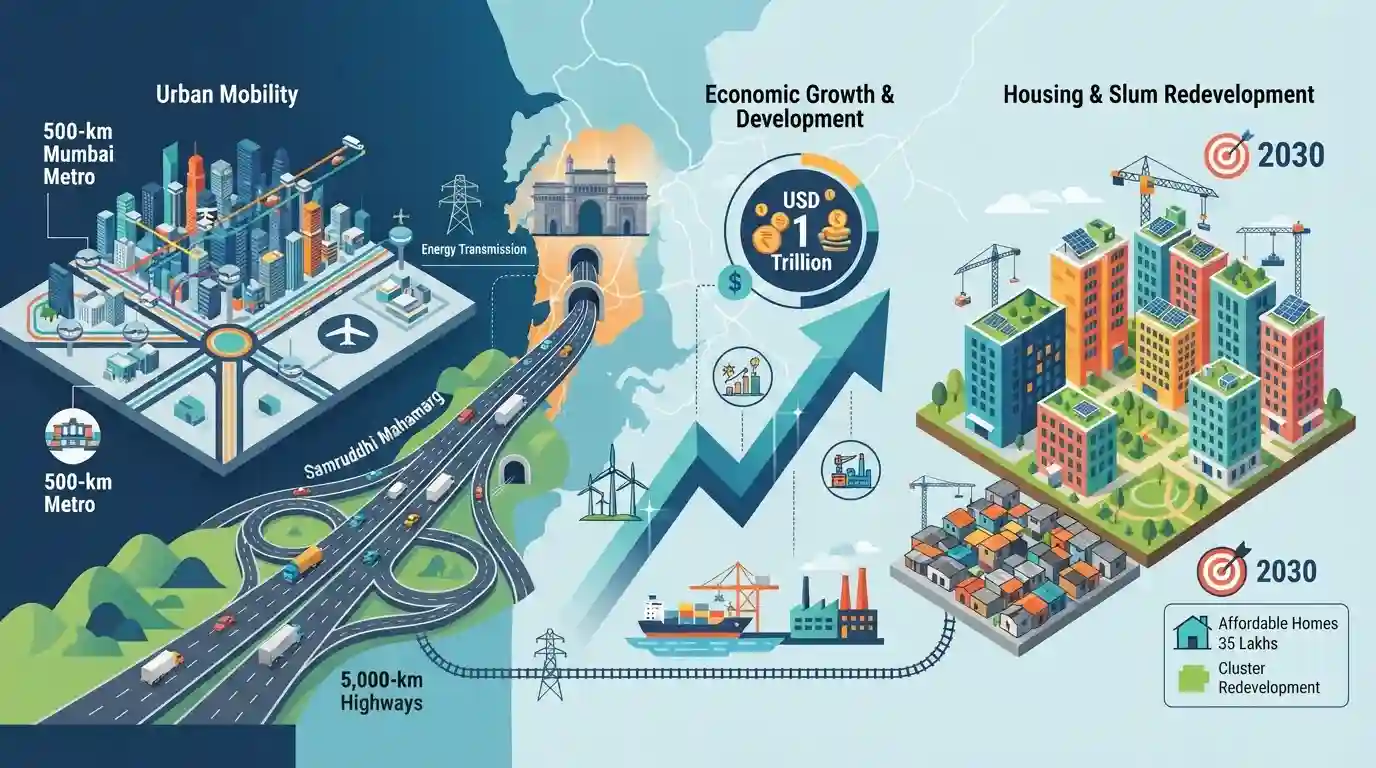
Deputy Chief Minister Eknath Shinde has outlined a comprehensive strategy for Maharashtra to achieve a USD 1 Trillion economy. The roadmap centers on the "Mumbai 3.0" vision, targeting large-scale urban infrastructure upgrades, such as a 500-km Mumbai Metro network and a 5,000-km access-controlled highway system including the Samruddhi Mahamarg. The government has prioritized affordable housing with an ambitious target of 35 lakh homes for EWS and LIG segments by 2030, alongside cluster redevelopment initiatives aimed at making Mumbai slum-free.
Key Points
- Maharashtra aims to become a USD 1 Trillion economy by focusing on infrastructure expansion, affordable housing, and urban redevelopment.
- The state plans a 5,000-km access-controlled road network and the expansion of the Mumbai Metro network to 500 km.
- The affordable housing plan targets 12 lakh homes for Mumbai, 20 lakh for the MMR, and an overall 35 lakh homes for EWS/LIG by 2030.
- The "Mumbai 3.0" vision plans to transform the city with high-tech urban centers, edge cities, medicities, and cluster redevelopment to achieve a slum-free environment.
Important Terms
Mumbai 3.0

An ambitious urban development vision for the Mumbai Metropolitan Region, incorporating an edge city, medicity, aerocity, and sports city, to transform the area into a global hub and achieve a USD 1 trillion economy.
UPSC context
Highly relevant for MPSC Economy (GS3) and Urbanization. It tests knowledge of Maharashtra's economic goals, urban infrastructure, and futuristic city planning.
Samruddhi Mahamarg
A 701-km, six-lane access-controlled greenfield expressway connecting Mumbai and Nagpur. It reduces travel time to eight hours, traversing 10 districts and facilitating the development of agricultural nodes called Krushi Samruddhi Kendras.
UPSC context
Crucial for MPSC Geography and Economy (GS1/GS3). Tests awareness of Maharashtra's flagship infrastructure, regional connectivity, and balanced regional development initiatives.
Mumbai Metropolitan Region Development Authority (MMRDA)
Established in 1975, this premier state agency is responsible for regional planning and executing large-scale infrastructure projects—including metro networks and urban transport—across Mumbai and its surrounding districts.
UPSC context
Important for MPSC Polity and Governance (GS2). Tests understanding of statutory regional planning bodies, urban administration, and sustainable infrastructure development.
Mumbai-Pune Missing Link
An infrastructure upgrade project on the Mumbai-Pune Expressway featuring a network of tunnels and bridges. It is designed to bypass the challenging Khandala Ghat, saving travel time and reducing traffic bottlenecks.
UPSC context
Relevant to MPSC Geography and Infrastructure (GS1/GS3). Evaluates knowledge of key transport projects addressing geographical challenges and improving state connectivity.
Economically Weaker Section (EWS) Housing
Affordable residential units prioritized by the Maharashtra government, aiming to construct 35 lakh homes by 2030. This initiative involves cluster redevelopment to replace slums and provide sustainable housing for marginalized populations.
UPSC context
Tests MPSC Social Justice and Economy (GS2/GS3) concepts, specifically urban poverty alleviation, inclusive growth, and state housing policies.
Prelims Trap
Maharashtra aims to achieve a USD 1 Trillion economy and 35 lakh affordable homes by 2025.
Aspirants often confuse Maharashtra's timeline with India's $5 Trillion goal or assume earlier deadlines. The state's $1 Trillion economy and housing targets are set for 2030.
Static Concepts Connected
How does 'Cluster Redevelopment' differ from the traditional SRA model in Mumbai?
- SRA Model: Focuses on individual slum pockets, often leading to fragmented, vertical slum-like high-rises with strained local amenities.
- Cluster Redevelopment: Amalgamates multiple adjacent plots (slums, old buildings) for holistic planning, creating wider roads and integrated open spaces.
- Urban Policy: Governed by Urban Renewal Schemes (URS) under DCR, offering higher FSI to developers as an incentive for comprehensive urban planning.
What are the core characteristics of an access-controlled highway like Samruddhi Mahamarg?
- Grade Separation: Eliminates direct intersections by using overpasses or underpasses to ensure an uninterrupted, continuous flow of traffic.
- Regulated Entry/Exit: Vehicles can only enter or exit the highway through designated interchanges or slip roads, heavily reducing accident risks.
- Fencing & Speed: Completely fenced to block pedestrian and animal access, designed for higher continuous vehicle speeds (often up to 120 km/h).
Cross-Topic Patterns
Mumbai 3.0 + SDG 11 linkages
The push for 35 lakh EWS/LIG homes and a 500-km metro network directly aligns with SDG 11 (Sustainable Cities), a highly tested theme in MPSC GS-3.
Highways + Regional Imbalance remedies
Expanding the 5,000-km highway network acts as a structural remedy for regional disparities, linking underdeveloped Vidarbha and Marathwada to coastal economic hubs.

Expect a multi-statement question on the $1 Trillion economy roadmap, specifically testing the 2030 target year and numeric infra goals.
Linked PYQs · 1
Linked PYQs · 1
- 2021MPSC_PRELIMSGS1
The Mumbai Metropolitan Region spread over 6,328 sq.km. consists of ________ Municipal Corporations.
