Tripura Launches Second Phase of Ek Ped Maa Ke Naam Campaign
Source:Indian Express ↗
Why It Matters
It highlights the role of emotional appeal and community-driven efforts in implementing national environmental campaigns at the state level, a key aspect of sustainable afforestation and participatory forest management.
Summary
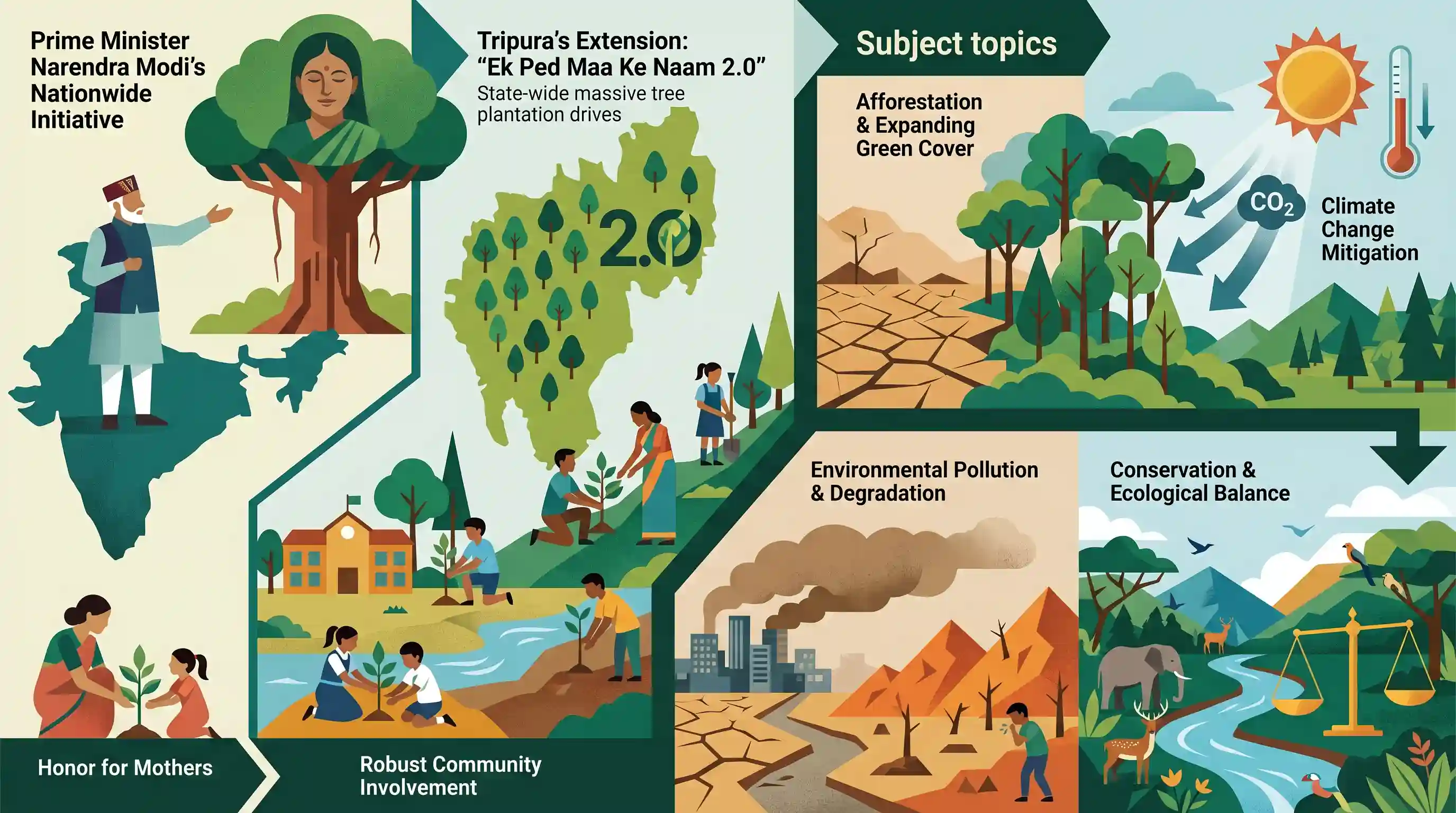
Tripura has launched the 'Ek Ped Maa Ke Naam 2.0' campaign, an extension of the nationwide initiative originally introduced by Prime Minister Narendra Modi. The campaign aims to boost ecological balance, expand the state's green cover, and mitigate the impacts of climate change through massive tree plantation drives. By encouraging citizens to plant trees in honor of their mothers, the initiative uniquely combines emotional resonance with environmental conservation, relying on robust community involvement for long-term sustainability.
Key Points
- The 2.0 version of the 'Ek Ped Maa Ke Naam' campaign was launched in Tripura to restore ecological balance, enhance forest cover, and create an effective carbon sink.
- The initiative builds on the nationwide 'Plant4Mother' campaign initiated by PM Modi, encouraging citizens to plant saplings in honor of their mothers to foster an emotional connection with nature conservation.
- The drive emphasizes community participation, involving local residents, women's groups, and the forest department to ensure the long-term survival and growth of the planted trees.
- This state-level afforestation effort contributes to India's broader climate change mitigation goals, environmental sustainability, and the prevention of soil degradation.
Important Terms
Ek Ped Maa Ke Naam

A nationwide mass plantation campaign launched on World Environment Day 2024 to encourage citizens to plant trees in honor of their mothers, blending emotional sentiment with environmental conservation.
UPSC context
GS Paper III: Environment and Biodiversity. Tests knowledge of community-led afforestation, climate mitigation, and innovative conservation strategies.
Plant4Mother
The global name and social media hashtag for the 'Ek Ped Maa Ke Naam' campaign, emphasizing India's leadership in global environmental movements and ecological restoration.
UPSC context
GS Paper III: Environment. Relevant for international environmental cooperation and India's global branding in sustainability initiatives.
Ministry of Environment, Forest and Climate Change
The nodal central ministry responsible for planning, promoting, and overseeing India's environmental, forestry, and climate change policies and programs, including national afforestation targets.
UPSC context
GS Paper II & III: Governance and Environment. Crucial for understanding central administrative structures and environmental policy implementation.
Tripura Forest Department
The state-level agency in Tripura responsible for forest conservation, mass plantation drives like 'Ek Ped Maa Ke Naam 2.0', and managing regional biodiversity and timber resources.
UPSC context
GS Paper III: Conservation. Important for state-specific initiatives and decentralized implementation of national environmental schemes in the Northeast.
Mission LiFE
A global mass movement introduced by India that promotes an environmentally conscious lifestyle, focusing on individual and collective actions to protect and preserve the environment.
UPSC context
GS Paper III: Environment/Climate Change. Central to India's climate action strategy (NDC) and behavioral change in sustainability.
Afforestation
The process of establishing a forest on land that has not recently been covered by trees, aimed at carbon sequestration, biodiversity enhancement, and ecological restoration.
UPSC context
GS Paper III: Environment. Fundamental concept for questions on ecosystem restoration, carbon sinks, and national forest policies.
Prelims Trap
"'Ek Ped Maa Ke Naam' is a maternal health initiative under the Ministry of Women and Child Development."
The name implies maternal welfare, misleading students to associate it with MWCD. It is actually a nationwide afforestation campaign to create a carbon sink.
Static Concepts Connected
What is India's forestry target under its Nationally Determined Contributions (NDCs)?
- Carbon Sink Target: To create an additional carbon sink of 2.5 to 3 billion tonnes of CO2 equivalent by 2030.
- Implementation Focus: This is achieved through increasing additional forest and tree cover outside traditionally recorded forest areas.
- Paris Agreement: This forms a core part of India's international commitments under the UNFCCC Paris Agreement.
What are the core principles of Mission LiFE (Lifestyle for Environment)?
- Pro-Planet People (P3): Aims to create a global network of individuals ('P3') committed to environmentally conscious lifestyles.
- Circular Economy: Replaces the prevalent 'use-and-dispose' mindset with a circular economy approach to everyday consumption.
- Behavioral Nudge: Relies heavily on behavioral economics to gently nudge individuals towards decentralized, sustainable climate action.
Cross-Topic Patterns
Afforestation meets Nudge Theory
Schemes like Ek Ped Maa Ke Naam and Mission LiFE use emotional and behavioral nudges to achieve hard NDC targets, linking psychology and behavioral economics with environmental policy.
Evolution of Community Forestry
Traces the shift from formal state-led Joint Forest Management (JFM) to citizen-driven, emotional-appeal grassroots campaigns aimed at expanding tree cover outside officially recorded forest areas.

Expect a statement linking Mission LiFE's behavioral nudges directly to India's 2.5-3 billion tonnes carbon sink NDC target in Prelims 2026.
Linked PYQs · 3
Linked PYQs · 3
- 2019PrelimsGS1
Consider the following statements : 1. As per law, the Compensatory Afforestation Fund Management and Planning Authority exists at both National and State levels. 2. People's participation is mandatory in the compensatory afforestation programmes carried out under the Compensatory Afforestation Fund Act, 2016. Which of the statements given above is/are correct?
- 2022MainsGS3
Discuss global warming and mention its effects on the global climate. Explain the control measures to bring down the level of greenhouse gases which cause global warming, in the light of the Kyoto Protocol, 1997.
- 2020MainsGS3
Explain intra-generational and inter-generational issues of equity from the perspective of inclusive growth and sustainable development.
