Ek Bagiya Maa Ke Naam Scheme: Empowering Women Farmers in MP
Source:ianslive ↗
Why It Matters
MPPSC State Service Prelims consistently features questions on state-specific welfare, agriculture, and women empowerment schemes (e.g., Ladli Behna Yojana, UNNATI). The 'Ek Bagiya Maa Ke Naam' scheme involves critical convergence between NRLM and MGNREGA, making it highly relevant for questions on rural development and poverty alleviation.
Summary
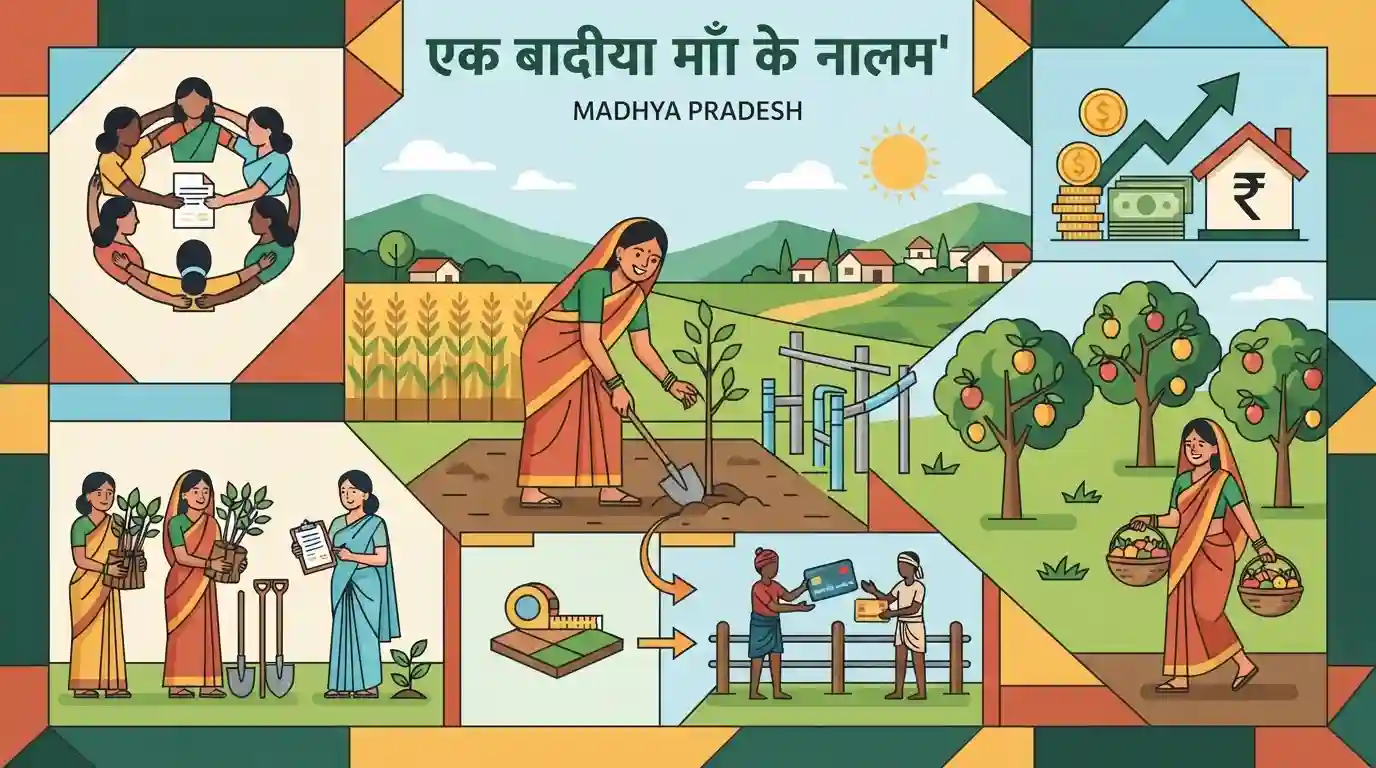
Madhya Pradesh has launched the 'Ek Bagiya Maa Ke Naam' scheme under the National Rural Livelihood Mission (NRLM) to enhance the income of rural families and promote financial self-reliance among women farmers. Implemented in convergence with MGNREGA, the scheme provides eligible women owning at least two bighas of land with fruit-bearing saplings, fencing materials, and assured wages for three years. Beneficiaries are mobilized through Self-Help Groups (SHGs) and guided by Krishi Sakhis to cultivate orchards alongside traditional crops. The initiative strongly aligns with the central government's vision of creating 'Lakhpati Didis' by ensuring sustainable economic independence.
Key Points
- The 'Ek Bagiya Maa Ke Naam' initiative has been launched in Madhya Pradesh under the National Rural Livelihood Mission (NRLM) for FY 2025-26.
- The scheme aims to empower rural women by providing them with fruit-bearing saplings, wire fencing, and MGNREGA wages for three years.
- Beneficiaries must own at least two bighas of land with irrigation facilities and are guided by 'Krishi Sakhis' through Self-Help Groups (SHGs).
- The initiative promotes the creation of 'Lakhpati Didis' by ensuring a permanent secondary source of income from orchards (mango, orange, pomegranate) alongside traditional crops.
Important Terms
Ek Bagiya Maa Ke Naam

A Madhya Pradesh scheme under MGNREGA and NRLM that empowers rural Self-Help Group women to cultivate fruit orchards on their lands, providing free saplings, fencing, and assured wages for three years.
UPSC context
GS Paper 2 & 3 (Government Policies, Rural Livelihoods). Tests awareness of state-specific micro-entrepreneurship and agro-forestry models.
Lakhpati Didi Initiative
A central government initiative under DAY-NRLM aiming to help rural Self-Help Group women earn a sustainable annual household income exceeding ₹1 lakh through diversified livelihoods, skill development, and financial inclusion.
UPSC context
GS Paper 2 (Social Justice, Women Empowerment). Tests knowledge of targeted poverty alleviation and financial independence schemes for women.
National Rural Livelihood Mission (NRLM)
A flagship poverty alleviation program by the Ministry of Rural Development. It mobilizes the rural poor, particularly women, into Self-Help Groups to promote self-employment, financial literacy, and sustainable livelihood options.
UPSC context
GS Paper 2 & 3 (Poverty, Rural Economy). Tests foundational understanding of India's grassroots institutional frameworks and self-employment initiatives.
Mahatma Gandhi National Rural Employment Guarantee Act (MGNREGA)
A statutory labor law and social security measure that guarantees at least 100 days of unskilled wage employment in a financial year to every rural household whose adult members volunteer.
UPSC context
GS Paper 2 & 3 (Welfare Schemes, Employment). Tests comprehension of rights-based approaches to rural poverty and employment generation.
Self-Help Groups (SHGs)
Informal, community-based associations, typically of women from similar socio-economic backgrounds, who pool savings and collectively access formal credit to engage in micro-enterprises and poverty-reduction activities.
UPSC context
GS Paper 2 (Governance, SHGs). Evaluates knowledge of grassroots socio-economic institutions and their role in local development and women's agency.
Krishi Sakhi
Rural women trained as agricultural para-extension workers under the Lakhpati Didi initiative. They provide grassroots guidance on sustainable farming, orchard management, and crop insurance, bridging the gap between farmers and schemes.
UPSC context
GS Paper 3 (Agriculture) and GS 2 (Women Empowerment). Highlights community-driven agricultural extension services and gender-inclusive farming policies.
Prelims Trap
A nationwide urban afforestation drive launched under the Ministry of Environment to combat climate change.
Do not confuse MP's 'Ek Bagiya Maa Ke Naam' (a horticulture/NRLM livelihood scheme) with the pan-India tree-planting campaign 'Ek Ped Maa Ke Naam'.
Static Concepts Connected
What are the core pillars of the DAY-NRLM framework?
- Social Mobilization: Organizes rural poor households into self-managed Self-Help Groups (SHGs) and federations to build social capital.
- Financial Inclusion: Provides revolving funds, community investment support, and bank linkages to build financial sustainability.
- Livelihoods Promotion: Diversifies incomes through farm and non-farm interventions, supported by community resource persons like Krishi Sakhis.
What is the Krishi Sakhi model under NRLM?
- Grassroots extension: Trained community resource persons who deliver agricultural knowledge directly to women farmers, bridging the lab-to-land gap.
- Sustainable farming: Promotes cost-effective, climate-resilient practices like natural farming, organic inputs, and multi-cropping to improve margins.
Cross-Topic Patterns
MGNREGA convergence and asset creation
Shifting MGNREGA's focus from basic manual labor to asset creation like orchards creates sustainable, multi-year income sources and builds rural climate resilience.
SHG-led agriculture & Poshan Abhiyaan
Empowering women to cultivate household fruit orchards simultaneously addresses rural dietary diversity and micro-nutrient deficiencies, linking economics to health.

Grassroots extension programs like Krishi Sakhis and multi-scheme convergence models are prime targets for 2026 agricultural questions.
Linked PYQs · 2
Linked PYQs · 2
- 2024MPPSC_PRELIMSGS1
UNNATI (Agri-GISl project of Madhya Pradesh Government is for :
- 2025MPPSC_PRELIMSGS1
The objective of "Mukhyamantri Ladli Behna Yojana" implemented in entire Madhya Pradesh, in addition to economic self-reliance is:
