Ex Situ Conservation and Captive Breeding of Crested Ibises
Source:The Hindu ↗
Why It Matters
This article provides an excellent international case study for GS3 Environment answers regarding the successful revival of an extinct-in-the-wild species through captive breeding (ex-situ conservation) and international environmental cooperation.
Summary
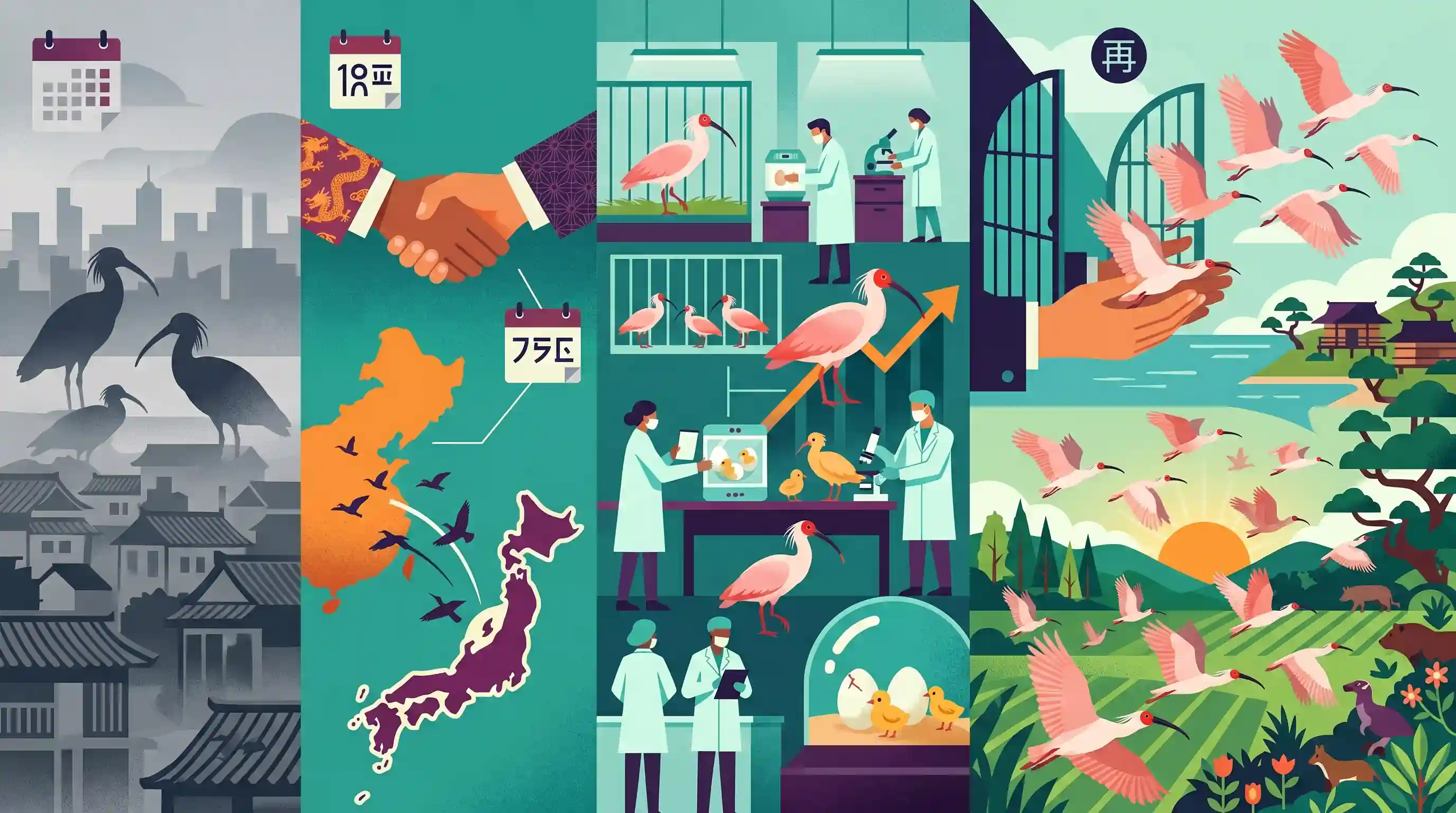
Japan successfully released eight crested ibises into the wild in Hakui city, marking a significant milestone in conservation efforts for the species, which had been extinct on the country's main island since the 1970s. The release represents a triumph for a decades-long captive breeding program located on Sado Island. The program, which started with birds donated by China in 1999, has successfully expanded the population to around 500 birds, showcasing how international cooperation and ex-situ conservation can revive species considered extinct in the wild.
Key Points
- Eight crested ibises were released into the wild in Hakui city, Japan, decades after going extinct on the Honshu main island in the 1970s.
- The crested ibis (Toki) suffered population collapse due to overhunting and environmental degradation, with the last native Japanese ibis dying in 2003.
- The species' revival in Japan is the result of a successful captive-breeding program on Sado Island, initiated using a pair of ibises donated by China in 1999.
- Since the first release of 10 captive-bred birds in 2008 on Sado Island, the wild population has grown to approximately 500.
Important Terms
Crested Ibis (Toki)

A medium-sized wading bird (Nipponia nippon) once extinct in Japan's wild but revived through captive breeding. It is currently listed as 'Endangered' on the IUCN Red List.
UPSC context
GS Paper 3: Conservation. A case study for successful species recovery through international cooperation and ex-situ conservation.
Ex-situ Conservation
The preservation of components of biological diversity outside their natural habitats, such as in zoos, botanical gardens, or specialized breeding centers (e.g., Sado Island facilities).
UPSC context
GS Paper 3: Environment. A fundamental biodiversity conservation strategy often compared with in-situ conservation in UPSC exams.
Captive Breeding
The process of breeding animals in controlled environments to increase population numbers, particularly for species threatened with extinction in their natural habitat.
UPSC context
GS Paper 3: Biodiversity. Critical for recovery programs of species like the Indian Vulture, Tiger, and Pygmy Hog.
Species Reintroduction
The deliberate release of a species into the wild from captivity or other areas to re-establish a self-sustaining population in its native range.
UPSC context
GS Paper 3: Environmental Impact Assessment. Relevant for understanding ecosystem restoration and wildlife management (e.g., Project Cheetah).
Sado Island
A Japanese island that serves as the primary hub for Crested Ibis conservation, housing specialized facilities for breeding and acclimating birds for wild release.
UPSC context
GS Paper 1 (Geography) & GS Paper 3. Known for the 'Sado Model' of symbiotic conservation between humans and nature.
International Environmental Cooperation
Collaborative efforts between nations to address environmental challenges, such as China donating breeding pairs of ibises to Japan to prevent species extinction.
UPSC context
GS Paper 2 & 3. Highlights how environmental diplomacy and transboundary cooperation can achieve global biodiversity targets.
Extinct in the Wild (EW)
An IUCN Red List category for species known only to survive in captivity or as a naturalized population well outside its past range.
UPSC context
GS Paper 3: Environment. Tests knowledge of IUCN classification and the criteria for declaring a species' recovery successful.
Prelims Trap
Captive breeding in specialized centers is considered a primary form of in-situ conservation.
Captive breeding is strictly an 'ex-situ' (off-site) conservation method. 'In-situ' refers to on-site conservation in natural habitats, such as National Parks and Biosphere Reserves.
Static Concepts Connected
What is a 'Genetic Bottleneck' in species conservation?
- Definition: A sharp, severe reduction in a species' population size due to environmental events, human activities, or overhunting.
- Conservation risk: Revived populations originating from a tiny founder group suffer from low genetic diversity, causing inbreeding depression and heightened vulnerability to diseases.
How does the IUCN define 'Extinct in the Wild' (EW)?
- Core criteria: When a species is known only to survive in captivity, cultivation, or as a naturalized population well outside its historical range.
- Exhaustive surveys: The classification is only applied after exhaustive surveys in known/expected habitats throughout its historic range have failed to record an individual.
Cross-Topic Patterns
Wildlife diplomacy and geopolitical soft power
China's 1999 donation of ibises to Japan mirrors its broader 'Panda Diplomacy' and India's 'Cheetah Diplomacy', highlighting how endangered megafauna and flagship species are used to build bilateral ecological alliances.
India's Species Recovery Programme parallels
Japan's captive breeding parallels India's Species Recovery Programme (under IDWH), which successfully uses ex-situ breeding centers to revive populations of the Pygmy Hog and Diclofenac-affected vultures.

Expect a multi-statement question testing the limitations of ex-situ conservation, specifically focusing on 'genetic bottlenecks' in 2026.
Linked PYQs · 2
Linked PYQs · 2
- 2017PrelimsGS1
In India, if a species of tortoise is declared protected under Schedule I of the Wildlife (Protection) Act, 1972, what does it imply?
- 2017PrelimsGS1
The term 'M-STRIPES' is sometimes seen in the news in the context of
